


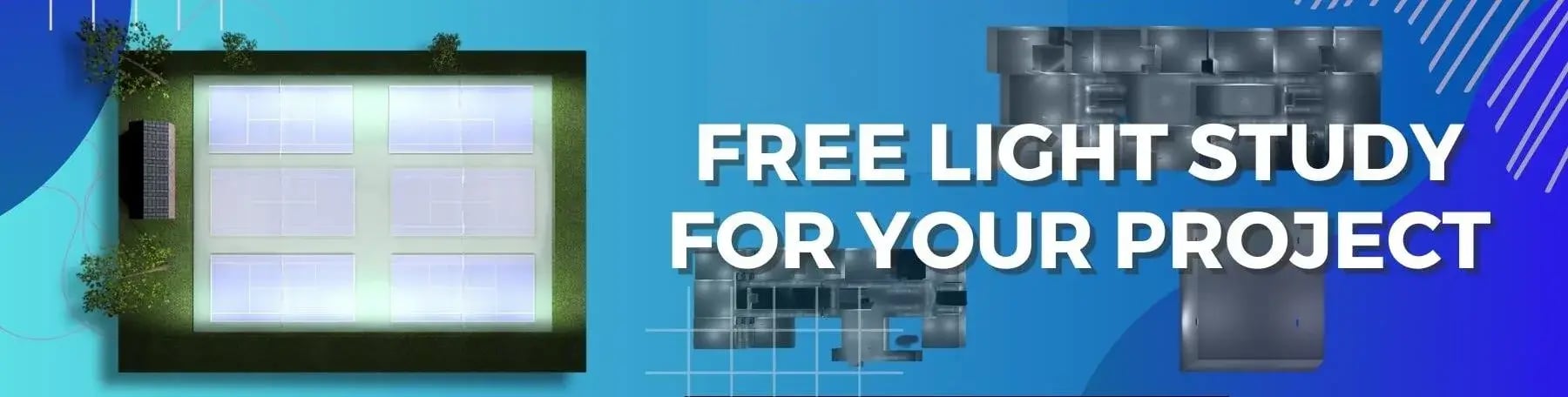
Free Light Study - Known as a Photometric Study
To make the most of your lighting design, it is crucial to plan. This is where a photometric study comes into play. With advancements in lighting technology LED fixtures have become the go-to choice for applications due to their energy efficiency, lifespan and controllability. However, selecting the right LED products and designing an optimal lighting scheme can be challenging without photometrics. In this article we will explore what a photometric study entails, the measurements involved, and the advantages of commissioning one for your lighting project.
What is a Photometric Study?
A photometric study, also referred to as a lighting calculation, involves analyzing how light is distributed from a luminaire or an entire lighting system. Certified lighting professionals utilize software and lab data provided by manufacturers to model real world light output conditions. The objective is to assess the performance of the lighting and determine the products and layouts for a given space.
During calculations various factors are taken into consideration such as room dimensions, surface reflectance, fixture spacing, mounting heights, optics and more. By simulating lighting scenarios on a computer system professionals can experiment with equipment and arrangements in order to find a tailored solution before actual installation takes place. This approach helps avoid mistakes while providing clients with assurance that their desired lighting goals will be met.
Mark S., Customer Service Specialist at LEDLightExpert.com, said: "Photometric studies illuminate what the eye cannot see, transforming imagined scenes into optimized lighting reality."
What is The Importance of Photometrics?
There are 6 main reasons why conducting a photometric analysis is crucial when planning a new lighting system: - Predicting Illuminance Levels: It helps to anticipate and meet the illuminance levels, on surfaces like workstations, walls, floors, etc. Having insufficient or excessive light can hinder visibility, safety and overall comfort.
- Minimizing Glare: By identifying and reducing glare caused by light sources or reflections off surfaces we can prevent eye fatigue and maintain optimal visual performance.
- Enhancing Uniformity: Achieving even lighting throughout a space reduces the need for constant visual adaptation as one moves around.
- Balancing Contrast: Calculating the luminance or brightness relationships between surfaces ensures that contrast is carefully balanced.
- Controlling Light Trespass and Uplight: Directing light where it's needed prevents it from spilling into neighboring properties or contributing to light pollution in the night sky.
- Energy Efficiency: Photometrics helps determine energy usage by guiding fixture and lamp selection, layout design, and control strategies for efficient lighting schemes.
- Predicting Illuminance Levels: It helps to anticipate and meet the illuminance levels, on surfaces like workstations, walls, floors, etc. Having insufficient or excessive light can hinder visibility, safety and overall comfort.
- Minimizing Glare: By identifying and reducing glare caused by light sources or reflections off surfaces we can prevent eye fatigue and maintain optimal visual performance.
- Enhancing Uniformity: Achieving even lighting throughout a space reduces the need for constant visual adaptation as one moves around.
- Balancing Contrast: Calculating the luminance or brightness relationships between surfaces ensures that contrast is carefully balanced.
- Controlling Light Trespass and Uplight: Directing light where it's needed prevents it from spilling into neighboring properties or contributing to light pollution in the night sky.
- Energy Efficiency: Photometrics helps determine energy usage by guiding fixture and lamp selection, layout design, and control strategies for efficient lighting schemes.
Important Photometric Measurements
During the design phase lighting professionals analyze four units:
- Luminous Intensity: Measured in candelas (cd) this unit quantifies the intensity of light emitted from a source in a given direction. It plays a key role in understanding beam patterns.
- Luminous Flux – Measured in lumens, flux measures the total amount of light emitted by a source in all directions. This helps determine the capacity of fixtures needed for a given space.
- Illuminance – Measured in lux or footcandles, illuminance refers to the amount of light that falls onto a surface. The desired illuminance values depend on tasks and industry standards.
- Luminance – Measured in candelas/m2 or nits, luminance indicates the brightness of a surface that emits or reflects light. It is used to calculate glare and contrast.
- Advanced photometric software enables these interconnected metrics to be visualized through color coded maps, isolines, 3D renderings and data reports. This provides insight into how light behaves within an environment.
- Benefits of Conducting an LED Lighting Study
- Photometrics proves particularly advantageous when working with LED lighting due to the following reasons;
- Enhanced lighting quality – LEDs offer design flexibility but require careful selection and placement due to their directional nature. Photometrics ensures that lighting quality standards are met.
- Energy-efficient designs – LEDs have long lifespans and consume less energy, resulting in excellent returns on investment. Photometrics allows for adjustments of fixture quantities, wattages and controls to maximize efficiency.
- Reduced glare and light pollution – The concentrated intensity of LEDs can lead to glare and spill if it is not controlled. Photometric techniques make it possible to mitigate these problems.
- Photometrics is a tool that helps address the issues of uplight and light spillage while also ensuring compliance with industry standards. It verifies that recommended levels, uniformity ratios, color rendering and other metrics are met.
To obtain a personalized photometric analysis for your project simply complete our request form with the details. Our team of lighting design experts will then initiate the study process. Schedule a call to discuss your space, goals and preferences in order to create a lighting scheme. You will receive a report containing our lighting recommendations along with supporting photometric data.
We can do indoor spaces, outdoor parking lots, sports lighting, stadium light designs and similar. We also do large projects such as arenas, and large residential projects such as barns. There are a few other restrictions and rules; some projects may require a deposit. Commercial, municipal and others may be prequalified. So call one of our experts with any questions or fill out the form and we'll get back to you.
We strive to make it effortless and risk free for you to achieve your lighting design. With our experience and cutting edge photometric software our experts can identify the fixtures, layouts and controls that cater to your unique requirements. Contact LED Light Expert® today to begin your photometric study.


