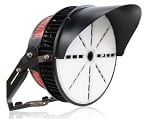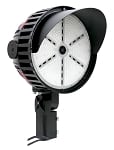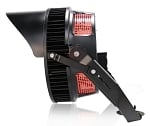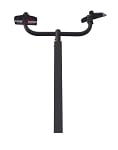
LED Arena Lights

USA Based Experts in less than 60 seconds Call Now: 800-674-9420
On orders over $49.00
Up to 7 Years Free Warranty On LED Lights

Horse arena lighting has to balance visibility, glare control, and uniformity. Riders need to see footing and jumps clearly. Horses should not be startled by harsh glare or deep shadows. Spectators, trainers, and maintenance crews also need consistent light without overlighting the space.
Start with the arena size, indoor or outdoor use, mounting height, pole locations, target foot-candles, and beam angles. A photometric plan is the most reliable way to confirm fixture count and aiming before poles or mounts are finalized.
Casual riding arenas may use lower light levels than show, jumping, or competitive training spaces. Narrow beam angles work from taller poles or longer throws. Wider beams help cover edges and lower mounting heights. Many arena projects use 4000K or 5000K light, but glare control and aiming are often more important than Kelvin alone.
For indoor arenas, consider dust, moisture, impact risk, and ceiling structure. For outdoor arenas, check wind load, pole height, spill light, and neighbor visibility. Controls can separate practice levels from event levels to save energy.
Arena lighting should be laid out before fixtures are purchased. A photometric plan can show average light level, minimum light level, uniformity, aiming angles, and spill light. That is especially important for horse arenas because bright spots and shadows can affect rider comfort and animal behavior.
For outdoor arenas, pole placement and beam angle often determine success more than wattage alone. For indoor arenas, mounting structure, dust, heat, and glare from low fixture angles need extra attention.
Arena lighting covers more than one sport. Planning guidance should include horse arenas, hockey rinks, rodeo grounds, stadiums, and other sports venues. The shared requirement is clear visibility for participants, spectators, officials, cameras, and maintenance crews. Poor lighting creates shadows, glare, blind spots, and uneven play conditions. Good arena lighting starts with the activity, the size of the area, the mounting points, and the expected level of competition.
Horse arena lighting needs enough light for riders and animals without harsh glare or distracting dark spots. The planning notes used practical foot-candle examples: 15 to 20 foot-candles for casual outdoor or home training, about 40 foot-candles for jumper or hunter training, around 50 foot-candles for competitive or training dressage, and about 70 foot-candles for competitive show jumping. Those are planning references, not a substitute for photometrics, because uniformity and shadow control can matter as much as average light level.
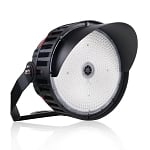
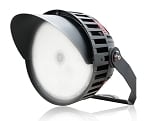
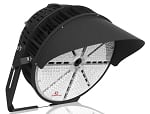
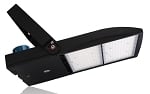
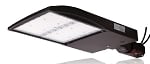
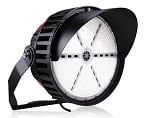
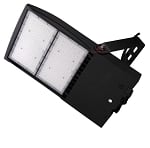
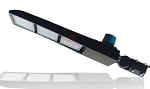
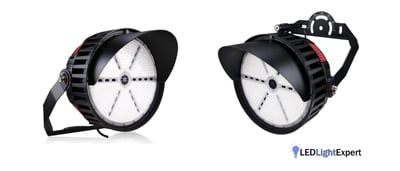
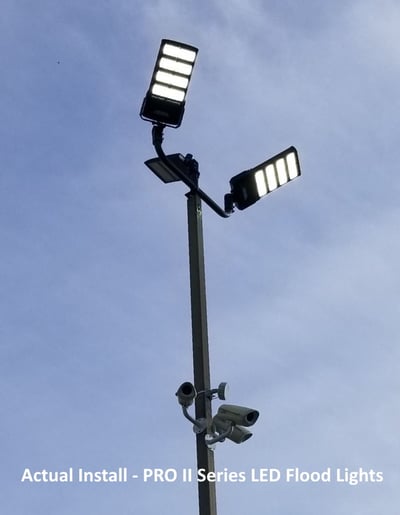
Arena fixtures are often selected from LED stadium lights, flood lights, high bays, or other high-output fixtures based on environment and mounting. Beam angles change how light reaches the playing surface. Narrow optics such as 10, 20, or 30 degrees can push light from higher poles toward the center. Wider optics such as 60, 90, 120, or 150 degrees spread light over shorter distances or edges. A common horse arena layout may use narrower beams from higher mounts and wider beams to soften the perimeter.
Hockey and broadcast sports need special attention to flicker, camera speed, puck or ball tracking, and color. Rodeo grounds need visibility for animals, riders, workers, and the public, while also managing wiring, warm-up time, maintenance access, and energy use. Pole choice matters as well: height, direct-burial or bolt-down base, steel or wood construction, tenon fit, wind load, and aiming hardware all affect the final result. Use a photometric layout before buying a full arena package.
Sports arena lighting should fit the sport, class of play, viewing distance, number of players, speed of movement, and camera needs. A local training arena can use a lower target than a televised venue. Class 1 competition areas may require much higher lux levels than class 2 or class 3 spaces. Horse arenas, hockey arenas, rodeo grounds, baseball fields, basketball courts, tennis courts, football fields, and volleyball courts all use different aiming and uniformity plans.
Energy costs matter because arena fixtures are often high wattage and may run for long events or practice periods. LED fixtures with efficient drivers, thermal management, and suitable optics can reduce electricity use compared with older metal halide systems. Pole height and pole type affect the optic choice. Shorter poles usually need wider beam angles. Higher poles often need narrower optics to carry light to the center and reduce waste around the edges.
Light levels depend on arena use. Casual riding and training may need lower levels than competition, jumping, or event spaces. Uniformity and glare control are just as important as average foot-candles.
Beam angle depends on mounting height, pole location, and arena size. Narrow beams work from taller mounting heights or longer throws. Wider beams help cover edges and lower mounting positions.
They can if aimed poorly or mounted too low. Use proper optics, shielding, mounting height, and photometric planning to reduce glare and avoid harsh shadows.
Many arena projects use 4000K or 5000K. The right choice depends on the activity, visibility needs, and comfort. Color temperature should be considered together with CRI, glare control, and uniformity.
Use the products above as a starting point, then confirm arena size, pole height, beam angle, target foot-candles, glare control, voltage, and controls before ordering.
Shop NowArena lighting is specified in lux at the surface, and the target follows the level of use. Most class-1 arenas need a minimum of 500 lux for effective lighting. Top-level competition runs between 800 and 1200 lux, which is also the range that lets television stations produce quality high-definition broadcasts. Recreational and training arenas sit comfortably below that.
For a typical horse arena we generally recommend a 500 watt stadium-style fixture with a 30 degree beam angle at a mounting height of around 30 feet. The narrower beam is what carries light into the centre of the arena, and wider angles are mixed in to cover the edges. Optics are available from roughly 10 and 20 degrees for tall installations up through 60, 120, and 150 degrees for lower mounting, where a wider, more dispersed beam is what the space needs.
Modern LED fixtures reach a luminous efficacy of about 140 lumens per watt, two to three times that of the metal halide fixtures they replace, and a retrofit typically cuts energy use by up to 70%. Flicker matters more in arenas than most buyers expect: for fast-moving disciplines and for any venue that films, fixtures compatible with 5000 Hz slow-motion photography avoid the banding that shows up on video.
On colour temperature, 5000K is the working standard for arena and sports use. That range sits in the pure white part of the spectrum, and the higher proportion of blue wavelengths in the 4000K to 6500K band supports attention and alertness for both riders and spectators while rendering the surface, rails, and obstacles clearly.
Arena lighting cost is driven by the lux target and the mounting height, in that order. An arena lit for training needs materially fewer fixtures than one lit for competition, and specifying to a level the venue does not need is the most common way these budgets get away from people. Where poles or trusses already exist and are sound, the project is fixtures and labour only.
Solar is worth asking about on remote arenas with no service run to them, and it is a real question here rather than a marketing one - the arena has to be evaluated for run hours and battery capacity before solar makes sense.
What comes with every order:
Send the arena dimensions, the mounting height available, whether it is indoor or outdoor, and the discipline. Roping, riding, and general-purpose arenas are lit differently, and the discipline determines where the light has to be concentrated.
Request PricingCall Now: (800) 674-9420
Dara Greaney is the CEO and President of LEDLightExpert.com, a leading company in commercial lighting solutions. Since 2015, he has led the company to achieve remarkable growth and recognition, including being an Inc5000 winner three times: No. 3783 in 2022, No. 2428 in 2021, and No. 531 in 2020.
Editing by David Peguero.
On orders over $49.00
Up to 7 Years Free Warranty On LED Lights