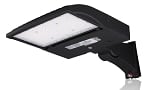
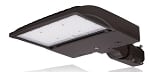
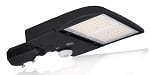
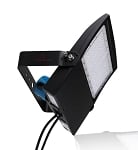
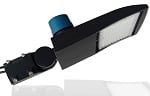
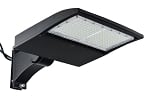
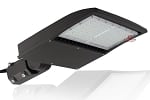
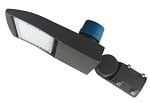
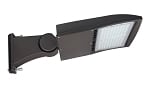
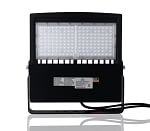
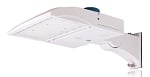
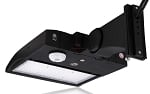
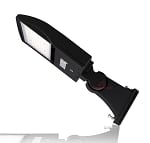
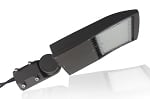
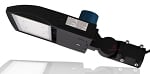
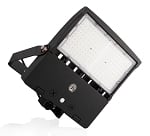
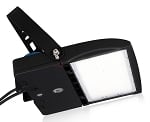
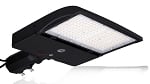
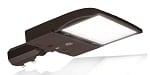
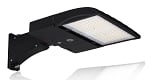
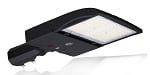
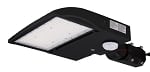
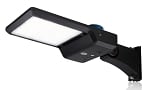
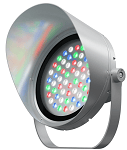
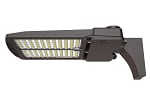
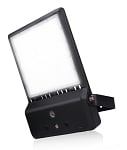
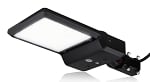
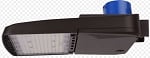
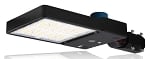
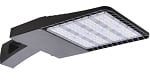
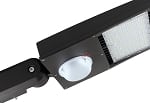
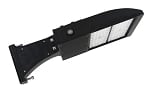
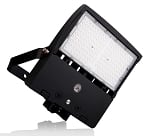
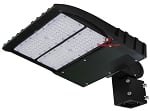
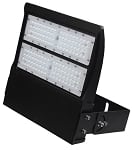
150 Watt LED Parking Lot Lights

USA Based Experts in less than 60 seconds Call Now: 800-674-9420
On orders over $49.00
Up to 7 Years Free Warranty On LED Lights

A 150 watt LED parking lot light is commonly used when a site needs more output than a wall pack or small flood light, but does not need a 240 watt, 300 watt, or stadium-level fixture. It is often selected for small parking lots, side lots, service lanes, building perimeters, neighborhood commercial properties, and replacement projects where older 400W to 600W metal halide or high pressure sodium fixtures are being removed.
Many 150W LED parking lot lights land near 19,500 lumens, with efficacy often around 130 lumens per watt depending on the model. Current fixtures vary by product line, so compare actual lumens, optics, wattage selectability, voltage, and controls on the product page before treating wattage as the only measure of brightness.
150W parking lot lights are often mounted on poles in the 15 to 25 foot range for smaller lots and perimeter areas. Some sites use them higher, but higher mounting needs wider spacing, better optics, and enough lumens to keep the pavement from looking patchy. Older category notes used spacing of roughly 40 to 75 feet as a planning range. Treat that as a starting point, not a final layout, because pole placement, pavement color, nearby buildings, and required light levels all change the result.
Beam distribution matters as much as wattage. Type III patterns are common along drive lanes and parking rows because they push light outward from the pole. Type V patterns spread light more evenly around a pole in open areas. Slip fitter mounts work on tenons and allow aiming. Straight arm mounts fit square poles and many shoebox replacements. Trunnion mounts are useful when the fixture is installed on a flat surface or needs more aiming range.
Most commercial parking lot projects use 4000K or 5000K. 4000K gives a neutral white look with less harshness. 5000K gives a brighter daylight appearance that can help visibility in commercial and security-oriented lots. Some projects still use 3000K when local code, neighborhood concerns, or dark-sky requirements call for a warmer appearance.
Check voltage before ordering. Many 150W fixtures support 120-277V, while some commercial and industrial sites need 277-480V options. Photocells allow dusk-to-dawn operation. Dimming leads and motion sensors can reduce energy use during low-traffic hours. The actual savings depend on the old fixture wattage, ballast loss, operating hours, and utility rate, but replacing a 400W to 600W HID system with a 150W LED can cut a large share of energy use while reducing lamp and ballast maintenance.
Choose 150W parking lot lights when poles are lower, spacing is moderate, and the site does not need high foot-candle levels across a wide area. Size up when poles are tall, spacing is wide, the lot has heavy commercial traffic, security cameras need stronger light, or the site must meet a formal photometric requirement. For uncertain projects, a photometric plan is the cleanest way to compare 150W against 200W, 240W, or 300W fixtures before buying.
Use 150W LED parking lot lights as a practical starting point for small lots, drive lanes, entrances, and many HID retrofits. They are often considered when replacing 400W metal halide or 250W high pressure sodium fixtures, but the final decision should be based on delivered lumens, optics, mounting height, pole spacing, and target light levels. Many 150W LEDs produce roughly 19,500 lumens, which can lower energy use compared with older HID fixtures while improving instant-on performance and optical control.
Compare the fixture specification before ordering: wattage, delivered lumens, color temperature options such as 3000K, 4000K, and 5000K, CRI, beam distribution, driver type, housing material, lens, IP rating, voltage range, dimming, photocell support, and surge protection. The exact spec varies by product, and those details matter more than the wattage label by itself.
Parking area size, layout, pole shape, pole height, and light distribution should drive the selection. Most 150W projects are strongest on lower poles, tighter spacing, perimeter areas, or moderate light-level targets. If poles are above roughly 25 feet, spacing is wide, or the site has higher security requirements, compare 200W, 240W, or 300W fixtures before ordering.
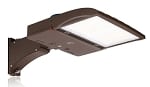
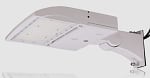
150W LED parking lot fixtures are easier to live with when they include the right bracket, driver access, controls, and service plan. Tilt-adjustable mounts can help aim the fixture from 0 to 180 degrees after installation. Integrated drivers remove the need for a separate driver box. LED chips with 50,000-plus hour life reduce relamping, and controls such as occupancy sensors, dimmers, and photocells can lower energy use during low-traffic periods.
When comparing 150W LED parking lot lights, record the power rating, delivered lumens, luminous efficacy, color temperature, CRI, beam angle, LED lifespan, driver type, body material, IP rating, operating voltage, dimmable driver, and control options. Compare 150 watts, 19,500 lumens, 130 lumens per watt, CRI above 70, 120 to 140 degree beam coverage, 50,000 hour LED life, built-in constant-current driver, die-cast aluminum housing, toughened glass lens, IP65 dust and water protection, 120-277V AC operation, and dimming capability.
For retrofit projects, compare the old technology against the new fixture. Many 150W LED fixtures are used to replace 400W metal halide, 250W high pressure sodium, or older fluorescent outdoor area lights. LEDs turn on instantly, use directional optics, create less waste heat, and remove mercury from the lighting system. They can also reduce maintenance because the LED chips last much longer than many HID lamps. Energy savings vary by old fixture wattage, ballast condition, nightly operating hours, electricity rate, controls, and fixture count. Larger office buildings, shopping centers, warehouses, and industrial complexes can see meaningful savings when a 150W LED fixture is the right replacement, but the estimate should be based on the actual site.
For layout, record parking area size, pole shape, pole height, pole spacing, beam angle, and required light level. A 150W fixture can work well on 15 to 25 foot poles and tighter layouts; taller poles or wider spacing may need higher output or a different optic. Professional planning prevents dark spots, glare, and uneven coverage.
A 150 watt LED parking lot light often replaces older 400W to 600W metal halide or high pressure sodium fixtures, depending on the LED lumen output and optics. Always compare actual lumens, mounting height, and beam distribution before using wattage as a one-for-one replacement rule.
Many 150W LED parking lot lights are used around 15 to 25 feet for small lots, drive lanes, entrances, and perimeter lighting. Higher mounting can work in some layouts, but it requires the correct optics, fixture spacing, and lumen output.
Common mounts include slip fitter mounts for round tenons, straight arm mounts for square poles, yoke or trunnion mounts for flat surfaces, and adjustable brackets for retrofit work. Match the mount to the existing pole, tenon, wall, or cross arm before ordering.
4000K is a balanced neutral white for most commercial lots and is often easier on neighboring properties. 5000K has a brighter daylight look and is common where visibility and security are the main priority. Local lighting code may limit Kelvin in some areas.
Share pole height, pole spacing, mount type, voltage, and the old fixture wattage. We can help decide whether 150W is enough or whether a higher output fixture should be used.
Contact LED Light ExpertCall Now: (800) 674-9420
Dara Greaney is the CEO and President of LEDLightExpert.com, a leading company in commercial lighting solutions. Since 2015, he has led the company to achieve remarkable growth and recognition, including being an Inc5000 winner three times: No. 3783 in 2022, No. 2428 in 2021, and No. 531 in 2020.
Editing by David Peguero.
On orders over $49.00
Up to 7 Years Free Warranty On LED Lights