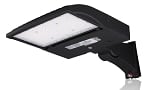
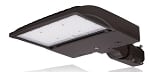
400 Watt Metal Halide LED Replacement for Parking Lot Lights

USA Based Experts in less than 60 seconds Call Now: 800-674-9420
On orders over $49.00
Up to 7 Years Free Warranty On LED Lights

A 400W metal halide fixture may draw more than 400 watts once ballast loss is included, and its output declines as the lamp ages. Many parking lot replacements use 100W to 150W LED fixtures, but the exact match depends on usable lumens, distribution pattern, pole height, spacing, and the required light level.
LED fixtures can reduce energy use and maintenance compared with metal halide, but the project still needs the right optics and aiming. A fixture with the wrong distribution can create dark areas even if the lumen number looks correct.
Check whether the existing pole uses a slip fitter, arm mount, trunnion, or another bracket. Confirm voltage, photocell needs, motion-sensor compatibility, surge protection, and whether the pole and wiring are in good condition.
Many commercial LED parking lot lights are DLC listed, which may support utility rebates. Rebate rules vary by utility and exact model, so confirm the product listing before counting the rebate in the project budget.

Retrofits can work when the old housing is sound and the owner wants to keep the same fixture body. Full replacement is usually better when the housing, lens, reflector, ballast, or aiming hardware is old or when the project needs better optics, controls, and warranty documentation.
A 400W metal halide lamp may start around 36,000 initial lumens, then lose output as the lamp ages. Ballast draw can push total system wattage above the lamp rating, and old reflectors or lenses can reduce usable light. A 100W to 150W LED fixture is a common replacement range, but the optics and mounting height matter as much as wattage.
Metal halide systems can involve slow warm-up, hot operation, UV output, mercury-containing lamps, glare, and maintenance cycles. LED replacements should be selected by delivered lumens, distribution, voltage, mounting style, color temperature, photocell needs, motion controls, DLC listing, and rebate rules for the exact model.
For a 400W metal halide conversion, compare total system wattage, not just lamp wattage. A 400W lamp with ballast draw can use more power than the nameplate suggests. LED efficacy, measured in lumens per watt, helps explain why a lower-watt LED fixture can match the usable light from an older metal halide system.
Maintenance savings can be as important as energy savings. Metal halide lamps lose output, run hot, take time to warm up, and require periodic replacement. LED parking lot fixtures reduce relamping cycles and can add photocells, motion sensors, tunable wattage, and better optical control. Environmental considerations include mercury-containing lamps, UV output, heat, and utility rebate requirements.
A 100-150 watt LED parking lot light is a common starting range for replacing a 400W metal halide fixture. A 400W metal halide may start around 36,000 initial lumens, but ballast loss, optical loss, dirt, and lamp age reduce usable light. A 150W LED in the 21,000-24,000 lumen range can be a useful comparison point, but the final match depends on optics, pole height, spacing, and target light levels.
LED parking lot fixtures that replace 400W metal halide vary in price depending on wattage, photocell, motion sensor, tunable settings, mounting, and rebate eligibility. Energy savings should be calculated from actual system wattage, runtime, utility rate, fixture count, and installation cost. Utility rebates and incentives can further reduce the payback period when the exact model qualifies.
Often, yes. Many LED parking lot lights use slip-fit mounting for 2-3/8 inch tenons or arm-mount brackets that work with common pole setups. Existing poles may support the new fixtures, but pole condition, wind load, hardware, and local requirements should be checked before reuse.
Many LED parking lot lights are DLC listed, which may qualify them for utility rebate programs. Rebate amounts vary by utility, product listing, wattage reduction, and program rules. DLC Premium listed fixtures may qualify for higher rebate amounts in some programs. Contact your local utility or our team for help identifying available rebates for your project.
Share existing wattage, pole height, mounting style, voltage, parking lot dimensions, and control needs so the LED fixture can be selected by light level, not guesswork.
The comparison that decides this replacement is lumens per watt, and it is worth doing explicitly. A typical 400 watt metal halide bulb produces about 36,000 lumens, but the fixture draws roughly 455 watts once ballast losses are counted. That works out to 79.12 lumens per watt. A 150 watt LED retrofit producing 23,250 lumens delivers 155 lumens per watt - very nearly double the efficiency of the metal halide it replaces. Users typically save up to 66% by making that swap.
The lower lumen figure on the LED side surprises people, and it should not. Metal halide emits in all directions, so a substantial share of those 36,000 lumens is absorbed by the reflector or thrown where it is not wanted. LED is directional, so a far higher proportion of its output reaches the pavement. The meaningful comparison is foot-candles on the ground, not lumens at the fixture, and on that measure the LED replacement matches or beats the metal halide.
Then there is depreciation. Metal halide lamps lose about 50% of their initial lumens by half-life, while still drawing the full 400-plus watts. So the honest comparison is not against a new metal halide fixture but against the aged one actually on the pole, which is producing far less light than its nameplate suggests for exactly the same energy cost.
Service life closes the case. LED fixtures run up to 100,000 hours against roughly 5,000 hours for a metal halide lamp. On a parking lot that is the difference between a relamp cycle with a lift and truck every year or two and effectively none at all.
The decision on this page is usually retrofit kit versus complete fixture. If the existing housing, lens, and mount are sound and the pole is in good order, a retrofit can be the economical route. Where the housing is corroded or the optics are no longer suitable, a complete LED area light is cleaner and normally performs better, since the optics are designed around the LED rather than around a lamp.
What comes with every order:
Send the fixture count, the pole height, and a photo of the existing fixture and pole top. The photo settles the retrofit-versus-replace question faster than any description. For the full range of pole heights, optics, and controls, see LED parking lot lights.
Request PricingCall Now: (800) 674-9420
Dara Greaney is the CEO and President of LEDLightExpert.com, a leading company in commercial lighting solutions. Since 2015, he has led the company to achieve remarkable growth and recognition, including being an Inc5000 winner three times: No. 3783 in 2022, No. 2428 in 2021, and No. 531 in 2020.
Editing by David Peguero.
On orders over $49.00
Up to 7 Years Free Warranty On LED Lights