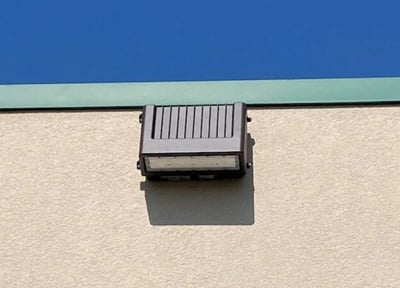
LED Barn & Yard Lights

USA Based Experts in less than 60 seconds Call Now: 800-674-9420
On orders over $49.00
Up to 7 Years Free Warranty On LED Lights


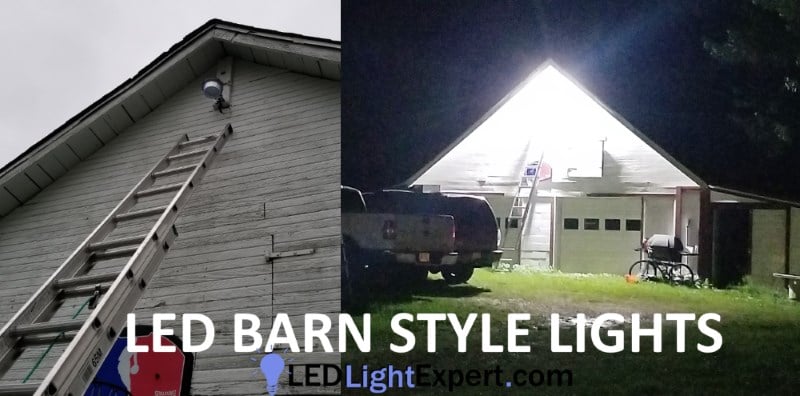
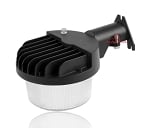
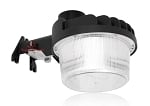
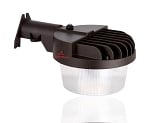
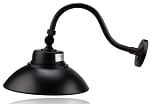
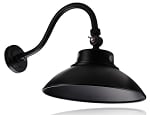
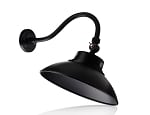
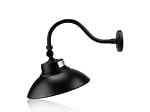
A barn light is a wall-mounted fixture with a dome or shade that directs light downward and outward. The design originated on farms and agricultural buildings where a single fixture needed to illuminate a large ground area below the roofline, such as a barn entrance, loading area, or equipment yard. The dome blocks upward light waste and protects the lamp from weather.
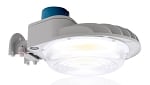
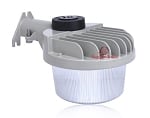
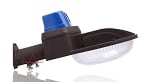
Modern LED barn lights retain that functional design but add efficiency, photocell controls, and color temperature options. They mount directly to a wall surface or on a gooseneck arm that extends the fixture away from the building. Typical wattages range from 35W to 100W, replacing 150W–400W HPS or metal halide dusk-to-dawn fixtures.
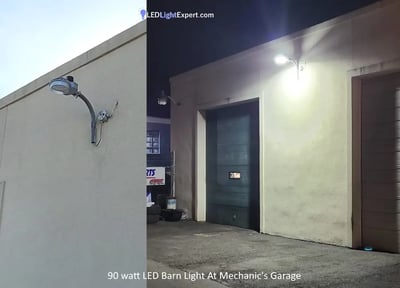
These fixtures are used on farms, warehouses, workshops, retail storefronts, restaurants, and residential properties. If you need broad-pattern outdoor illumination from a wall-mounted position at 8–16 feet, a barn light is likely the right fixture type.
These three fixture types overlap in application but differ in optics, mounting, and appearance. The table below shows where each works best.
| Feature | LED Barn Light | LED Wall Pack | LED Gooseneck |
|---|---|---|---|
| Light Distribution | Downward + outward (broad dome) | Forward from wall (cutoff optics) | Downward spotlight (focused) |
| Typical Wattage Range | 35–100W | 20–150W | 10–40W |
| Mounting Height | 8–16 ft | 8–25 ft | 8–14 ft |
| Best For | Barns, yards, general area lighting | Commercial buildings, parking structures, perimeters | Signs, storefronts, decorative/architectural |
| Aesthetic | Traditional / rustic | Commercial / industrial | Decorative / retail |
| Photocell Standard? | Usually built-in or included | Often optional add-on | Rarely included |
If your primary goal is to light a large outdoor area from a building wall, such as a barn entrance, equipment yard, loading dock, or driveway, the barn light's broad dome pattern can be the right choice. If you need light pushed forward along a wall or walkway, a wall pack is better suited. For decorative sign lighting or storefront accents, a gooseneck is the right fixture.
Barn light performance depends on mounting height. Mount too high and you lose ground-level intensity. Mount too low and the coverage area shrinks. Here are practical guidelines:
8–10 ft mounting height: Residential entries, side doors, garage areas. A 35–40W LED barn light delivers 4,000–5,000 lumens and covers roughly 1,500–2,000 sq ft of ground area. This is the standard for single-family residential and small outbuildings.
10–14 ft mounting height: Barn entrances, workshop exteriors, commercial loading areas. A 50–75W fixture producing 6,000–10,000 lumens covers 2,500–4,000 sq ft. This is the most common range for agricultural and light commercial use.
14–16 ft mounting height: Large barn facades, equipment yards, arena entrances. A 75–100W fixture at this height covers 3,500–5,000 sq ft. For areas larger than 5,000 sq ft, use multiple fixtures spaced 40–60 ft apart rather than a single higher-wattage unit. Uniformity matters more than raw output.


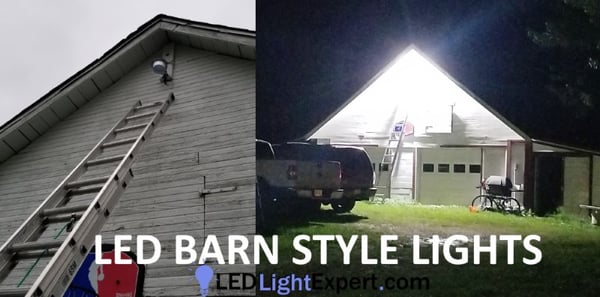
Most LED barn lights are used as security or area lights that run from dusk to dawn. A photocell sensor detects ambient light levels and switches the fixture on at sunset and off at sunrise without seasonal timer adjustments.
There are three photocell configurations to know about:
Built-in photocell: Integrated into the fixture housing. Simplest installation — wire it, mount it, done. This is the standard on most residential and agricultural barn lights.
Button photocell (twist-lock): A separate sensor that plugs into a standard NEMA twist-lock receptacle on the fixture. This lets you replace the photocell independently if it fails, and allows the fixture to operate without a photocell if you want manual or timer control.
No photocell (switch or timer controlled): Some fixtures ship without a photocell for applications where the fixture is controlled by a wall switch, timer, or building management system. If you need dusk-to-dawn operation on one of these fixtures, an external photocell switch can be added to the circuit.
For most barn and yard applications, a fixture with a built-in or included button photocell is the right choice. It is the simplest setup and the most reliable for unattended operation.
LED barn lights can reduce lamp changes, warm-up delays, and energy use compared with many older yard lights. Their downward shade design also helps put more light on entries, work areas, and yards instead of sending light upward.
From agricultural buildings to workshops, storefronts, and residential outbuildings, LED barn lights remain useful because they combine broad area lighting with a familiar wall-mounted shape.
The humble barn light began as a practical fixture for farmers who needed a long-lasting light over doors, work areas, and equipment yards. Modern LED technology keeps that simple design but improves efficiency, color quality, and control. LED barn light bulbs and integrated fixtures use less energy than many older mercury vapor, high-pressure sodium, or metal halide yard lights, which can create meaningful savings over long nightly run times.
Barn lights are not only for barns. They can help make outdoor areas feel safer at restaurants, shops, homes, warehouses, and rural properties. A pole-mounted or wall-mounted design can create broad coverage outdoors, while a gooseneck or decorative version can preserve a classic appearance indoors or at an entry. Whatever the setting, the important details are mounting height, beam spread, photocell control, color temperature, and whether the fixture is designed for the weather and service conditions.
For a standard barn entrance or residential yard, a 35–40W LED barn light (4,000–5,000 lumens) is commonly used at 8 to 10 feet for smaller entries, yards, and outbuildings. For larger barn facades and work areas with 10–14 ft mounting heights, a 50–75W fixture (6,000–10,000 lumens) is appropriate. A 75W LED is often considered for older 250W to 300W HPS or metal halide dusk-to-dawn replacements, depending on the lumen output and coverage area. For very large coverage areas, space multiple fixtures 40–60 ft apart rather than using a single oversized unit.
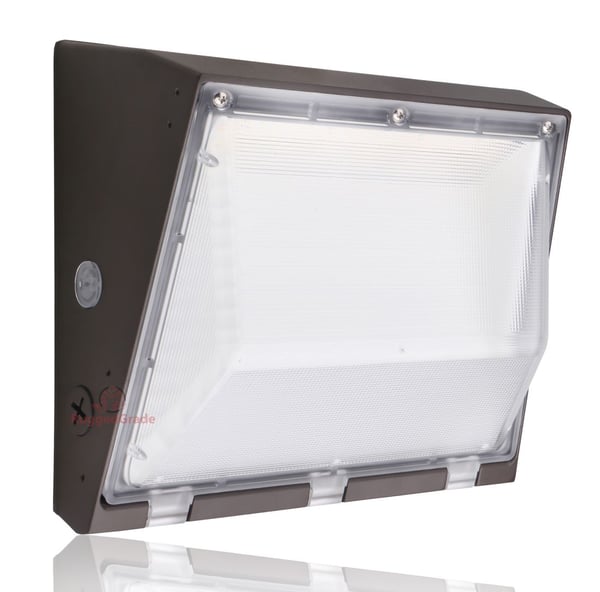
Barn lights use a dome or shade that directs light downward and outward in a broad circular pattern, illuminating the ground area below the fixture. Wall packs project light forward from the wall surface in a more controlled beam, typically a semi-cutoff or full-cutoff pattern designed to push light along walkways, parking areas, or building perimeters. Barn lights are standard on farms, residences, and rustic commercial properties. Wall packs are standard on commercial buildings, parking structures, and institutional facilities.
Many LED barn lights include a built-in photocell or ship with a NEMA twist-lock button photocell, but the control package should be confirmed on the product page. The photocell provides automatic dusk-to-dawn operation without a seasonal timer. Some models offer motion sensor options instead of or in addition to photocells, useful for areas where you only need illumination when activity is detected rather than all night.
Reliable LED barn lights carry IP65 or higher ratings, meaning they are sealed against dust ingress and protected from water jets from any direction. This makes them suitable for fully exposed outdoor mounting on barn exteriors, fences, and outbuildings. The dome design also provides physical protection for the LED module and driver. For cold-climate agricultural applications, check the listed operating-temperature range before ordering. Some lower-rated fixtures can have driver failures in extreme winter conditions.
For security and area lighting where visibility is the priority, 5000K (cool white) provides the clearest illumination and highest perceived brightness. For residential, hospitality, or settings where a warmer appearance is preferred, 3000K (warm white) creates a more inviting look similar to incandescent lighting. 4000K (neutral white) splits the difference and is a popular choice for commercial properties that want good visibility without the stark appearance of 5000K. For properties near residential areas, 3000K is also consistent with dark sky recommendations to reduce light pollution.
Most LED barn lights accept universal voltage input, typically 120V–277V AC and will operate on standard 120V residential circuits or 208V/240V/277V commercial circuits without any modification. Check the fixture spec sheet to confirm the voltage range. For new installations, 120V is standard for residential and most agricultural buildings. Commercial properties with higher-voltage panels can wire directly at 277V for slightly lower current draw, though the energy consumption is the same.
LED barn lights mount directly to a standard outdoor junction box (round or square) with the included hardware. The typical installation is: mount the junction box to the wall at the desired height, run your circuit wiring into the box, connect the fixture leads to line/neutral/ground, and secure the fixture to the box. Installation time depends on the existing junction box, wiring, mounting surface, and site conditions. For locations without an existing junction box, a surface-mount box with conduit or direct burial cable to the nearest circuit is required.
Use the products above as a starting point, or contact LED Light Expert to confirm wattage, mounting, controls, and layout before ordering.
Shop NowAgricultural lighting has requirements that general commercial lighting does not. Barns and outbuildings are dusty, humid, and often contain ammonia from livestock, all of which attack fixtures that were not built for it. Sealed housings and appropriate ingress protection are the baseline, and fixtures should be selected on the assumption that they will be washed down rather than dusted.
Service life carries more weight here than in most applications, because barn fixtures are frequently mounted high in structures with no convenient access. An average LED corn light bulb runs beyond 50,000 hours - more than five and a half years of heavy use - which for an operator with a ladder and a busy season is the difference between a maintenance task and a non-issue.
LED also emits no meaningful ultraviolet, which matters around livestock, feed storage, and produce, and it is a genuine advantage over the mercury vapour and metal halide fixtures still found in older barns. The reduced heat output is worth noting in hay and bedding storage as well.
For yard lighting, mounting is the main decision. Wall-mounted fixtures on the barn face cover working areas and doorways; pole-mounted yard lights cover the open ground between buildings. Dusk-to-dawn photocells suit both, since farm yards are used at unpredictable hours and nobody wants to be hunting for a switch in the dark.
Barn and yard fixtures are among the least expensive commercial lights we sell, and most orders are for a handful of units rather than a large package. Pricing follows lumen output and whether the fixture includes a photocell.
What comes with every order:
For a straightforward replacement, the useful information is the existing fixture wattage, the mounting height, and whether it is wall or pole mounted. For a new build, send the building dimensions and what the space is used for - a machinery shed, a milking parlour, and a general storage barn have quite different light level requirements.
Request PricingCall Now: (800) 674-9420


Dara Greaney is the CEO and President of LEDLightExpert.com, a leading company in commercial lighting solutions. Since 2015, he has led the company to achieve remarkable growth and recognition, including being an Inc5000 winner three times: No. 3783 in 2022, No. 2428 in 2021, and No. 531 in 2020.
Editing by David Peguero.
On orders over $49.00
Up to 7 Years Free Warranty On LED Lights