


Quick Answer: Which Kelvin Color Should You Choose?
Use 3000K for warmer, more relaxed spaces. Use 4000K for neutral work areas and offices. Use 5000K for bright, high-visibility commercial and warehouse lighting. Kelvin controls the color appearance of light, while CRI/R9 controls how accurately colors render under that light.
Customers often ask about color temperature, what it is and what it means to them. In order to help explain, we created this page as a quick reference for all your questions.
Kelvin and Color Temperature Basics
Light color is the color of the light itself. Some light appears white or cool in color while others appear warm or brownish in color. Other specialty lights can be blue, red or green. Lights can be engineered to replicate any color. Choosing the correct one, which is the one you prefer, is important to getting a space to feel right.
Kelvin (K) is a unit of measure for temperature, thermodynamic temperature to be exact, named after the physicist William Thomson, 1st Baron Kelvin. 0 Kelvin is also known as Absolute Zero and effectively the lowest possible temperature. The magnitude of a degree in Kelvin is the same as a degree in Celsius, with 0 Kelvin equal to -273.15 Celsius.
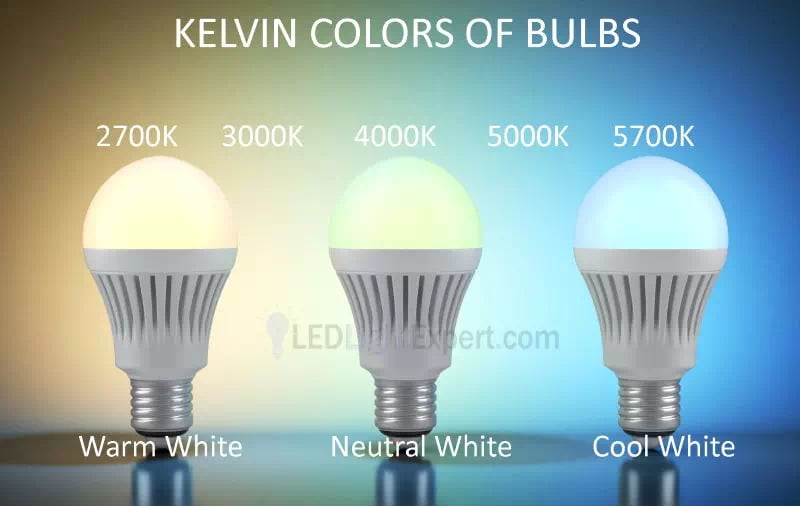
To convert Kelvin to Celsius, take the Kelvin temperature and subtract 273.15 for the corresponding Celsius temperature, i.e. 300 Kelvin is equal to 26.85 Celsius. Kelvin temperature when referring to light is based on the color emitted by a black body radiator based on the characteristic of its temperature. The simple thing to remember is higher color temperatures head into the blue end of the color spectrum and lower into the red end of the spectrum. See the chart below for a visual representation.

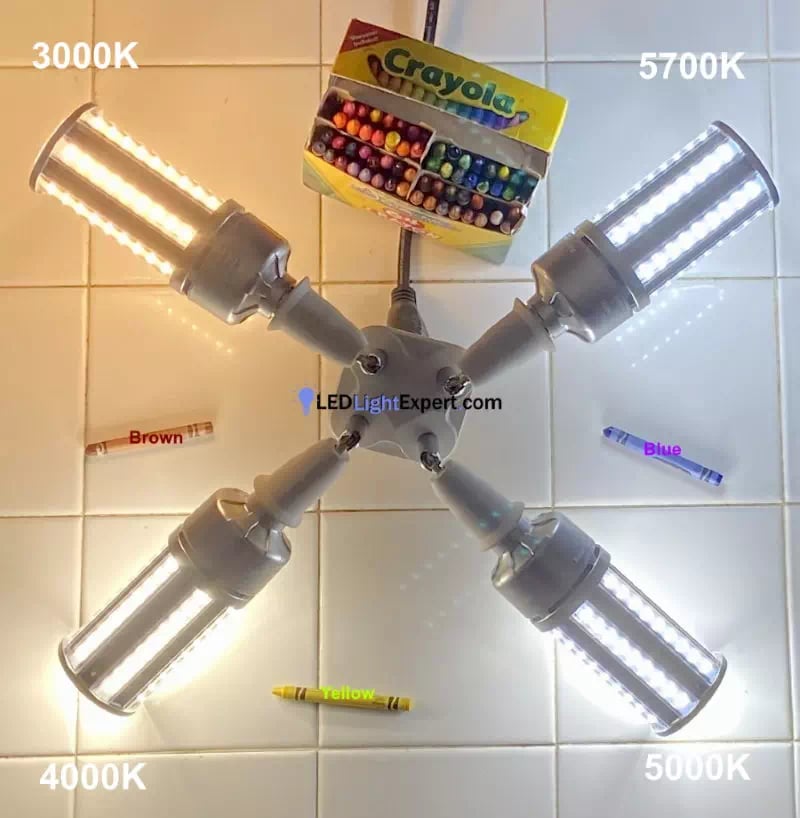
3000K is a warm white color light. Based on the Kelvin scale it has a distinct brownish tint often called warm white.
4000K is a natural white color light. Based on the Kelvin scale it has a slight tint of yellow to the color. This makes it a popular neutral color, especially in offices and home areas that are highly used.
5000K is a pure white color light. Based on the Kelvin scale it has no other colors in it, just white.
This is getting to Kelvin in reverse. They have to build the LEDs based on CCT (correlated color temperature) to get to Kelvin. If ordering LED diodes you would do it by CCT, when buying light fixtures you do it by Kelvin.
Warm lights are colors that head toward the red end of the spectrum, usually referring to lights below 4000K and have a yellow to red tint to them. Cool colors are typically lights above 4000K and have a blueish tint to them. 4000K is often referred to as natural white since it is right in between.
CRI and R9: Color Rendering
The CRI or R9 is very different than Kelvin. Kelvin is the temperature or color of the light itself, but CRI or R9 will tell us how well that light will reproduce colors when using it. They are independent metrics and are not correlated in any way.
So you can have a 2700K light that produces blue colors very well, even though it's a warm colored light, or a 4000K that does red well. These move independently of each other and are based only on the light source itself. There are ways to cheat colors with any light, especially LED, so just because a light is 5000K or pure white, does not tell us whether it will reproduce colors well or not. You have to look at each separately.
CRI (color rendering index) and R9 (the saturated red test sample) reflect how well a light will reproduce colors. Just because a light is white does not mean that colors will show true underneath it. Incandescent and halogen do a good job of color rendering (CRI 95+), where HID sources typically are low color rendering (sub 50 CRI).
CRI is based on the R1 to R8 colors only, also known as the pastel colors. The higher the CRI the better those colors show. CRI is a 1960 standard, but in reality there are 15 color bands, these are referred to as R15.
Since R10-R15 are generally not an improvement in color reproduction, those are skipped. ( For reference; solid saturated colors are R9-R12 and earth solids are R13 to R14) The big one, however, is R9 because that is red! R9 matters because it measures the all-important saturated red that CRI leaves out. Thus colors with red in them will show much better in a high R9 score.
Here is how CRI, R9 and R15 are calculated. You can see that CRI uses a limited, albeit critical part of the scale. R9, however adds that important Red color which is why it's becoming a more preferred metric in lighting. For designers and users anyway, less so for manufacturers as we'll get to below.
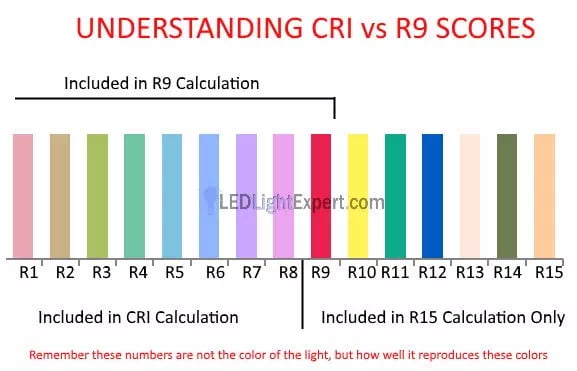
What does the R mean in R9? Each R value scores one of the test colors below; CRI (Ra) is the average of R1-R8. TCS means Test Color Samples based on a 1995 standard
TCS01 7.5 R 6/4 Light grayish red
TCS02 5 Y 6/4 Dark grayish yellow
TCS03 5 GY 6/8 Strong yellow green
TCS04 2.5 G 6/6 Moderate yellowish green
TCS05 10 BG 6/4 Light bluish green
TCS06 5 PB 6/8 Light blue
TCS07 2.5 P 6/8 Light violet
TCS08 10 P 6/8 Light reddish purple
TCS09 4.5 R 4/13 Strong red
TCS10 5 Y 8/10 Strong yellow
TCS11 4.5 G 5/8 Strong green
TCS12 3 PB 3/11 Strong blue
TCS13 5 YR 8/4 Light yellowish pink
TCS14 5 GY 4/4 Moderate olive green (leaf)
TCS15 Light yellowish pink (skin tone)
CRI (color rendering index) is calculated as an average of R1-R8, known as the pastel color group.
R9 is not an average. It is the score for a single test color, TCS09, a strong saturated red, measured the same way as the other samples.
CRI (Ra) and extended scores such as the R1-R15 average are averages, so a light has to do well on every sample to score very high. Generally incandescent is the benchmark or reference light (black body radiator in the lab, but that's a much longer article) but a 100 score on an R15 measurement would represent a reference-level result, with sunlight often used as the comparison point.
Here is an example where the CRI would be high, but the low R9 does not tell the whole story.
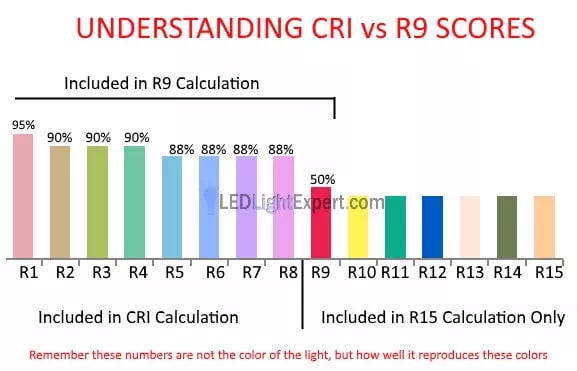
Now most lighting spectrum charts will generate all the data. In this chart we see the light is about 4100 kelvin and 93 CRI. The R9 drops to 75, which is actually excellent because this is a grow light. Grow lights are usually evaluated by plant-useful spectrum and PAR/PPFD rather than Kelvin alone.
Most R9 in general LED is closer to 40-50. To give some perspective, standards such as Title 24 in California (CRI 90+ and R9 50+ for JA8 lamps), the WELL Building Standard and the GSA (General Services Administration) set R9 minimums of 50+. This shows that LEDs in general have some work to do to reach R9 of 70+, and also why the R9 metric is not listed on many lights yet.

Choosing the Right Kelvin Color
Color temperature is mostly a matter of preference. In general, most warehouse lighting and outdoor lighting is 5000K, often called bright white as it's a close representation of sunlight. Residential lighting, in more relaxed settings, is usually 3000K-4000K.
Business office lighting is usually around 4000K. Retail lighting is usually 4000K-5700K and more often than not on the cooler side as the cooler color temperatures typically have a slight advantage in lumen output over a warmer color in the exact same wattage. For retail sales, bright is good to show off the products being sold.
Again, these are just common uses, some people do prefer to have a 5700K in their home and others may prefer 3000K for LED wall packs on the side of their building. One thing we will mention is that the American Medical Association's 2016 guidance on street lighting recommended 3000K or lower outdoors, because blue-rich light at night can disrupt circadian rhythm and affect sleep patterns.
Research in this field is still ongoing and there is a lot of conflicting information out there. Some people claim to get headaches from cooler color temperatures, others from warmer color temperatures. Everybody is different so it really comes down to personal preference.
Some municipalities have strict requirements on what color temperatures can be used for certain applications. If you are doing lighting where there are requirements of a certain color temperature, then you will know the options available to you. Otherwise, go with what you are comfortable with or ask for advice from the experts.
Get a sample. Buy 1 light so you can hook it up to power and see it in action. If you decide you want to change colors, you'll only have to return 1 light instead of 20. Once you figure out what you are happy with you can buy the full quantity
I need a lot of lights but I still don't know what color I want to use.
Get a sample. Buy 1 light so you can hook it up to power and see it in action. If you decide you want to change colors, you'll only have to return 1 light instead of 20. Once you figure out what you are happy with you can buy the full quantity.
I just don't get it, what color should I choose?
Give us a call and speak with one of our lighting experts to help go over your application and we can help guide you to the right option.
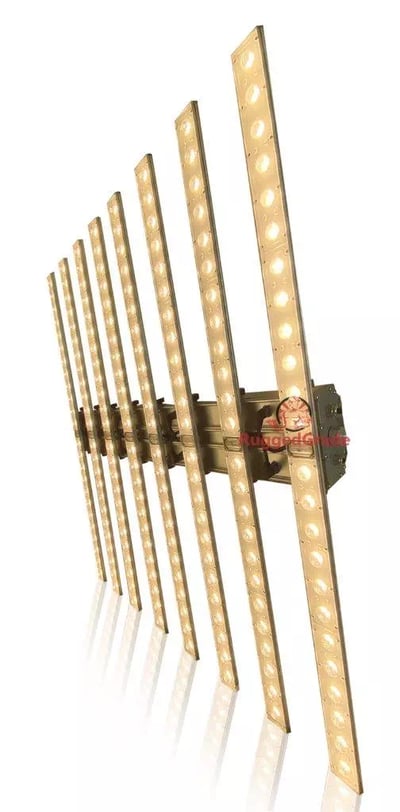
Example of a warm colored light. Note the yellow or brownish tint to the color.
Here is a 5000K white light. Note that the 5000K appears true white.

Here is a 5000K tester vs the 4000K. While some consider the 4000K "dirtier" it is easier on the eyes, especially if you are working under it for long periods.

Choose the Right LED Light Color for the Space
Understanding LED light color temperatures is key to creating spaces that are both functional and inviting. For warm ambiance, neutral work light, or bright commercial visibility, selecting the correct color temperature can make a major difference.
Now that you're equipped with the knowledge, it's time to put it to use! At LED Light Expert, we can help compare Kelvin, CRI, R9, fixture type, and application so the color temperature supports the space instead of fighting it.
Related Questions About Light Color Temperature
A light spectrum is the visible range of wavelengths that make up white light, ranging from about 380 nanometers (violet) to 700 nanometers (red). LED light spectrum varies by the phosphors and diodes used. The spectrum determines both the Kelvin color temperature and how well colors render under that light.
LED spectrum directly determines the perceived color temperature. LEDs with strong output in the red region appear warmer (lower Kelvin). LEDs with more blue output appear cooler (higher Kelvin). The spectrum also affects CRI and R9 — a well-balanced spectrum across all wavelengths produces better color rendering.
Higher Kelvin temperatures (5000K+) contain more blue wavelengths, which our eyes perceive as "cool" or "daylight." Lower Kelvin temperatures (2700-3000K) contain more red/orange wavelengths, which we perceive as "warm." This is opposite of actual thermodynamic temperature but matches human color perception.
2700K-3000K: Residential, hospitality, ambient/relaxation lighting. 4000K: Office, retail, task lighting. 5000K-5700K: Warehouse, industrial, outdoor, medical/inspection lighting. 6500K+: Specialty applications like horticulture and sports lighting.
Yes. Manufacturing tolerance on LED diodes can cause 200-500K variation even within the same product line. Quality manufacturers specify a "MacAdam ellipse" (a tolerance zone on color space) to ensure consistent color appearance. Most commercial fixtures fall within +/- 3 steps MacAdam standard.
Color-selectable LED fixtures allow switching between multiple Kelvin temperatures (e.g., 3000K/4000K/5000K) using a control wire or switch, typically via a 0-10V dimmer or wireless controller. This flexibility is useful for spaces that need different color temperatures at different times.
Blue-heavy light (5700K+) suppresses melatonin production and can disrupt sleep when used at night. Warmer light (2700-3000K) supports natural circadian rhythm. Health standards such as the WELL Building Standard increasingly recommend limiting exposure to high-Kelvin light in the evening and overnight.
Historically, cooler Kelvin temperatures (5000K+) were slightly cheaper because phosphor costs were lower. Today, manufacturing costs are nearly identical. Color selection is based on application need, not price. Specialty colors like 2200K or 6500K may cost slightly more due to lower production volume.
Quality LEDs are designed to limit color shift over their rated life, but actual shift depends on phosphor quality, heat, driver performance, and operating environment. Low-cost LEDs or fixtures exposed to heat may show more visible color change.
No. Other color specification systems include: CIE xy coordinates (precise color location on the color gamut), CCT (Correlated Color Temperature) (how LEDs are manufactured), and ANSI bins (manufacturing tolerance categories). However, Kelvin remains the most intuitive for end-user selection.
Technically yes, but not recommended. Mixing 3000K and 5000K in the same room creates visual discomfort and makes the space feel disjointed. If using multiple light sources (ambient + task + accent), keep within one Kelvin family or use no more than 500K variation to maintain cohesion.
Most people can discern Kelvin differences of 300K or more (e.g., 3000K vs 3300K). Below 200K, differences are subtle. Expert eyes trained in color matching can sometimes detect 100K shifts. This is why "warm white" vs "cool white" marketing exists — it reflects meaningful perceptual categories rather than precise engineering specs.
Related Articles



About the Author


Need Help Choosing the Right LED Light Color?
Our lighting specialists can help select a Kelvin range, evaluate CRI/R9 requirements, and plan a lighting solution for your space.
SHOP KELVIN SELECTABLE LIGHTS


