


- Industrial Lighting: A Complete Buying Guide
- LED Shop Lighting Buyers Guide
- LED Lighting: A Complete Buying Guide
- LED Light Fixtures: A Complete Buying Guide
- Outdoor Lighting: How to Choose the Best LED Fixtures for Your Property
- Color Selectable LED Lights: Complete Guide to CCT Tunable Fixtures
- Ceiling Lights: A Complete Buying Guide
- Panel Lights: A Complete Buying Guide
- Outside Lights Buyers Guide
- Motion Sensor Lights Explained - Buyer's Guide
- LED Area Lights Guide by the Experts
- Hazardous Location Lighting Buyer’s Guide
- LED Linear Lights Buyers Guide: Types, Installation & Selection
- LED Grow Lights for Seedlings
- UV-C Disinfectant Lighting — Germicidal LED Buyer's Guide
Quick Answer
Commercial LED lighting includes high bays for warehouses, troffers and panels for offices, wall packs for perimeters, parking lot lights for outdoor areas, and flood lights for security. LEDs can lower energy use, reduce relamp labor, add controls, and may qualify for utility rebates where programs are available.
Commercial lighting encompasses every illumination system used in non-residential spaces, from offices and retail stores to warehouses, parking lots, and sports facilities. Making the right fixture and mounting choices can reduce energy costs, improve visibility for work tasks, and create a safer, more inviting environment for customers and staff.
This guide covers the full scope of commercial lighting: design principles, color temperature selection, every major mount type, high bay and low bay options, wall and stadium lights, and why LED technology has become a common choice for modern commercial spaces. If you are upgrading a single office or outfitting a multi-building campus, the information below will help you compare fixture types, light levels, controls, and installation tradeoffs.
In This Guide
- Scope & Objectives of Commercial Lighting
- Commercial Lighting Design & Layout Principles
- Commercial Lighting Mount Options
- High Bay & Low Bay Mounting Styles
- Wall Lights & Common Mount Styles
- Stadium Light Mount Options
- Key Considerations for Fixture Mounts
- Why Choose LED Commercial Lights
- Commercial Lighting FAQs
Scope & Objectives of Commercial Lighting
Key takeaway: Commercial lighting is not just about illumination—it affects safety, brand perception, energy use, and how comfortably people can work in a space. A well-planned LED system can often pay back through reduced operating and maintenance costs.
The term “commercial lighting” covers a broad range of illumination needs: offices, retail stores, educational institutions, healthcare facilities, hospitality venues, warehouses, manufacturing plants, and public infrastructure including government buildings, streets, and bridges. Any space that is not a private residence typically falls under the commercial lighting umbrella.
Objectives of Commercial Lighting
An efficient commercial lighting solution should achieve several goals simultaneously:
- Task visibility: Adequate, well-distributed light helps employees see labels, tools, displays, aisles, and work surfaces more clearly.
- Welcoming ambiance: The right color temperature and fixture placement ensure visitors, clients, and customers feel comfortable in your space.
- Seamless navigation: Lighting should facilitate smooth movement between different sections of a commercial building, including egress paths and emergency lighting.
- Energy efficiency: With lighting accounting for approximately 17% of total electricity consumption in U.S. commercial buildings (DOE, 2023), choosing high-efficacy fixtures can materially affect operating costs.
- Natural light integration: Modern commercial lighting works in harmony with daylight through sensors and controls, reducing artificial light use when sunlight is available.
Commercial Lighting Design & Layout Principles
Key takeaway: Effective commercial lighting design balances illuminance levels (foot-candles), lighting power density (watts per square foot), and color temperature (kelvins) to match the specific activities and code requirements of each space.
Effective lighting is integral to creating an environment conducive to productivity, comfort, and a positive work atmosphere. While the initial installation cost of LED commercial light fixtures may be higher than legacy technologies, the long-term benefits include reduced maintenance costs and energy savings that typically deliver ROI within 1–3 years.
The lighting scheme for commercial spaces should be tailored to the specific activities conducted within, ensuring adequate illuminance levels and energy efficiency. Illuminance—the amount of light falling on a surface—directly impacts well-being, communication, mood, and the overall ambiance of a workspace. Both under-lighting and over-lighting can affect productivity, comfort, and visual accuracy. To strike the right balance, professionals reference the IES Lighting Handbook, which provides guidelines for diverse commercial needs. Key concepts include:
1. Foot-Candles (FC) and Lux
Foot-candles measure the light that actually reaches a surface: one foot-candle is one lumen per square foot, or about 10.76 lux. Offices typically target 30–50 fc, retail 30–75 fc, and warehouses 20–30 fc. See our footcandles and lux guide for targets by application.
2. Lighting Power Density (LPD)
LPD measures installed lighting wattage per unit of floor area, typically in watts per square foot. Energy codes like ASHRAE 90.1-2022 set maximum LPD allowances by building or space type—for example, about 0.73 W/sq ft for enclosed offices, 0.56 W/sq ft for open-plan offices, and 0.33 W/sq ft for medium/bulky warehouse storage under the space-by-space method. LED fixtures make staying at or below these limits straightforward due to their high lumen-per-watt efficiency (typically 130–200+ lm/W).
3. Color Temperature (Kelvins)
Color temperature determines the visual warmth or coolness of a light source and directly affects ambiance:
- 2700–3000K (warm white): Cozy, inviting atmosphere. Common for hotels, restaurants, and lobbies.
- 3500K (neutral white): Balanced and alert. Strong choice for offices and conference rooms.
- 4000K (cool white): Clear, crisp light. Common in retail, garages, and grocery stores.
- 5000K (bright white/daylight): High visual clarity. Common for warehouses, hospitals, manufacturing, stadiums, and outdoor security. Learn more about Kelvin color temperature.
4. Pole Spacing and Layout
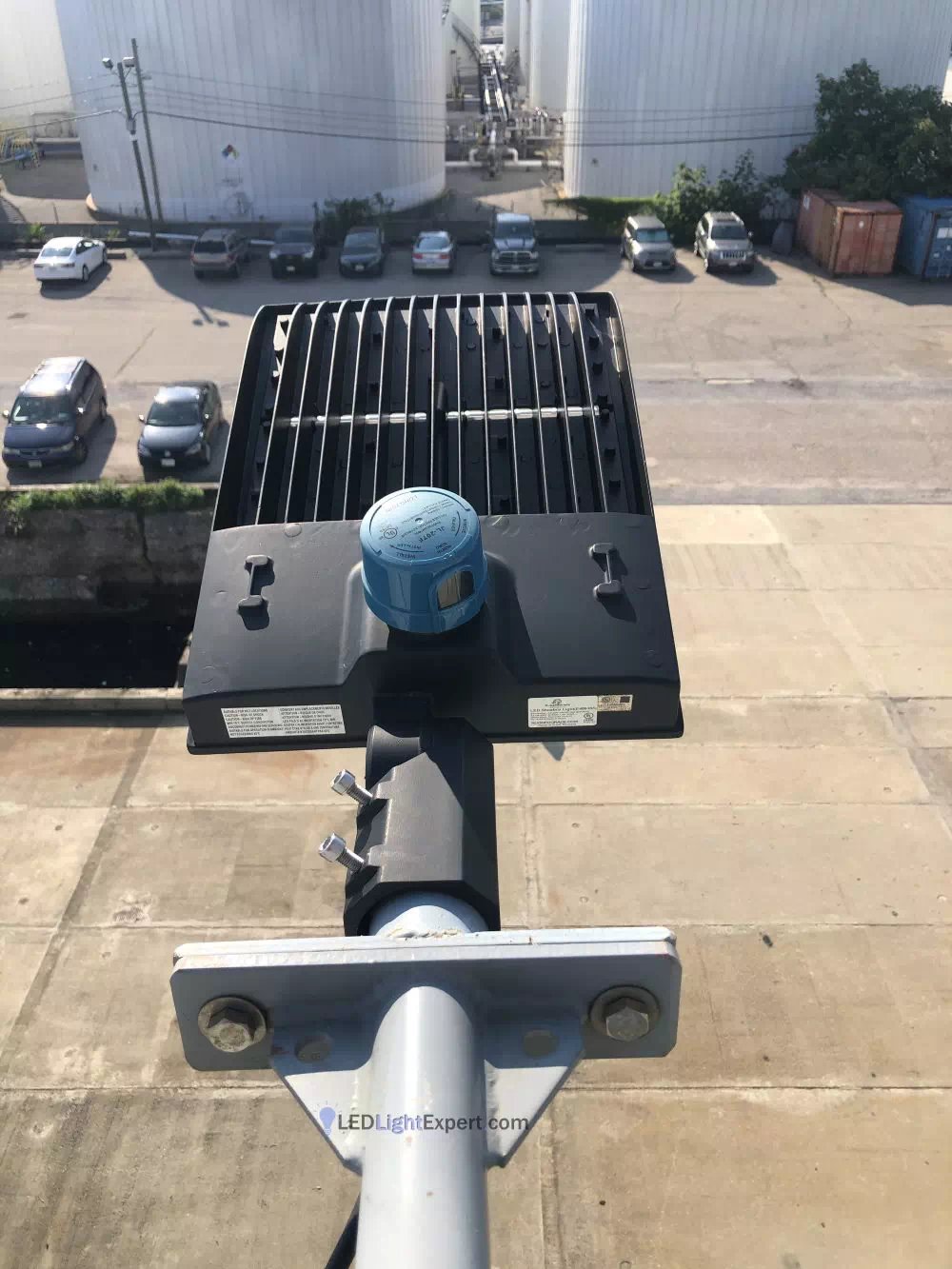
For outdoor commercial lighting, the general rule is that pole spacing should be 2.5 to 3 times the mounting height. A 20-foot pole typically calls for 50–60 feet between poles. Shorter poles require closer spacing. Standard commercial poles are aluminum 6063-T6, typically 4–5 inches square or round tapered, with 0.156-inch wall thickness. Outdoor installations may require pole heights from 10 to 100+ feet, and fixtures should be paired with photocells, timers, motion sensors, or directional shielding to minimize light pollution and maximize efficiency.
Commercial Lighting Mount Options
Key takeaway: Choosing the correct mount is just as important as choosing the right fixture. Mount type determines how the light is aimed, how wiring is routed (internal vs. external), and what surfaces the fixture can attach to. The five primary mount types for parking lot, area, and flood lights are slip fit, direct arm, flood/U-bracket, yoke/trunnion, and knuckle/conduit.
From parking lots to warehouses, sports stadiums to restaurants, there are many applications for commercial LED lights, and each requires the correct mounting hardware. Below is a breakdown of every major mount type used in commercial lighting installations.

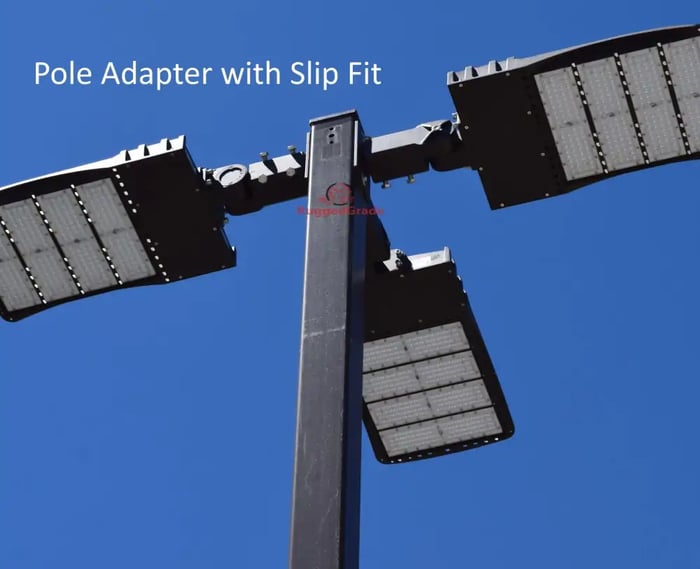
Slip Fit Mount (Slip Fitter)
The most common mount for parking lot lights, area lights, street lights, and flood lights. Slip fit mounts slide over the pole tenon like a sheath and are tightened with set bolts, allowing the fixture angle to be adjusted and the mount to rotate on the pole. The most common slip fit size accepts a 2″ to 2-3/8″ tenon adapter. Electrical wiring runs internally through the mount, eliminating the need for external weatherproofing.
Direct Arm Mount (Pole Mount)
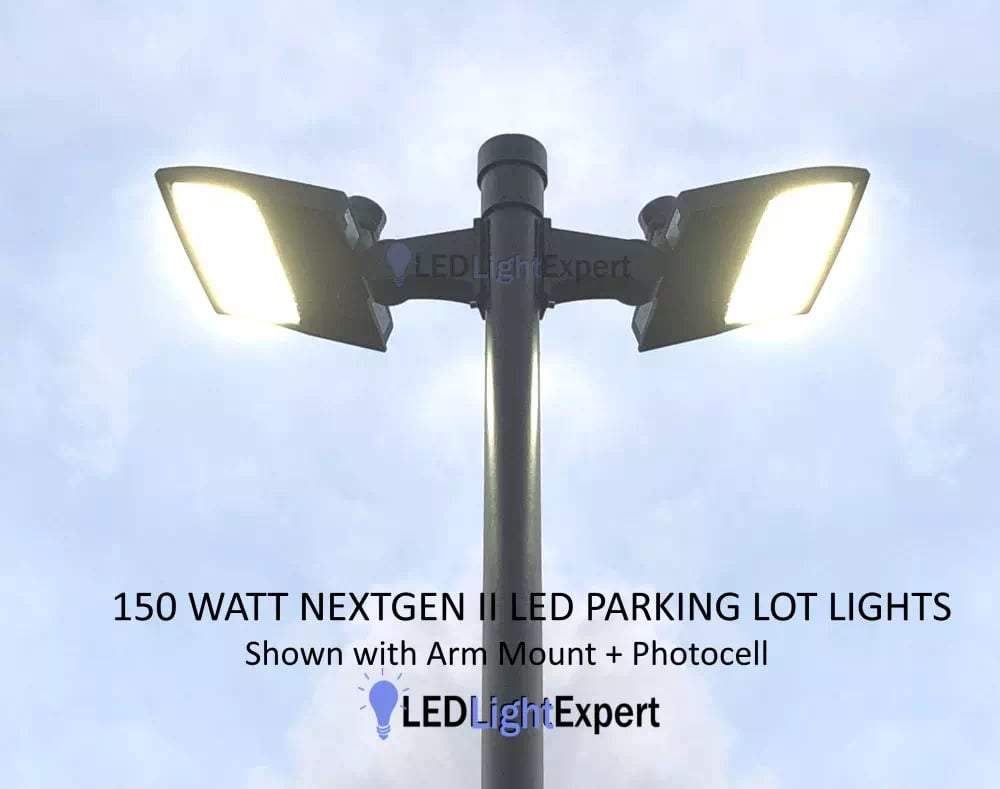
Designed to mount directly onto a steel light pole, the direct arm mount is secured with two bolts—one top, one bottom—that pass through the mount, through the pole, and into a bracket on the inside. Some designs accommodate both round and square poles. Like the slip fit, wiring runs internally through the mount for weather protection.
Flood Mount (U-Bracket)
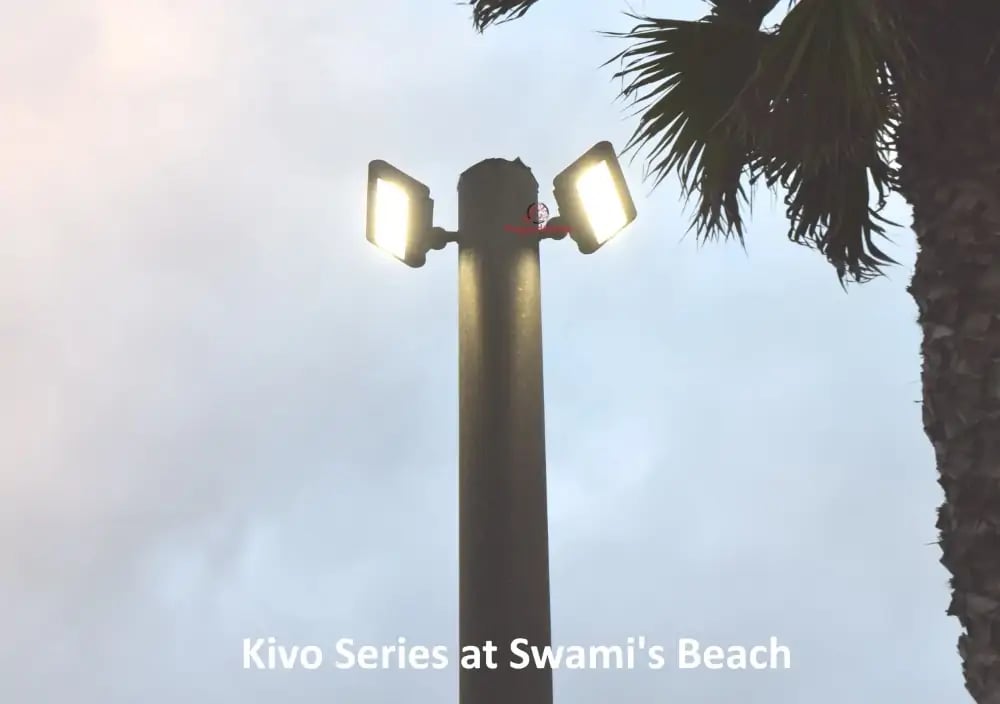
Flood mounts use a U-shaped bracket that connects to opposite sides of the fixture, allowing the bracket to pivot around the light. Multiple mounting holes provide flexibility for attaching to walls, roofs, and ceilings. Unlike slip fit and direct arm mounts, wiring runs externally—an advantage when wiring cannot be routed through the mounting surface.

Yoke Mount (Trunnion)
Similar to the flood mount, the trunnion mount runs wiring externally. However, it attaches to only one side of the fixture and has a pivot point on the mount itself rather than at the fixture connection. Trunnion mounts are typically used for smaller fixtures or those mounted vertically. They are not recommended for heavy fixtures in horizontal orientation.

Knuckle Mount (Conduit Threaded)
Conduit mounts screw directly into a conduit port and run wiring internally through the mount. Their key advantage is the ability to thread directly into most standard junction boxes. However, they are often suited for lighter fixtures—typically up to about 90 watts and approximately 11,000 lumens. For sport court lighting above that output, a flood mount is the better choice.
Mount Styles for High and Low Bay Lighting
High bay and low bay lighting requires mounting styles matched to the fixture, ceiling height, and safety requirements. Here are the most common options:
1. Cable or Chain Mounts
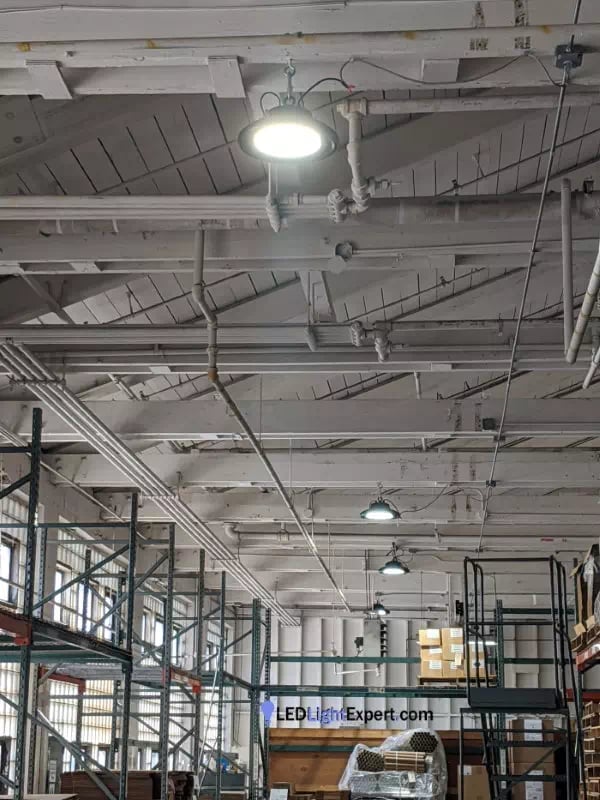
UFO high bay fixtures typically feature an eyehook on top, allowing them to be suspended using cables or chains at adjustable heights. LED linear high bay lights use cables or chains connected at multiple points that converge into two primary suspension cables from the ceiling, ensuring uniform hanging and stability.
2. Flood Brackets
For spaces with limited vertical clearance, flood brackets affix UFO or linear high bay fixtures directly to the ceiling. This positions the lights as close to the ceiling as possible, maximizing usable headroom below.
3. Ceiling Mounted (Flush & Semi-Flush)
Flush mounted fixtures are affixed directly to the ceiling with no visible gap and work well for unobtrusive lighting in offices and retail. Semi-flush fixtures maintain a slight gap from the ceiling, providing a balance between direct and ambient illumination in areas where overhead space is limited.
4. Pendant or Pipe Mounts
Pendant mounts connect to a downward-extending pipe from the ceiling, with wiring concealed inside the pipe and linked to a junction box. They are favored in hazardous environments because the internalized wiring is safer than external setups. Pendant mounts are also popular for aesthetic applications above tables and kitchen islands.
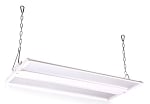
Linear high bay: 2-point cable mount
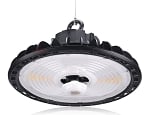
UFO high bay: single-point mount
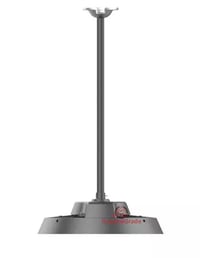
Pendant/pipe mount
Wall Lights — Common Mount Styles
Wall-mounted commercial light fixtures are generally designed to attach directly to a junction box. Junction boxes can be surface-mounted externally or recessed into a wall or concrete surface so the fixture sits flush. Many wall lights have flexible back plates that can be drilled for mounting on a variety of surfaces.
For outdoor installations, sealants such as silicone caulk are used to weatherproof the mount-to-surface connection. Wall lights—sometimes called sconces—can be configured to direct light upward, downward, or both, and some diffuse light for a more ambient effect.
For applications requiring higher lumen levels than a standard wall pack provides, LED parking lot lights can be wall-mounted using a tenon adapter bracket, combining the output of an area light with the convenience of wall mounting.
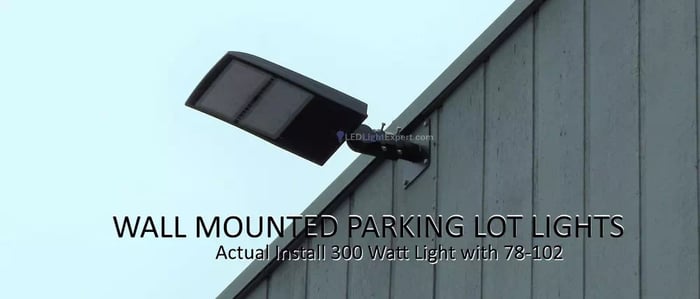
Slip fit parking lot light mounted with a wall adapter tenon.
Stadium Light Mount Options
Stadium lights are typically mounted using either flood brackets or slip fit adapters. Flood brackets are the most common configuration, providing the rigid support needed for large, high-output fixtures at extreme mounting heights (60–100+ feet). Some installations call for slip fit mounts when fixtures need to be rotated and angled independently on the pole.

Key Considerations When Selecting Commercial Light Fixture Mounts
Light Distribution
Understand how your fixture distributes light. Surface-mounted options often allow beam angle adjustments—narrow beams (under 60°) provide focused illumination for aisles and task areas, while wide beams (90–120°+) offer broader coverage for open floor plans. Some mounts can direct fixtures upward or downward, and reflectors or louvers can diffuse light for softer illumination.
Performance Customization
Work with a lighting expert to find fixtures that match your performance goals. Many modern commercial LED lights support 0-10V dimming, allowing finer brightness control and additional energy savings. Fixture and mount choices also affect color temperature delivery and overall ambiance.
Aesthetic Fit
Beyond performance, ensure your fixtures complement the space’s visual identity. Popular finishes include powder-coated, painted, and metal-plated options. Aluminum is a common choice for its durability, light weight, and easy customization, while brass and steel offer a premium look at higher cost.
Why Choose LED Commercial Lights Over Traditional Lighting
Key takeaway: LED commercial lights consume 50–75% less energy than HID, fluorescent, and halogen alternatives while lasting 3–10 times longer. The combination of lower energy bills, reduced maintenance, instant-on performance, and better controllability makes LEDs a strong choice for many commercial lighting projects in 2026.
In the range of lighting technologies available—incandescent, fluorescent, halogen, CFL, HID, and LED—LEDs have become a common solution for many commercial applications. Here is why businesses and lighting professionals are moving to LED:
- Energy efficiency: LEDs consume approximately 50–75% less energy than fluorescent, halogen, and HID counterparts. For spaces where lighting runs 12–24 hours per day, the energy savings are substantial.
- Durability and lifespan: LED fixtures last 50,000–100,000 hours compared to 10,000–20,000 for fluorescent and 6,000–15,000 for HID. LEDs exhibit gradual lumen depreciation rather than sudden burnout, allowing planned replacement schedules.
- Instant-on performance: LEDs reach full brightness immediately with no warm-up period, unlike HID lamps that can take 5–15 minutes to reach full output.
- Dimming and controls: LEDs integrate seamlessly with 0-10V dimmers, occupancy sensors, daylight harvesting systems, and building automation, giving operators finer control over brightness and scheduling.
- Lumens over watts: When transitioning to LED, focus on lumens (light output) rather than wattage. A 150W LED high bay can replace a 400W metal halide while producing equal or greater lumens.
- Color options: LEDs offer a full spectrum of color temperatures from 2700K to 5000K+ without external filters. Color-selectable fixtures let you switch temperatures to match different use cases.
Conclusion
As lighting technology advances, LEDs stand out for their efficiency, adaptability, and sustainability. Their advantages over traditional systems make them the foundation for creating energy-efficient commercial spaces. While factors like design, layout, foot-candles, color temperature, and pole spacing all matter, the specific environment and its purpose will always guide the final fixture and mount selection. With the information in this guide, you are equipped to make informed commercial lighting decisions that balance performance, aesthetics, and long-term cost savings.
Commercial Lighting FAQs
Commercial lighting refers to illumination systems for non-residential spaces such as offices, retail stores, warehouses, healthcare facilities, educational institutions, hospitality venues, and public infrastructure. It prioritizes energy efficiency, code compliance, durability, and consistent light distribution across large areas.
The most common types include LED high bay lights for warehouses, LED troffers and panel lights for offices, LED parking lot and area lights for exterior spaces, LED wall packs for building perimeters, LED flood lights for security and sports, and LED corn bulbs as HID retrofit replacements. Each fixture type is designed for specific mounting heights, beam distributions, and lumen requirements.
Mount selection depends on fixture type, installation location, and structural surface. Slip fit mounts often work for pole-mounted parking lot and area lights. Direct arm mounts bolt to steel poles. Flood or U-brackets suit walls, roofs, and ceilings. Yoke/trunnion mounts are for smaller vertical installations. Knuckle/conduit mounts thread into junction boxes for lighter fixtures. Always match mount capacity to fixture weight.
It depends on the space: 2700–3000K (warm white) for hotels and restaurants, 3500K (neutral) for offices, 4000K (cool white) for retail and garages, and 5000K (daylight) for warehouses, hospitals, and outdoor security. Many modern LED fixtures offer color-selectable options that let you switch between temperatures without changing the fixture.
High bay lights are for ceilings above about 20 feet (warehouses, gyms, factories) and use focused beam angles to project light over long distances. Low bay lights are for ceilings of roughly 12 to 20 feet (retail, workshops) and use wider beam angles. Mounting methods also differ: high bays typically hang from chains or cables, while low bays are surface-mounted or semi-flush.
LEDs consume 50–75% less energy and last 50,000–100,000 hours compared to 10,000–20,000 for fluorescent and 6,000–15,000 for HID. They reach full brightness instantly, support dimming and smart controls, produce minimal heat, and contain no mercury. The typical ROI for an LED conversion is 1–3 years through energy and maintenance savings.
Multiply the target foot-candles for your space by total square footage to get total lumens needed. Divide by the lumen output of your chosen fixture. For example, a 10,000 sq ft warehouse at 30 FC needs 300,000 lumens. Using 150W high bays at 22,000 lumens each, you need approximately 14 fixtures before losses. Applying a light loss factor of 0.85–0.90 raises that to about 16–17 fixtures; consult a photometric layout for precise placement.
Lighting Power Density (LPD) measures installed lighting wattage per square foot. Energy codes like ASHRAE 90.1-2022 set maximum LPD limits by building or space type—for example, about 0.73 W/sq ft for enclosed offices, 0.56 W/sq ft for open-plan offices, and 0.33 W/sq ft for medium/bulky warehouse storage under the space-by-space method. LED fixtures can help projects stay below these limits, which can qualify your project for utility rebates and energy-efficiency incentives.
Related Articles
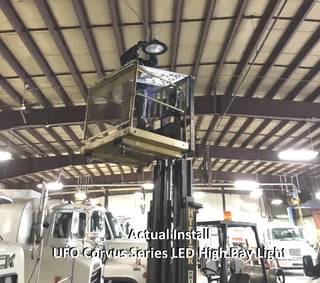 Industrial Lighting: A Complete Buying Guide
Complete guide to industrial lighting — high bays, hazardous location lights, retrofit vs. replacement, and a 10-step buying checklist.
Industrial Lighting: A Complete Buying Guide
Complete guide to industrial lighting — high bays, hazardous location lights, retrofit vs. replacement, and a 10-step buying checklist.
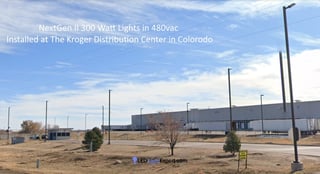 Outdoor Lighting: A Complete Buying Guide
Everything you need to know about outdoor LED lighting — parking lot lights, flood lights, wall packs, and how to choose the right fixtures.
Outdoor Lighting: A Complete Buying Guide
Everything you need to know about outdoor LED lighting — parking lot lights, flood lights, wall packs, and how to choose the right fixtures.
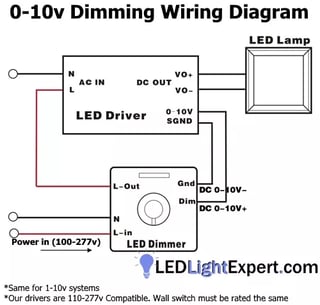 0-10V Dimming Explained: Complete Guide
Learn how 0-10V dimming works, how to wire a dimmer, and which LED fixtures support low-voltage dimming for commercial installations.
0-10V Dimming Explained: Complete Guide
Learn how 0-10V dimming works, how to wire a dimmer, and which LED fixtures support low-voltage dimming for commercial installations.

About the Author


Need Help With Commercial Lighting?
Our lighting specialists can help you select the right commercial light fixtures, plan your layout, and choose appropriate mount options for commercial or industrial projects.
SHOP COMMERCIAL LED LIGHTING


