


Key Takeaway: Use BUG ratings to check where light goes, not just how bright the fixture is. Backlight affects neighbors, uplight affects sky glow, and glare affects drivers and pedestrians.
How to Use BUG Ratings in a Lighting Review
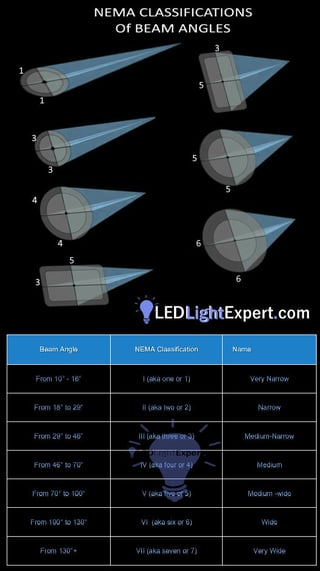
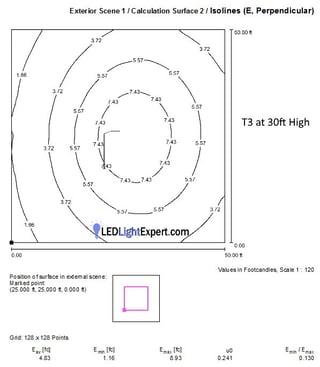
Start with the fixture photometric file, mounting height, pole setback, and beam angle. Then compare the B, U, and G values against any local outdoor lighting ordinance, dark-sky rule, property-line concern, or roadway-glare requirement. A lower BUG rating is not automatically better if the area becomes underlit; the goal is enough useful light on the pavement with controlled spill and glare. Ask for a photometric layout when pole height, property lines, fixture tilt, nearby homes, spill-light limits, or municipal review make the choice uncertain.
BUG Ratings of LED Parking Lot Lights - Backlight Uplight and Glare Classifications for Light Fixtures
If you work anywhere in the lighting industry, you have likely heard of BUG Ratings. These ratings help light designers, property owners, and cities understand where the light may spill beyond the intended area.
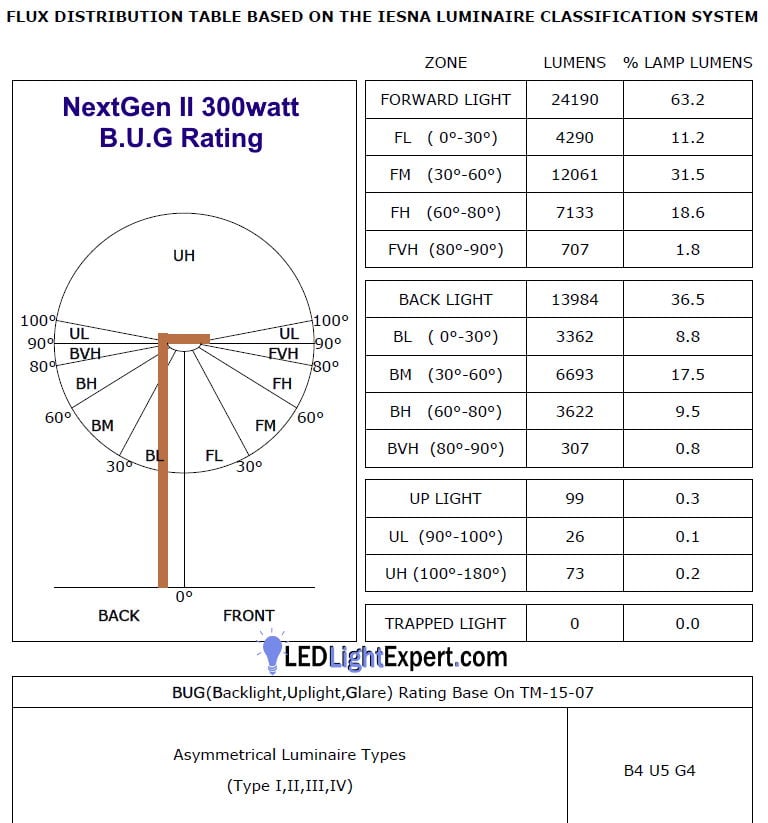
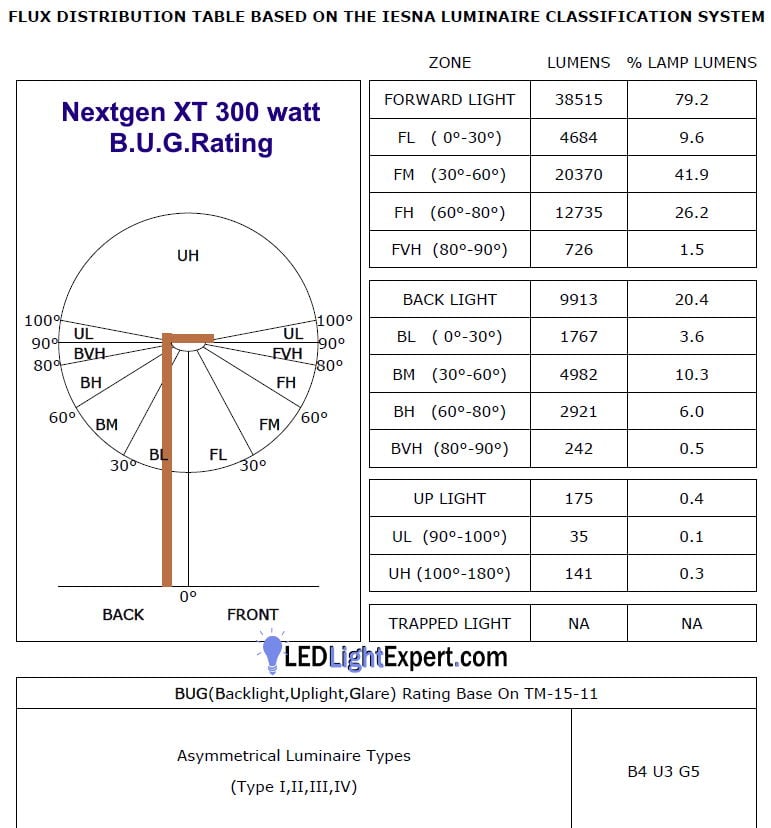
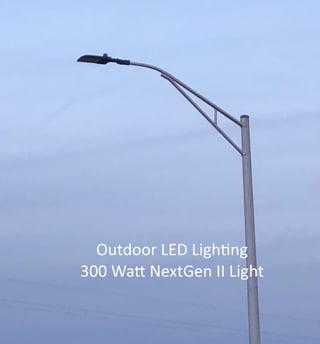
Above was the 300 watt version of the LED parking lot light BUG ratings chart and below is the 150 watt version of the BUG ratings. The 300 watt is a B4 U5 G4 where the 150 watt with the identical beam angle is a B3 U2 G3.

Frequently Asked Questions
BUG stands for Backlight, Uplight, and Glare. In light design, designers try to manage all three, but every fixture has tradeoffs. Fixtures that reduce these three classifications of light help improve light quality and dark sky compliance and reduce light harshness.
Light fixtures are tested in a lab. Total lumens and color are measured in an integrating sphere, a closed ball that captures all of the light a fixture puts out. Light direction is measured with a goniophotometer, a machine that turns the fixture (or moves a sensor around it) to measure brightness in every direction, in effect building a complete sphere of readings around the fixture. The resulting IES file shows how much light goes where, and it is used to calculate the BUG rating and to model light installations for planning, permitting and other functions.
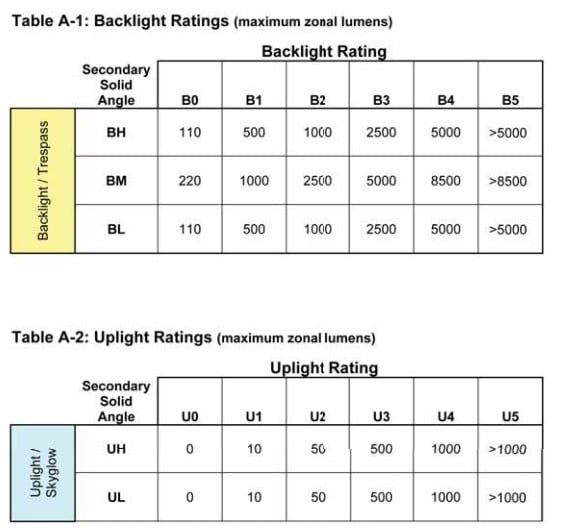
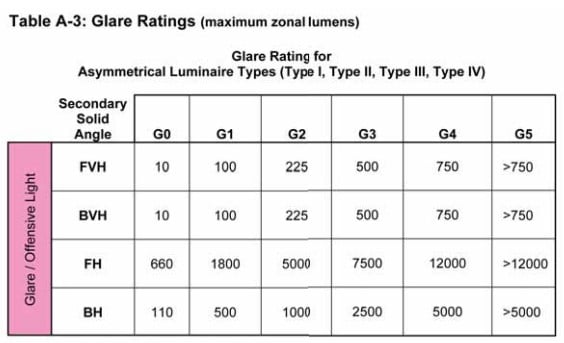
BUG ratings are based on hard lumens. That means a very good 300 watt fixture will still often have higher BUG ratings than an average 100 or 150 watt fixture. The number in the classifications of BUG ratings is based on total lumens in that particular area. As the lumens increase so does the BUG score.
BUG ratings are designed and maintained by the IES based on their published spec TM-15-11.
BUG ratings are based on hard lumens. The challenge with BUG ratings is that we calculate light by direction or angle and then it's summarized into categories. Only certain percentages are considered to be harsh light. IES defines these "zonal lumens" as follows:
Forward light: FL is from 0-30 degrees, FM is from 30-60 degrees, FH is from 60-80 degrees, FVH is from 80-90 degrees.
Back light: BL is from 0-30 degrees, BM is from 30-60 degrees, BH is from 60-80 degrees, BVH is from 80-90 degrees.
Up Light: UL is from 90 to 100 degrees, UH is from 100-180 degrees.
Related Articles
 LED Parking Lot Lights Buyers Guide
Expert guide to choosing the right LED parking lot lights for your commercial property.
LED Parking Lot Lights Buyers Guide
Expert guide to choosing the right LED parking lot lights for your commercial property.
 Light Beam Angles and NEMA Classifications
NEMA classifications of beam angles explained — beam spreads, distribution types, and how to choose the right pattern.
Light Beam Angles and NEMA Classifications
NEMA classifications of beam angles explained — beam spreads, distribution types, and how to choose the right pattern.
 Parking Lot Light Coverage Area Charts
Coverage area charts by mounting height and spacing — plan your LED parking lot layout with real data.
Parking Lot Light Coverage Area Charts
Coverage area charts by mounting height and spacing — plan your LED parking lot layout with real data.


Need Help With Parking Lot Lighting?
Our lighting experts can help you compare LED parking lot lights and BUG ratings for your project.
TALK TO THE EXPERTS


