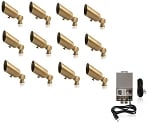
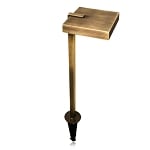
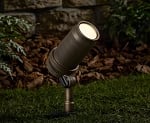
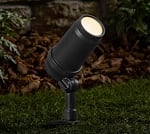
Landscape Spot Lights

USA Based Experts in less than 60 seconds Call Now: 800-674-9420
On orders over $49.00
Up to 7 Years Free Warranty On LED Lights

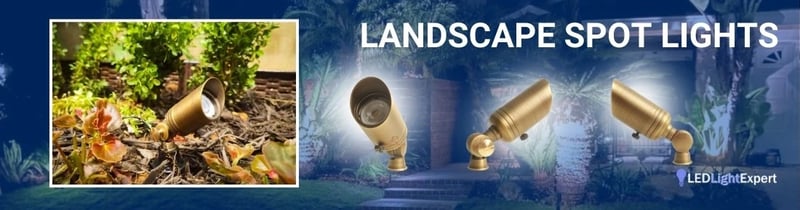
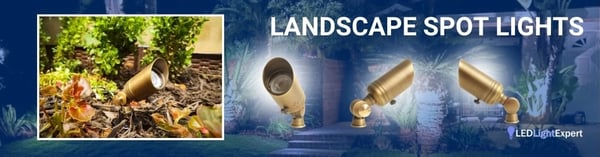
Landscape spot lights create focused beams for trees, walls, signs, garden features, columns, and building details. The right fixture depends on beam angle, lumen output, mounting distance, aiming angle, fixture material, IP rating, and transformer capacity.
Narrow beams work for tall trees, columns, and tight architectural details. Medium beams fit shrubs and smaller features. Wider beams are better for walls, signs, and broad planting areas. Aim the fixture after dark and adjust it until the feature is visible without glare.
Most residential landscape spotlights use 12V low-voltage power. Add fixture wattage, leave transformer headroom, and choose wire gauge around the run length to avoid voltage drop.

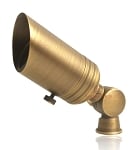
Landscape fixtures live in soil, irrigation, heat, cold, and foot traffic. Brass, copper, stainless steel, and quality aluminum usually last longer than thin plastic. Check lens style, stake strength, sealed wire connections, IP rating, finish, and replacement parts before ordering.
The original spotlight guide included useful material and fixture details. Landscape spotlights are installed outdoors where irrigation, soil, heat, cold, and impact can shorten fixture life. Brass is common because it combines copper and zinc, resists corrosion, and develops a natural finish over time. Copper, stainless steel, and quality aluminum are also common choices depending on the site and budget.
IP ratings should be checked before installation. IP65 means the fixture is protected against dust and water jets, which is a common baseline for exposed landscape fixtures. Most residential landscape spotlights use 12V low-voltage power from a transformer, making wire sizing, connector quality, burial depth, and transformer capacity part of the lighting design.
Beam angle decides the effect. Narrow beams can reach trees and columns. Medium beams work on shrubs and signs. Wider beams are closer to flood lighting for walls or broader planting areas. Aim each fixture at night, then adjust for glare and shadow.
Spotlights are often placed near a tree trunk, wall, doorway, sign, or bush and aimed upward or across the feature. A short throw with a narrow beam can show bark texture or a column. A wider beam can cover a tree canopy, large wall, or broader planting bed. The same fixture can look very different when moved a few feet.
Brightness should match the feature. Too many lumens on a small tree can flatten the effect, while too few lumens on a large canopy will disappear. Voltage, transformer size, wire run, beam angle, material, weather conditions, and fixture position should be reviewed together. Outdoor spotlights need enough durability for soil, irrigation, and seasonal temperature changes.
Landscape spotlights can enhance aesthetics and safety around doorways, paths, walls, trees, and property features, but they should not shine into eyes or windows. Aim each fixture after dark, then lock the position once the beam is correct.
Landscape spotlights are often used for a tree, canopy, wall, doorway, sign, bush, or entire property feature. A fixture near the trunk can create a narrow column of light. A second fixture positioned outside the drip line can show the canopy width. Wall washing uses a wider beam and even spacing so the light does not create a single bright point.
Brass is an alloy, and that material is popular for spotlights because it handles weather conditions and outdoor voltage systems well. A powerful spotlight still has to be aimed carefully. Too much brightness on a small tree can look harsh; too little brightness on a large canopy will disappear. Determine whether the goal is accent, safety, depth, or broad landscape illumination before choosing lumens and beam range.
Landscape spot lights are used to highlight trees, architectural features, signage, and garden focal points. They produce a focused beam of light that draws attention to specific elements in your outdoor space.
Narrow beams (15-25 degrees) are best for highlighting tall trees and narrow features. Medium beams (25-40 degrees) work well for shrubs and medium features. Wide beams (40-60 degrees) are well suited for illuminating broad surfaces.
Position spot lights at the base of the feature you want to highlight and angle them upward at 30-45 degrees. Experiment with placement to avoid harsh shadows and achieve the desired dramatic effect.
Yes, most landscape spot lights are rated for wet locations with IP65 or higher ratings. They are designed to withstand rain, sprinkler systems, and ground moisture in outdoor landscape installations.
Create dramatic effects with LED landscape spot lights. Contact our specialists for help selecting beam angles, fixtures, and design layouts.
Contact LED Light ExpertCall Now: (800) 674-9420
Dara Greaney is the CEO and President of LEDLightExpert.com, a leading company in commercial lighting solutions. Since 2015, he has led the company to achieve remarkable growth and recognition, including being an Inc5000 winner three times: No. 3783 in 2022, No. 2428 in 2021, and No. 531 in 2020.
Editing by David Peguero.
On orders over $49.00
Up to 7 Years Free Warranty On LED Lights