Landscape Path Lights

USA Based Experts in less than 60 seconds Call Now: 800-674-9420
On orders over $49.00
Up to 7 Years Free Warranty On LED Lights

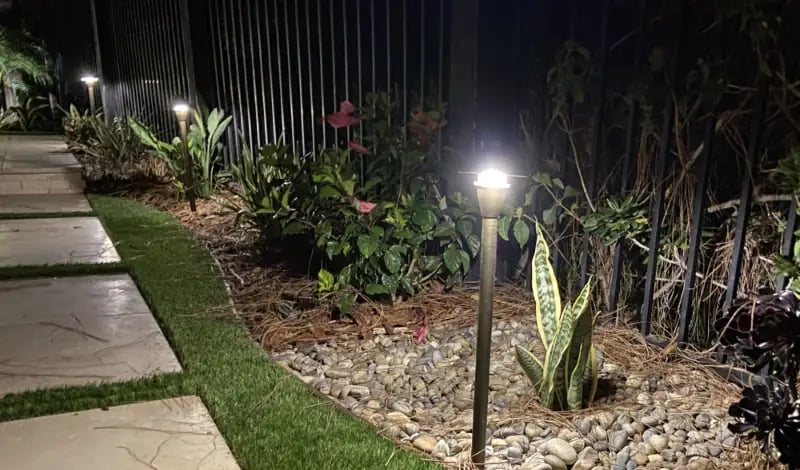
Path lights guide people through outdoor spaces while adding enough light to show steps, edges, planting beds, and changes in direction. They should create comfortable pools of light, not a runway or a glare line. Plan spacing, fixture height, beam spread, finish, transformer size, and wire runs together.
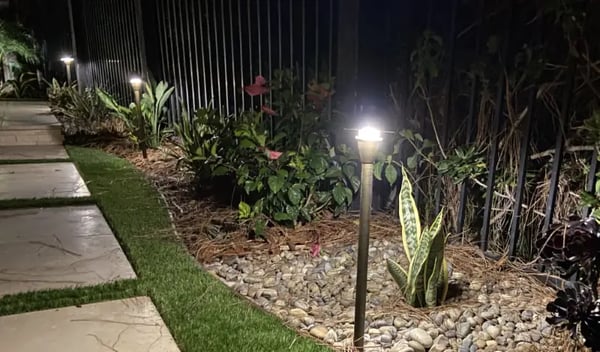
Many path lights are spaced 6 to 8 feet apart, but the right spacing depends on fixture output, lens shape, mounting height, path width, and whether you want continuous light or separate pools of light. Staggering fixtures often looks more natural than placing them directly across from each other.
Set fixtures slightly back from the path when possible so the light reaches the walking surface without being kicked, buried by mulch, or blocked by plants. Avoid aiming light into the eyes of people walking toward the fixture.

Most wired landscape path lights use a 12V transformer. Add the wattage of each fixture, include headroom, and choose wire gauge based on load and distance. Timers, photocells, and multiple zones can make the system easier to operate and maintain.
Choose fixture material for the site. Brass, copper, stainless steel, and quality aluminum are common for long-term outdoor use. Confirm wet-location rating, stake design, lens, finish, and replacement parts before ordering.
The original pathway guide correctly treated path lights as one part of landscape lighting. Spot lights, path and spread lights, in-ground lights, step lights, deck lights, and brick lights all solve different problems. Path lights are for walkways, driveways, patios, garden edges, docks, tricky steps, and transitions where people need guidance.
Most wired path systems use a transformer to step 120V building power down to 12V. Transformer sizes can range from small residential units to much larger multi-zone systems. Timers, photo-electric sensors, wireless controls, and multiple circuits can make the system easier to operate.
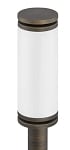
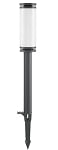
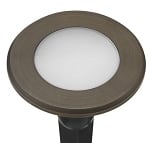
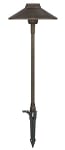
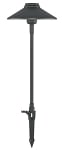
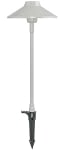
Fixture shape changes the light pattern. Hat-style path lights cast a pool of light downward. Directional path lights aim toward a specific surface. Bollard path lights give a taller, more visible marker. Warm 2700K to 3000K color temperature is common because it looks comfortable around gardens, patios, and front entries.
Spacing depends on beam spread. Some fixtures are placed 5 to 15 feet apart, while wider spread fixtures can be farther apart. A fixture should often sit near the beginning and end of a path so the transition is visible. Avoid placing lights so close together that the path becomes a flat strip of brightness.
Pathway lighting helps define flower beds, trees, garden edges, steps, and walking surfaces so people can see where to move. It also marks the front of the property at night. A path can use continuous illumination when the surface is uneven, or pools of light when the path is simple and there is some ambient light.
Transformer sizing starts with total fixture wattage. If ten path lights use 4 watts each, the lighting load is 40 watts before headroom. Larger properties may need more than one circuit so voltage remains even. Wire gauge, run length, fixture count, and connector quality all affect how much light reaches the end of the pathway.
Path lights should be placed where they illuminate the walking surface and nearby landscape without becoming obstacles. Fixtures near the beginning and end of a route help visitors find the transition. Brass, copper, aluminum, and stainless steel are common materials; the right choice depends on budget, finish, soil, irrigation, and how long the system is expected to last.
Pathway lights should illuminate the path, nearby flower beds, gardens, trees, driveways, and step areas enough for safety without removing the night character of the space. Lumens, beam spread, fixture height, and voltage all affect the result. A low-output fixture may be enough for a garden path, while a wider driveway or public walkway may need more brightness.
Consider how the pathway is used before placing fixtures. Continuous light can help on uneven areas or steps. Separate pools of light can work where the path is simple. Fixtures are generally placed near the beginning and end of the route, then spaced by beam spread and visual effect. Brass fixtures are often chosen when long service life and outdoor appearance are crucial.
Path lights should be spaced 6 to 8 feet apart for consistent illumination along walkways. Stagger lights on alternating sides of the path for a more natural appearance and balanced light distribution.
Most landscape path lights are 14 to 24 inches tall. Taller path lights (18-24 inches) provide wider light spread and work well for broader paths. Shorter fixtures (14-18 inches) are suited for garden borders and narrow walkways.
12V wired path lights provide more consistent and brighter illumination than solar options. They work reliably in shaded areas and during extended cloudy periods where solar lights may underperform.
The number depends on your transformer capacity and each fixture wattage. LED path lights typically use 2-5 watts each, so a 150W transformer can power approximately 30-50 LED path lights with capacity to spare.
Guide the way with LED landscape path lights. Contact our team for help selecting path light styles, spacing, and transformer sizing.
Contact LED Light ExpertCall Now: (800) 674-9420
Dara Greaney is the CEO and President of LEDLightExpert.com, a leading company in commercial lighting solutions. Since 2015, he has led the company to achieve remarkable growth and recognition, including being an Inc5000 winner three times: No. 3783 in 2022, No. 2428 in 2021, and No. 531 in 2020.
Editing by David Peguero.
On orders over $49.00
Up to 7 Years Free Warranty On LED Lights