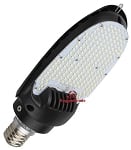
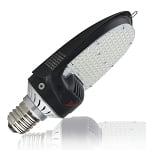
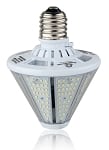
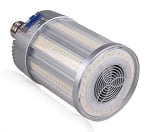
150W Metal Halide LED Replacement Bulbs
USA Based Experts in less than 60 seconds Call Now: 800-674-9420
On orders over $49.00
Up to 7 Years Free Warranty On LED Lights


The 150-watt metal halide lamp serves the lower end of the commercial HID range — common in retail ceiling fixtures, office lobbies, small warehouse bays, parking structure canopy lights, and residential security fixtures. At 13,500 initial lumens, the lamp provides adequate brightness for spaces with 10 to 20 foot ceiling heights, but the technology carries the same fundamental drawbacks as its higher-wattage siblings: a 5 to 15 minute warm-up period, 15 to 20 minute restrike delay after power loss, ballast energy overhead that pushes wall draw to 185 to 190 watts, and color shift that turns the light pink or green as the lamp ages.
These drawbacks create real operational problems in commercial settings. A retail store that loses power during business hours waits 15 to 20 minutes for its sales floor lighting to come back to full brightness. A parking garage with 150W metal halide canopy fixtures runs those lamps continuously because shutting them off means a 15-minute dark period before they restrike. An office building pays for ballast losses on every fixture, around the clock, whether the lights are at full output or warming up. LED eliminates all of these problems instantly — full brightness in under one second, no ballast losses, no color shift, and significantly lower energy consumption.
Most 150W metal halide fixtures fall into a few common form factors: PAR38 flood lamps for track and recessed lighting, ED17 or ED28 enclosed-rated lamps for commercial wall packs and canopy fixtures, and BT28 or BT37 lamps for open industrial fixtures. The LED corn bulb replaces all of these with a single form factor that fits the E39 or E26 socket common to each fixture type. The corn bulb's 360-degree light pattern fills the existing fixture reflector similarly to the omnidirectional metal halide lamp, making it a direct optical replacement in most housings.


The most common mistake in 150W metal halide replacement is over-specifying the LED wattage. Many buyers assume they need a 150W LED to replace a 150W metal halide, but that would result in significantly more light than the original installation — potentially causing glare issues in low-ceiling applications. The correct approach is to match delivered lumens, not wattage.
A 150W metal halide delivers approximately 8,000 to 9,500 usable lumens after fixture and depreciation losses. For a 1:1 replacement in the same fixture, a 40 to 54W LED corn bulb is typically sufficient. For applications where the original 150W lamp was already inadequate (common in aged installations with heavily depreciated lamps), stepping up to a 60 to 80W LED provides a noticeable brightness improvement while still saving 55 to 68 percent in energy. Browse our full range of LED corn light bulbs to find the right wattage for your fixture.
Physical fit matters as much as lumen output. The LED corn bulb must clear the fixture housing — length, diameter, and heat sink clearance all need to be verified. 150W metal halide lamps in ED17 envelopes are relatively compact (roughly 7 inches long, 2.1 inches in diameter), while BT28 and BT37 lamps are larger. LED corn bulbs in the 30 to 60 watt range are typically 7 to 10 inches long and 3 to 4 inches in diameter, so they fit most 150W metal halide housings. For our complete range of base types including E26 medium and E39 mogul, see our LED light bulbs collection.
An LED corn bulb in the 30 to 60 watt range replaces a 150W metal halide lamp. A 150W metal halide produces approximately 13,500 initial lumens but delivers only 8,000 to 9,500 usable lumens after fixture losses and lumen depreciation. A 40 to 54W LED corn bulb producing 5,200 to 8,100 directional lumens provides comparable working-plane illumination at 65 to 75 percent less energy consumption. The exact LED wattage depends on the fixture type and required light levels for your application.
150W metal halide fixtures commonly use either an E26 medium base or an E39 mogul base, depending on the fixture design. Smaller fixtures such as recessed downlights, track lights, and compact wall packs typically use E26. Larger fixtures such as high bays and industrial wall packs use E39. Some 150W fixtures use a dedicated pulse-start base (ED17 or ED28 envelope) that accepts the same E39 mogul base used by LED corn bulbs. Always verify your current lamp base type before ordering a replacement.
A 150W metal halide lamp draws more than 150 watts at the wall because the magnetic or electronic ballast consumes additional power. A typical 150W metal halide system draws 185 to 190 watts total. Replacing it with a 40W LED corn bulb reduces system draw by roughly 145 to 150 watts per fixture — a 77 to 79 percent energy reduction. For a facility with 50 fixtures operating 10 hours per day, the annual savings is approximately 26,500 kWh, or about $3,175 at $0.12 per kWh.
Some LED corn bulbs support 0-10V dimming and some do not — check the product specification before purchasing. For 150W metal halide applications in spaces where dimming is required (retail, hospitality, conference rooms), look for bulbs that explicitly list 0-10V dimming compatibility. Note that the existing metal halide ballast does not support dimming and must be removed (ballast-bypass wiring) before dimming control can be connected to the LED driver.
If you choose a ballast-compatible (Type A) LED corn bulb that works with your existing ballast, the swap is as simple as removing the old lamp and inserting the new LED — no electrician required. However, if you choose a ballast-bypass (Type B) bulb, the ballast must be disconnected and line voltage wired directly to the socket, which requires a qualified electrician. We recommend ballast-bypass for long-term reliability, but ballast-compatible options are available for facilities that need a quick, no-electrician swap.
LED replacement bulbs deliver significantly better light quality than 150W metal halide lamps in the areas that matter for the application. LED corn bulbs achieve CRI (Color Rendering Index) values of 80 to 90, compared to 65 to 70 for standard metal halide. LED light output is consistent from the first second of operation — no warm-up period, no color shift as the lamp ages, and no flicker at end of life. Metal halide lamps produce noticeable color shift (pink or green tint) as they age, and many develop visible flicker in the last 20 to 30 percent of their lamp life.
A 150W metal halide lamp often reaches the point where ballast service and lamp changes cost more than a clean LED retrofit. Our lighting specialists can identify the right LED corn bulb for your fixture type and base size, calculate your energy savings, and ensure the physical fit works in your housing. Call us at (800) 674-9420 or contact us online to get started.
Call Now: (800) 674-9420


Dara Greaney is the CEO and President of LEDLightExpert.com, a leading company in commercial lighting solutions. Since 2015, he has led the company to achieve remarkable growth and recognition, including being an Inc5000 winner three times: No. 3783 in 2022, No. 2428 in 2021, and No. 531 in 2020.
Editing by David Peguero.
On orders over $49.00
Up to 7 Years Free Warranty On LED Lights