


Quick Answer
LED light bulbs come in several base types: E26/E27 (standard medium), E39/E40 (mogul for high-wattage), GU10 (twist-lock spotlight), and pin bases (G13 for T8 tubes, GU24 for CFL replacements). Key specs include lumens (brightness), watts (energy use), color temperature (2700K warm to 5000K daylight), and CRI (80+ minimum). LED bulbs last 15,000–50,000 hours vs. 750–2,000 for incandescent.
Key Takeaway: Match the bulb to the fixture before choosing wattage. Confirm base type, shape code, voltage, lumens, color temperature, dimming compatibility, and whether the fixture is enclosed, damp-rated, or wet-rated.
Light Bulb Basics - Bases and Types
Understanding light bulbs starts with knowing the basics — from how they evolved over the past century to the different types, bases, shapes, and color temperatures available today. Whether you are upgrading your home lighting or selecting commercial LED lighting, this guide covers everything you need to know about LED light bulbs.

What Is the History of the Light Bulb?
The history of lighting and light bulbs takes us back all the way to 1879 when Thomas Edison invented the light bulb. He created the first commercially viable incandescent light. There were earlier attempts, but Edison gets the credit because his design was practical and long-lasting.
One of the first electric lights was actually invented by Humphry Davy in 1802. Even though it could produce light, it could not produce light that lasted, and it was too bright for everyday use.
Humphry Davy built a large electric battery while experimenting with electricity. When he connected wires and a piece of carbon to the battery, the carbon glowed and produced light. This became known as the electric arc lamp, and it paved the way for the light bulb of today.
As time passed, other inventors created their own light bulbs, however none of these designs could be used for commercial purposes.
The cost of platinum also made it difficult to develop new models. As history shows, many inventors had built their own versions of incandescent lamps before Thomas Edison. However, Edison's version proved better than the earlier designs because he used an effective incandescent material. Its high resistance made it economical to power, and his bulb used a higher vacuum than the others.
Why LEDs Are Commonly Chosen
For most replacement projects, LED light bulbs are the practical starting point because they use less energy and last longer than incandescent or many HID options. Before buying, check the bulb base, fixture voltage, lumen target, color temperature, and whether the bulb is rated for enclosed or damp locations. Learn more about how LED lights work and how they are made.
LEDs last much longer than other lighting options. As LED pricing and product variety have improved, LEDs have become the dominant choice for many residential, commercial, and industrial replacements.
What Are the Types of Light Bulbs?
The types of light bulbs have evolved throughout history from the first incandescent light created by Thomas Edison. There are many types of light bulbs which have been produced for a diverse range of needs.
- Incandescent — Incandescent lighting, made commercially practical by Thomas Edison, led to the creation of the modern-day light bulb. The incandescent was the light bulb of choice for over 100 years.
- Halogen — In the 1950s, the first halogen lights were produced, paving the way for further development in the light bulb industry. Halogens are much smaller per lumen than incandescent. Their efficiency is about the same, but halogens can get up to 2,000 watts in just a 6-inch long bulb.
- HIDs Including Metal Halide and High Pressure Sodium — Metal halide is an HID lamp that produces light with an electric arc. Developed in the 1960s, it works much like a mercury vapor lamp but adds metal halide compounds, which gave the lamp its name. The 400-watt and 1,000-watt metal halide became the light of choice for warehouses and parking lots for almost 30 years.
- Fluorescent and Compact Fluorescent — Fluorescent technology, commercialized in the late 1930s, enabled a popular series of light bulbs. The technology required long skinny tubes and thus the rise of the T12 and later the T8. As the technology improved, a compact fluorescent option became available, designed to replace the incandescent light bulb with energy-saving light.
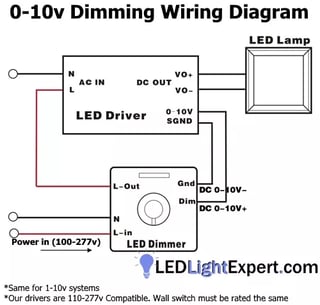
- LEDs — As the light bulbs were further developed, they paved the way for LEDs. LEDs, including the LED corn light bulb, use semiconductors to create light through electroluminescence. LED lighting quickly became popular once it reached the general lighting market. It is one of the most energy efficient options. LEDs are now widely used because they can reduce energy use, offer multiple color temperatures, and fit many common bulb and fixture formats. For dimming commercial LED fixtures, 0-10V dimming is the most common protocol for commercial applications, using a simple low-voltage signal to adjust brightness from 100% down to minimum output.
Understanding Bulb Bases — E26 and E39
What Do the E Numbers Mean?
The E numbers refer to the base of the bulb. Other numbers and letters in a bulb's name refer to the shape. For example, an A19 has an "A" (arbitrary/standard) shape that is 19 eighths of an inch in diameter.
What Is an E26 Base Bulb?
E26 stands for Edison style screw-in that is 26mm across. This is also known as a standard or household bulb base. It is one of the most typical light bulb sizes and has a diameter of 26mm or about 1 inch, making it the most common base found in residential lighting fixtures.
What Is an E39 Base Bulb?
E39 stands for Edison style screw-in that is 39mm across. Also known as a mogul or large Edison base. The E39 light bulb is the most common base in commercial HID-replacement fixtures, and many E39 LED corn bulbs are DLC listed. The E39 base is about 39 millimeters or 1.5 inches in diameter.

What Are the Different Bulb Shapes?
There are hundreds of light bulbs to choose from. They differ in shape, length, diameter, and purpose, but what separates each LED light bulb from the rest? All bulbs are defined by a code that includes both letters and numbers. In sequence, the "name" of a light bulb will start with a letter and then a number or numbers following. The letter indicates the shape of the bulb and the number relates to the diameter. The diameter is usually translated to eighths of an inch.
- A Series — Standard household globe shape. Arbitrary or standard bulbs are one of the most well known and used bulbs as far as the home goes. They are usually found in ceiling fans, lamps, vanities, closets, and other fixtures. A bulbs come in a few sizes — A15, A19, A21 and A25. These translate on the eighth scale with sizes of 1-7/8", 2-3/8", 2-5/8" and 3-1/8". The most common base for A bulbs is the E26/E27 medium screw.
- PAR Series — Floodlight and downlight. Parabolic Aluminized Reflector bulbs are used in recessed lighting, track lighting, and outdoor flood applications. Understanding light beam angles and NEMA classifications is important when selecting PAR bulbs for specific applications.
- PS Series — Large globe often used in HID high pressure sodium or metal halide applications.
- B Series — Blunt-tip candle bulbs with a bullet shape.
- C Series and CA Series — Candelabra style, usually with a smaller E12 candelabra or E17 intermediate base. The bulbs in the B and C groups resemble candle flame shapes and are therefore referred to as candle bulbs. Conical angular bulbs are cone-shaped with a bent tip and blunt-tip bulbs have a bullet structure. They are seen in wall sconces, pendant lights, and Christmas tree light strands. B10, CA10, C7, C9, and C15 make up this family of bulbs.
- Globe (G) Bulbs — More full and round in shape than A bulbs, available in various sizes. These bulbs are used in bigger light fixtures like chandeliers and ornamental fixtures. G bulbs come in G11, G14, G16/G50, G60, G25/G80, and G30 sizes. This LED light bulb shares a common base with the A bulb.
LED Light Bulb Families
Beyond the groups above, LED light bulbs come in a few more sizes and types. Bulged Reflector (BR), Parabolic Aluminized Reflector (PAR), Multifaceted Reflector (MR) and Tubular (T) bulbs are all a part of the LED light bulb family. Each serves a different purpose — from recessed can lights (BR) to landscape lighting (MR16) to linear strip replacements (T8). Understanding which type you need depends on your fixture and the footcandle requirements of your space.
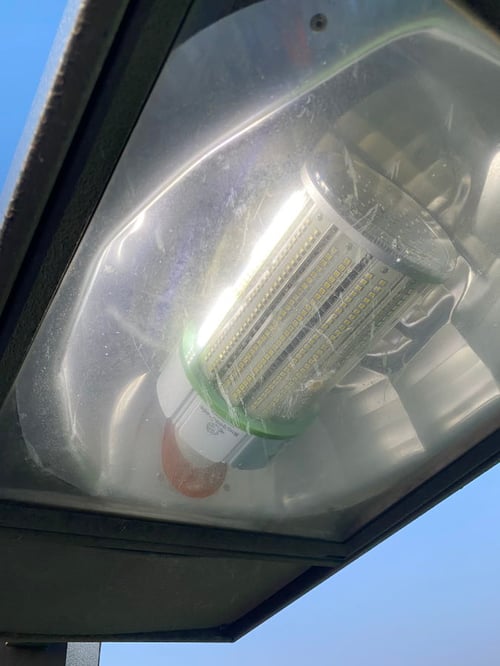
LED Corn Light Bulb
The most recognizable of the LED bulbs, LED corn light bulbs look like an ear of corn. With high lumen output in a small package, this is the go-to for LED replacements of metal halide or HID. They are used inside and outside of the home — your basement, path lights, motion sensors, gazebo lights, high bay fixtures, and parking lot lights. The list goes on.
No matter the size or shape, every bulb has a purpose. Today, the bulbs in most homes are likely LED, in a wide range of wattages and LED light bulb colors. A proper LED driver is essential for powering these bulbs efficiently.
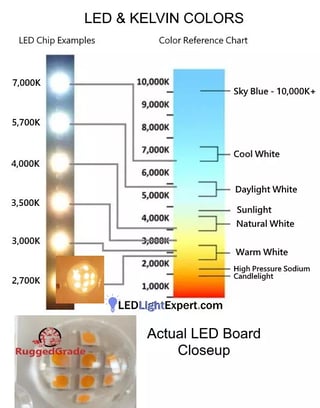
Different Light Colors Called Kelvins
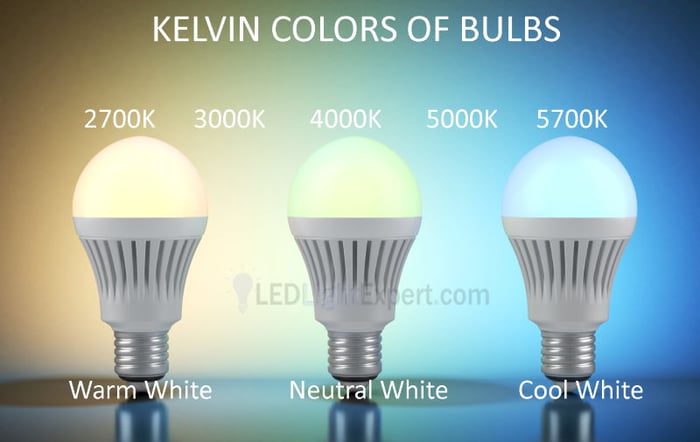
One of the most common questions is — what is the light color? Color temperature is measured in Kelvins (K) and describes how warm or cool the light appears. Here are the most common LED color temperatures:
- 2700K–3000K Warm White — A soft, yellowish glow similar to traditional incandescent bulbs. Common for residential spaces, restaurants, and hospitality.
- 4000K Natural White — A neutral tone that balances warm and cool. Popular for offices, retail, and task lighting.
- 5000K Pure White — A common commercial choice. A clean white that closely resembles daylight. Ideal for warehouses, garages, and commercial spaces.
- 5700K Cool White — A touch of blue. Used in security lighting, outdoor areas, and industrial applications.
Many modern LED fixtures now offer tunable or selectable color temperature, allowing you to switch between kelvin options without changing the bulb.
Bulb Bases and Connectors
There are many bulb bases which have been developed, but the most common series is the Edison Base, labeled with an "E" in front. The Edison screw-in base is universally recognized as the light bulb base. Here are the most common bulb bases:
E26 Base
The E26 base is a popular choice among the public. It is one of the most typical light bulb sizes. It has a medium or standard base. The E26 has a diameter of 26mm or about 1 inch, which makes it the common choice for many household and light commercial fixtures.
DLC provides one of the most important ratings in commercial lighting. It does not list E26 bulbs because they are used mostly in homes, and DLC focuses on commercial products. DLC Listed lights are popular with customers who know their value, and they are known for higher quality.
E39 Base
Another popular option is the E39 base. It is a larger screw base than the typical medium (E26) base. Both names refer to the width of the screw base in millimeters: the E39 is 39 millimeters, or about 1.5 inches, across, while the E26 is 26 millimeters, or just about an inch.
Due to their large size, the E39 base is also called a mogul or large mogul base. The E39 light bulb is the most common commercial lighting fixture base because it is widely used by commercial businesses. Many E39 LED bulbs are DLC listed, which makes them even more popular in the market.
EX39 Base
Another common base is the EX39, which has the same diameter as the E39; however the center terminal at the base of the socket protrudes a bit further. An EX39 bulb is often compatible with an E39 socket; however, an E39 bulb will not work in an EX39 socket. The socket should be swapped out to use an LED corn bulb. EX39 bulbs can be ordered, but it is usually cheaper and faster to swap the socket.
Pin Base
Many T8, MR16 and other bulbs use a 2-pin base connector instead of a screw-in Edison base. Pin bases are common in commercial fluorescent replacements and landscape lighting applications.
LED Corn Light Bulb Diagrams
Here is a size diagram of a common LED corn light bulb showing the E39 mogul base dimensions and overall bulb measurements:

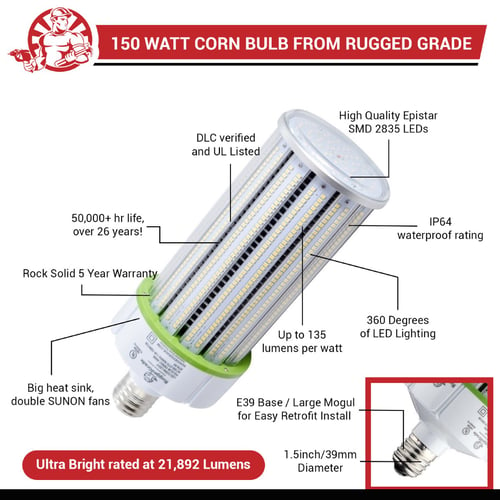
Here is the feature callout of an LED corn light bulb showing internal components and construction:
Frequently Asked Questions
The history of the light bulb dates back to 1802 when Humphry Davy created the first electric arc lamp. However, it was Thomas Edison in 1879 who invented the first commercially viable incandescent light bulb, using a high-resistance material with a higher vacuum than previous attempts. Edison's design became the standard for over 100 years, eventually giving way to halogen, fluorescent, and today's LED technology — the most energy-efficient option available.
The main types of light bulbs include incandescent (the original Edison bulb), halogen (developed in the 1950s), HIDs including metal halide and high pressure sodium (1960s), fluorescent (late 1930s) and compact fluorescent (1970s), and LEDs — the current standard for both residential and commercial lighting. LEDs offer the longest lifespan, greatest energy savings, and the most versatility in terms of color temperature and dimming options like 0-10V dimming.
The E numbers refer to the base type — "E" stands for Edison screw-in, and the number is the diameter in millimeters (E26 = 26mm, E39 = 39mm). The other letter-number codes describe the bulb shape and size — the letter indicates the shape (A for arbitrary/standard, PAR for parabolic reflector, B for blunt tip, etc.) and the number relates to the diameter in eighths of an inch. For example, an A19 bulb is an A-shape that is 19/8 inches (about 2-3/8") in diameter.
E26 stands for Edison style screw-in base that is 26mm (about 1 inch) across. This is also known as a standard or household bulb base and is the most common base size found in residential light bulbs and fixtures throughout North America.
E39 stands for Edison style screw-in base that is 39mm (about 1.5 inches) across. Also known as a mogul or large Edison base, the E39 base is the most common base for commercial and industrial LED fixtures. It is DLC certified and widely used in LED corn light bulbs, high bay lights, and parking lot fixtures.
LED light bulbs come in many shapes, each identified by a letter code: A series (standard household), PAR series (floodlight/downlight), PS series (large globe for HID), B series (blunt-tip candle), C and CA series (candelabra style), G series (globe), BR (bulged reflector), MR (multifaceted reflector), and T (tubular). The letter indicates the shape and the number relates to the diameter in eighths of an inch. LED corn light bulbs are also popular for their high lumen output in a compact form.
Related Articles
 LED Corn Light Bulb Buyer's Guide
Everything you need to know about LED corn light bulbs — wattages, bases, lumen output, and how to choose the right one for your application.
LED Corn Light Bulb Buyer's Guide
Everything you need to know about LED corn light bulbs — wattages, bases, lumen output, and how to choose the right one for your application.
 What Is an LED Driver?
Learn what an LED driver is, why it matters, and how to choose the right driver type for your LED lighting setup.
What Is an LED Driver?
Learn what an LED driver is, why it matters, and how to choose the right driver type for your LED lighting setup.
 Understanding LED Color Temperatures
A complete guide to Kelvin color temperatures — from warm white 2700K to cool white 5700K and everything in between.
Understanding LED Color Temperatures
A complete guide to Kelvin color temperatures — from warm white 2700K to cool white 5700K and everything in between.

About the Author


Need Help Choosing the Right LED Light Bulb?
Our lighting experts can help match the base, voltage, lumen output, and fixture rating to your application.
SHOP LED LIGHT BULBS


