400W Metal Halide LED Replacement Bulbs
USA Based Experts in less than 60 seconds Call Now: 800-674-9420
On orders over $49.00
Up to 7 Years Free Warranty On LED Lights


The 400-watt metal halide lamp was the standard workhorse for warehouses, parking lots, gymnasiums, and commercial interiors for decades. It produces roughly 36,000 initial lumens from a single E39 mogul-base lamp — bright enough for high-ceiling applications where light needs to travel 15 to 40 feet to reach the working plane. But the technology carries penalties that compound with every hour of operation: a 15 to 20 minute warm-up to full brightness, another 15 to 20 minute restrike delay after a power interruption, ballast losses that push actual wall draw to 458 watts, and lumen depreciation that erodes light output by 30 to 40 percent well before the lamp's rated 15,000 to 20,000 hour life ends.
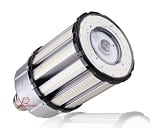
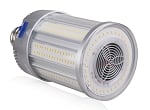
LED replacement bulbs address several of those problems. A 100 to 150 watt LED corn bulb delivers the same or better usable light output from the same E39 socket, reaches full brightness in under one second, and maintains at least 70 percent of its initial lumens out to 50,000 hours or more. The energy difference can be estimated from actual system draw, LED wattage, operating hours, and utility rate. For example, replacing a 458-watt metal halide system draw with a 120-watt LED saves 338 watts while the fixture is operating. Across 20 fixtures running 12 hours per day, that reduction can produce meaningful annual electricity savings before maintenance savings are added.
Raw lumen specs are misleading when comparing metal halide to LED. A 400W metal halide lamp is rated at 36,000 initial lumens, but that number represents bare-lamp output in a laboratory — not what reaches the floor. Metal halide is omnidirectional (light radiates 360 degrees), so a significant portion of that output hits the back of the reflector and is either absorbed or redirected with losses. After accounting for fixture efficiency (typically 60 to 70 percent), ballast losses, and lumen depreciation, the effective delivered lumens from a 400W metal halide fixture may be 18,000 to 22,000. A 120W LED corn bulb producing 16,000 to 19,000 directional lumens delivers equivalent or better light where it matters — on the working surface.


The replacement process starts with identifying your fixture type and wiring preference. Most 400W metal halide fixtures use an E39 mogul-base socket, so the LED replacement bulb must use the same base. From there, the primary decision is between ballast-bypass (Type B) and ballast-compatible (Type A) operation.
Ballast-bypass bulbs require an electrician to disconnect the existing magnetic or electronic ballast and wire line voltage (120-277V) directly to the lamp socket. This adds a one-time installation cost of $15 to $40 per fixture but eliminates the ballast as an ongoing maintenance liability and energy drain. Ballast-compatible bulbs drop into the existing socket with no rewiring, but they remain dependent on the ballast — when the ballast fails (and it will, typically at 50,000 to 75,000 hours), the LED bulb goes dark until the ballast is replaced. For facilities with 400W magnetic ballasts already nearing end of life, ballast-bypass is a practical choice.
Not every 400W metal halide replacement needs to be a 1:1 lumen match. If your space was over-lit or if the original lamps had significant depreciation, a lower-wattage LED may provide adequate light while maximizing energy savings. Our LED corn light bulbs range from 12 to 450 watts, giving you the flexibility to right-size the replacement for your actual light level requirements rather than simply matching the old lamp's nameplate rating.
An LED corn bulb in the 100 to 150 watt range replaces a 400W metal halide lamp. At 130 to 160 lumens per watt, a 120W LED corn bulb produces approximately 16,000 to 19,000 lumens — matching the usable light output of a 400W metal halide that produces roughly 36,000 initial lumens but loses 30 to 40 percent to omnidirectional waste, lumen depreciation, and fixture inefficiency. The exact LED wattage depends on your fixture type and required light levels.
Yes, if the LED bulb is designed as a retrofit. Most LED corn bulbs use an E39 mogul base that fits directly into the same socket as your 400W metal halide lamp. Some models are ballast-bypass (direct wire) and require removing or disconnecting the existing ballast, while others are ballast-compatible and work with specific magnetic or electronic ballasts. Ballast-bypass is generally preferred because it eliminates the ballast as a point of failure and avoids the energy waste of running a ballast that is no longer needed.
Estimate savings from the existing system draw, proposed LED wattage, fixture count, operating hours, utility rate, and whether the ballast is removed. A 400W metal halide system may draw about 458 watts with ballast losses. Replacing it with a 120W LED reduces roughly 338 watts per fixture during operation before controls or maintenance are considered.
It depends on the LED bulb type. Ballast-bypass (Type B) LED corn bulbs require removing or disconnecting the existing ballast and wiring line voltage directly to the socket. Ballast-compatible (Type A) bulbs work with certain existing ballasts without rewiring. We generally recommend ballast-bypass for 400W replacements because the ballast itself consumes 50 to 60 watts of energy and represents a potential failure point — when the ballast fails, the bulb goes dark regardless of the bulb's own lifespan.
LED corn bulbs rated for 400W metal halide replacement typically last 50,000 to 80,000 hours at L70, meaning they retain at least 70 percent of initial brightness at rated life. A 400W metal halide lamp lasts 15,000 to 20,000 hours and experiences significant lumen depreciation — losing 30 to 40 percent of its output well before end of life. At 12 hours per day of operation, an LED replacement lasts 11 to 18 years versus 3 to 5 years for metal halide, eliminating multiple re-lamping cycles and the associated labor costs.
Most 400W metal halide lamps produce light in the 3700K to 4200K range (neutral white). For a similar appearance, choose a 4000K LED replacement. For brighter, crisper light that improves visibility and color rendering in warehouses and industrial spaces, 5000K is the most popular choice. For outdoor and parking lot applications, 5000K or 5700K provides better contrast and perceived brightness. Some LED corn bulbs offer selectable color temperature (3000K/4000K/5000K) so you can dial in the right look after installation.
A 400W metal halide lamp can use far more power than the LED lamp that replaces it, especially after ballast losses are included. Our lighting specialists can help you identify the right LED replacement bulb for your fixture type, wiring configuration, and light level requirements — and calculate the estimated payback period for your facility. Call us at (800) 674-9420 or contact us online for a free consultation.
Call Now: (800) 674-9420


Dara Greaney is the CEO and President of LEDLightExpert.com, a leading company in commercial lighting solutions. Since 2015, he has led the company to achieve remarkable growth and recognition, including being an Inc5000 winner three times: No. 3783 in 2022, No. 2428 in 2021, and No. 531 in 2020.
Editing by David Peguero.
On orders over $49.00
Up to 7 Years Free Warranty On LED Lights