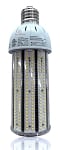
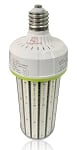
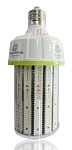
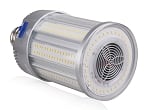
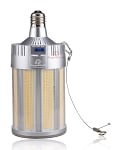
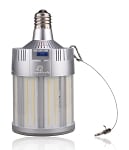
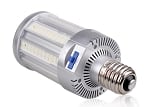
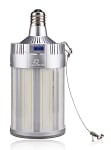
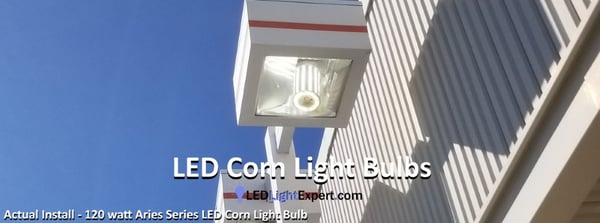
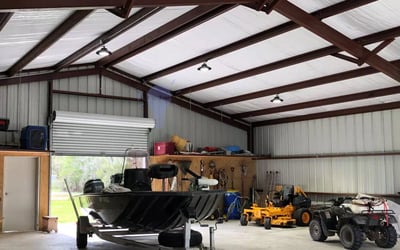
480v LED Corn Light Bulbs

USA Based Experts in less than 60 seconds Call Now: 800-674-9420
On orders over $49.00
Up to 7 Years Free Warranty On LED Lights

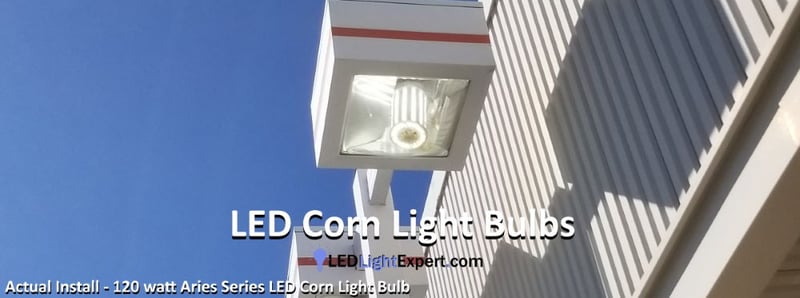
480V LED corn bulbs are retrofit lamps for facilities that use high-voltage electrical service, including warehouses, manufacturing plants, distribution centers, and large outdoor sites. They are often used to replace metal halide or HPS lamps in fixtures where a full fixture swap is not required.
Confirm the voltage range on the lamp label before ordering. Many standard LED corn bulbs stop at 277V and cannot be used on 347V or 480V circuits. High-voltage corn bulbs may support ranges such as 200-480V, but the exact listing matters.
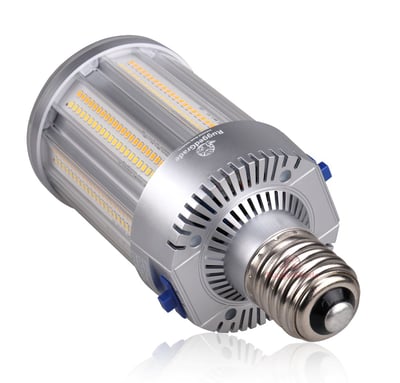
Most LED corn bulb retrofits require bypassing the ballast and wiring line voltage directly to the socket. Confirm base type, fixture dimensions, socket condition, enclosed-fixture rating, orientation, and heat dissipation. Corn bulbs need room for airflow, especially in high-output models.
Also compare lumens, color temperature, surge protection, and IP rating. In outdoor shoeboxes, wall packs, and post tops, verify that the existing fixture lens and reflector will distribute light properly after the retrofit.
Use a 480V corn bulb when the existing fixture housing is still sound, the socket can support the lamp, and the project benefits from keeping the current fixture body. A full fixture replacement may be better when the old housing has poor optics, water intrusion, heat damage, or a lens that blocks too much light.
Also check fixture orientation. Some corn bulbs can be mounted base-up, base-down, or horizontal, while others have limits. For enclosed shoeboxes, wall packs, or post tops, verify the enclosed-fixture rating and leave enough clearance around the heat sink so the driver and LEDs can run within their temperature limits.
A 480 VAC LED corn light bulb is built for facilities that use higher-voltage electrical service. Most standard corn bulbs stop at 277 VAC, so a 480V or 200-480 VAC rating matters in industrial and commercial buildings where 208V, 277V, 347V, or 480V service may be present. A multivolt LED driver usually auto-switches across the stated voltage range, but the installer still has to verify the supply, the socket, the fixture condition, and the wiring method before energizing the lamp.
VAC means volts of alternating current. In a 480V system, the rating commonly refers to the root-mean-square line-to-line AC voltage in a three-phase power system running at 60 Hz. Although 480V is often called high voltage in everyday facility work, it is still classified as low voltage in broader electrical standards because voltage classes extend much higher. For lighting buyers, the practical point is simpler: 480V service can deliver more power with less current than lower-voltage service, which is one reason it is common in factories, warehouses, and other heavy commercial sites.
Many 480V lighting systems are 480Y/277, also written as 480V three-phase, four-wire. In that configuration, phase-to-neutral is 277V, which is useful for many lighting loads, while line-to-line is 480V. Some facilities have delta configurations without a neutral. Do not assume the voltage from the building label alone. Measure and confirm the circuit with a qualified electrician, especially when replacing HID lamps in older fixtures.
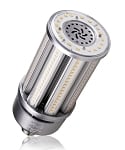
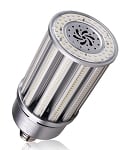
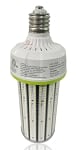
Corn lamps are named for the rows of LED chips mounted around the lamp body, similar to kernels on corn. They are often used to replace mercury vapor, metal halide, and high-pressure sodium HID bulbs. Many 480V corn lights are ballast-bypass lamps, meaning the old HID ballast is removed and line power is wired directly to the socket. That can reduce maintenance, but it also makes correct wiring, E39 or E26 socket type, fixture ventilation, and enclosed-fixture suitability essential.
Before replacing a HID lamp with a 480V LED corn bulb, confirm the actual power configuration. Voltage is electrical pressure, current is the flow of charge, and power is the work the circuit can deliver. AC voltage changes polarity in a repeating cycle, while DC voltage keeps one polarity. In North America, AC building power commonly operates at 60 Hz. A 480V corn lamp must match the voltage range, phase condition, socket, and fixture wiring.
Plug-and-play lamps keep a ballast in the circuit. Ballast-bypass lamps remove the ballast so line power feeds the lamp socket directly. For older metal halide, mercury vapor, and high-pressure sodium fixtures, many facilities choose ballast bypass to remove one known maintenance point. That choice still requires a qualified electrician, because neutral wire availability, 480Y/277 labeling, delta systems, E39 mogul sockets, and fixture ventilation all change the job.
A 480V LED corn bulb is a retrofit lamp with a driver rated for high-voltage electrical systems. It is used in commercial and industrial fixtures where the supply voltage is above the range supported by standard 120-277V lamps.
No, not unless the product label specifically includes 480V. Many LED corn bulbs are rated only for 120-277V. Using them on 480V can damage the driver and create electrical risk.
Most LED corn bulb retrofits require bypassing the existing ballast and wiring line voltage directly to the socket. Follow the product instructions and use a qualified electrician.
Only if the lamp is rated for enclosed fixtures and has enough space for heat dissipation. High-output corn bulbs can fail early if heat is trapped inside a small housing.
Use the products above as a starting point, then confirm voltage range, ballast bypass, socket type, fixture size, enclosure rating, and installation method before ordering.
Contact LED Light ExpertCall Now: (800) 674-9420
Dara Greaney is the CEO and President of LEDLightExpert.com, a leading company in commercial lighting solutions. Since 2015, he has led the company to achieve remarkable growth and recognition, including being an Inc5000 winner three times: No. 3783 in 2022, No. 2428 in 2021, and No. 531 in 2020.
Editing by David Peguero.
On orders over $49.00
Up to 7 Years Free Warranty On LED Lights