500 Watt Sports Lights

USA Based Experts in less than 60 seconds Call Now: 800-674-9420
On orders over $49.00
Up to 7 Years Free Warranty On LED Lights


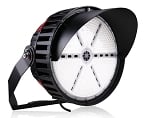
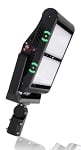
The 500-watt LED sports light is a common fixture size for outdoor athletic venues. At 140 to 160 lumens per watt, a single 500W fixture produces 70,000 to 80,000 lumens of directional light — enough to illuminate a significant portion of a playing field from pole-mounted heights of 60 feet or more. This wattage sits in the practical center of the sports lighting range: powerful enough for competitive play on full-size fields, yet efficient enough to keep operating costs manageable for municipal parks, schools, and community recreation departments.
Compared to the 1,000 to 1,500 watt metal halide fixtures they replace, 500W LEDs deliver the same or better on-field illumination at roughly one-third the energy draw. The math is straightforward — a facility running 20 metal halide fixtures at 1,500 watts each consumes 30 kilowatts per hour of operation. Replacing those with 20 LED fixtures at 500 watts drops consumption to 10 kilowatts, cutting the lighting portion of the electricity bill by 67 percent. At average commercial rates of $0.12 per kWh and 1,500 annual operating hours, that translates to approximately $3,600 in annual energy savings.
Sports lighting is not just about raw lumens — the distribution pattern determines whether the field receives uniform, glare-free coverage or uneven pools of light with dark gaps. 500W LED sports lights are available in multiple beam angle configurations, including narrow (15 to 30 degrees) for long-throw applications like outfield lighting at 70-plus foot mounting heights, medium (40 to 60 degrees) for mid-range coverage across the main playing surface, and wide (80 to 120 degrees) for sideline and spectator area illumination. Most field lighting designs use a combination of narrow and medium beam fixtures on the same pole to achieve the overlap pattern required by IES RP-6 standards.


The number of 500W fixtures required depends on the sport, the field dimensions, and the target illumination level. The Illuminating Engineering Society (IES) publishes recommended foot-candle levels by sport and competition class. Recreational baseball or softball fields require 30 foot-candles on the infield and 20 foot-candles in the outfield. Competitive play raises those minimums to 50 and 30 foot-candles respectively. Football and soccer fields follow similar tiers — 30 foot-candles for recreation, 50 for competition, and 75 or more for broadcast-level lighting.
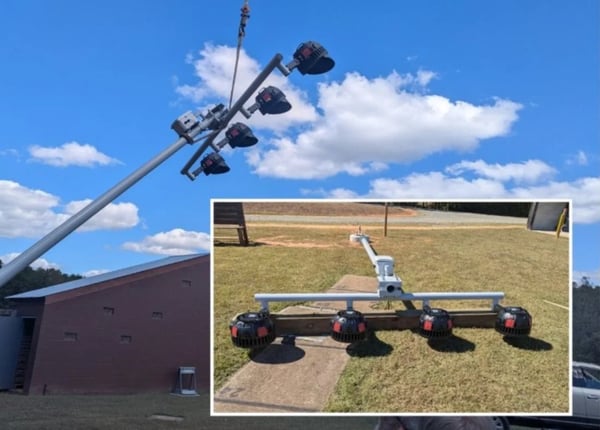
Pole selection is inseparable from fixture selection. A 500W LED on a 40-foot pole produces a different coverage pattern than the same fixture on a 70-foot pole. Higher poles reduce glare angles for players, increase the spread of each fixture's beam, and reduce the number of poles needed around the field perimeter. The tradeoff is cost — taller poles require deeper foundations, heavier gauge steel, and more complex installation logistics. For most 500W installations, 60 to 80 foot poles strike the right balance between performance, cost, and wind-load engineering. Consult our stadium light poles page for pole options engineered to support 500W-class fixtures.
Outdoor sports fixtures face constant exposure to electrical surges from lightning, grid switching, and motor loads on shared circuits. Quality 500W LED sports lights include built-in surge protection rated at 10kV or higher. For facilities in high-lightning areas — Florida, the Gulf Coast, the Southeast — external surge protection devices at the pole base and at the main disconnect provide additional defense layers. All 500W sports fixtures operate on 120-277V or 347-480V input, with most large field installations running on 480V three-phase service to minimize wire gauge requirements on long pole runs.
A regulation football field typically requires 16 to 24 fixtures rated at 500 watts each, mounted on 4 to 6 poles at heights of 60 to 80 feet. The exact count depends on the required illumination level — recreational play needs 30 foot-candles minimum, while competitive or broadcast-level play requires 50 to 75 foot-candles. A photometric study is the only way to determine the precise layout for your field dimensions, pole placement, and target light levels.
A 500W LED sports light replaces a 1,000 to 1,500 watt metal halide or high-pressure sodium fixture. At 140 to 160 lumens per watt, a 500W LED produces 70,000 to 80,000 lumens — matching or exceeding the usable light output of a 1,500W metal halide that produces roughly 150,000 initial lumens but loses 30 to 40 percent to fixture inefficiency, lumen depreciation, and omnidirectional light waste.
500W LED sports lights are typically mounted at 40 to 80 feet depending on the application. Baseball and softball fields often use 60 to 70 foot poles for outfield lighting, football and soccer fields use 60 to 80 foot poles, and tennis and basketball courts use 25 to 40 foot poles. Higher mounting heights reduce glare for players and spectators while providing more uniform light distribution across the playing surface.
No. LED sports lights reach full brightness instantly — within one second of power-on. Metal halide fixtures require 15 to 20 minutes to reach full output and another 15 to 20 minutes to restrike after a power interruption. This instant-on capability makes LED a practical choice for facilities that schedule back-to-back events or need reliable lighting during weather-related power cycling.
Quality 500W LED sports lights are rated for 80,000 to 100,000 hours at L70, meaning they retain at least 70 percent of their initial light output at rated life. At 1,500 hours per year, the rated L70 life may represent many years of operation, but actual replacement timing depends on heat, controls, environment, lumen needs, and fixture condition. Metal halide lamps, by comparison, require re-lamping every 6,000 to 15,000 hours — roughly every 4 to 10 years.
Yes, most 500W LED sports lights support 0-10V dimming, allowing output to be reduced to as low as 10 percent of full brightness. This is valuable for practice sessions that do not require full competition-level illumination, and for reducing energy consumption and light pollution during off-peak hours. Some models also support programmable scene control through DMX or DALI protocols for more granular lighting management.
For sports lighting, fixture selection should follow the layout, not the other way around. Our lighting team can help review pole placement, beam angles, target foot-candle levels, and glare limits before fixtures ship. Call us at (800) 674-9420 or contact us online to get started.
Call Now: (800) 674-9420


Dara Greaney is the CEO and President of LEDLightExpert.com, a leading company in commercial lighting solutions. Since 2015, he has led the company to achieve remarkable growth and recognition, including being an Inc5000 winner three times: No. 3783 in 2022, No. 2428 in 2021, and No. 531 in 2020.
Editing by David Peguero.
On orders over $49.00
Up to 7 Years Free Warranty On LED Lights