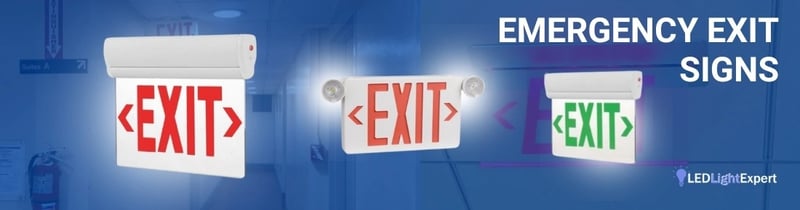
Emergency Exit Signs

USA Based Experts in less than 60 seconds Call Now: 800-674-9420
On orders over $49.00
Up to 7 Years Free Warranty On LED Lights

Emergency exit signs mark the route occupants should follow during an evacuation or power outage. Commercial, industrial, and public buildings typically need clearly visible exit signage with battery backup or connection to an emergency power system. Requirements vary by code, building type, and local authority.
Compare red versus green lettering, single-face versus double-face layout, wall or ceiling mounting, wet-location rating, voltage, battery type, and self-test features. Combination units add emergency heads where the sign location also needs egress illumination.
Exit signs should be installed where they remain visible from the path of travel. Test batteries and lamps on schedule, and replace failed units quickly because exit signage is a life-safety item.
Exit signs are simple until they fail inspection. Check whether the sign is visible from the required travel path, whether arrows are correct, whether the face is single- or double-sided, and whether the battery passes a runtime test. In damp or outdoor areas, use wet-location rated signs with suitable housings.
For renovations, keep sign style and lettering color consistent across the building unless the local authority approves a change. Mixed red and green signs or inconsistent arrow placement can confuse occupants and create avoidable review comments.
Look at the viewing distance, arrow direction, and whether the sign must be seen from one side or both sides of a corridor. In warehouses and large rooms, standard signs may need to be supplemented by additional signs because racks, doors, or equipment can block the line of sight. In public spaces, vandal-resistant or wet-location housings may be worth specifying up front.
Whether you’re working with a commercial high-rise or a residential complex, choosing listed LED emergency exit signs and maintaining them on schedule supports clearer egress marking during outages. Classic exit signs feature clearly marked letters that remain lit under normal conditions and during outages, guiding people to the nearest exit. Regulatory Compliance: Various safety codes—like OSHA and NFPA 101 (Life Safety Code)—require proper exit signage and emergency lighting.
Often installed in hallways or stairwells, these fixtures activate when the regular power supply fails, helping occupants identify the egress path during an outage.
Most commercial exit signs need backup power through an internal battery or an emergency power system so the sign remains visible during an outage. Requirements depend on local code and building type.
Both are used, but local code or the authority having jurisdiction may dictate the color. Match the building standard so occupants see consistent exit markings throughout the facility.
Exit signs should be placed where the path of egress changes direction, at exit doors, and where occupants need visual guidance. Mounting height and visibility distance should follow applicable code.
An exit sign marks the egress route. An emergency light illuminates the path during power loss. Combination units include both a sign and emergency light heads.
Use the products above as a starting point, then confirm exit sign lettering color, mounting style, voltage, battery backup, wet or damp rating, and local egress-code requirements before ordering.
Shop NowCall Now: (800) 674-9420
Dara Greaney is the CEO and President of LEDLightExpert.com, a leading company in commercial lighting solutions. Since 2015, he has led the company to achieve remarkable growth and recognition, including being an Inc5000 winner three times: No. 3783 in 2022, No. 2428 in 2021, and No. 531 in 2020.
Editing by David Peguero.
On orders over $49.00
Up to 7 Years Free Warranty On LED Lights