


Quick Answer
Commercial LED bollard lights are short, vertical outdoor fixtures designed to illuminate walkways, building entrances, parking areas, and pedestrian zones at commercial properties. They typically stand 30–42 inches tall, produce 1,500–4,500 lumens at 15–30 watts, and use full-cutoff or directional optics to control light distribution. Commercial-grade bollards are built with die-cast aluminum housings, carry wet-location or IP ratings for weather resistance, and often have long rated LED life. They can replace traditional 70–150W metal halide bollards with lower energy use when wattage and light levels are matched correctly.
Commercial LED Bollard Lights: A Buyer’s Guide
Commercial LED bollard lights are a common specification for low-level pedestrian lighting on commercial and institutional properties. Corporate campuses, retail centers, hospital complexes, and municipal parks use bollard lighting to help define pathways and improve low-level visibility without the visual intrusion of tall poles. The shift from HID to LED bollard technology can reduce operating costs, improve light quality, and expand design options when light levels and spacing are planned correctly.
This guide covers the specifications that matter when specifying commercial LED bollard lights: fixture style, optical distribution, lumen output, mounting method, spacing, IP rating, voltage, controls, and long-term maintenance. Use it to compare replacement projects, new construction, campus walkways, entrances, and pedestrian zones without relying on appearance alone.
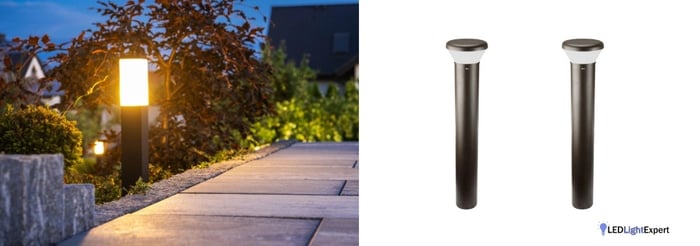
Commercial LED bollard lights installed along a property walkway — LED Light Expert
Table of Contents
- What Makes a Bollard Light “Commercial Grade”?
- Commercial Bollard Styles and Optical Types
- Key Specifications: Lumens, Wattage, and IP Ratings
- Spacing and Layout Guidelines
- Commercial Applications
- How to Specify the Right Bollard Light
- Energy Savings and Lifecycle Cost
- FAQs About Commercial LED Bollard Lights
What Makes a Bollard Light “Commercial Grade”?
The term “bollard light” covers everything from a $30 solar garden stake to a $600 specification-grade fixture. The difference between a residential bollard and a commercial LED bollard light comes down to construction, certifications, and performance under sustained use.
Commercial-grade bollards are built with die-cast aluminum housings and stainless steel hardware that resist corrosion in coastal, industrial, and high-humidity environments. The LED modules are driven by constant-current drivers rated for 120–277V universal input, which means they wire directly into commercial electrical systems without external transformers. The optics are engineered to meet IES distribution standards, and the fixtures carry UL listing for wet locations.
Most importantly, commercial LED bollard lights are commonly rated to L70 lumen-maintenance standards, but actual service life depends on heat, driver quality, operating hours, controls, and site conditions. A residential bollard might last a few seasons. A commercial bollard is engineered for long service life and fewer lamp-replacement visits than metal halide bollards.
Key Takeaway: Commercial-grade bollard lights are often distinguished by die-cast aluminum construction, UL wet-location listing, 120–277V universal drivers, tested optics, and L70 lumen-maintenance ratings. Treat these as common specification checks for commercial projects.
Commercial Bollard Styles and Optical Types
Commercial LED bollard lights are available in several housing forms, each designed for specific site conditions and architectural contexts. The housing shape determines mounting method, visual profile, and to some degree the optical distribution available.
Round Bollards
The most common commercial form factor. Round bollards use a cylindrical housing, typically 6–8 inches in diameter, with a domed, flat, or louvered top cap. They blend into most architectural contexts and are the default specification for campus walkways, hospital corridors, and public parks. Round bollards are available in 360°, 180°, and directional optical configurations.
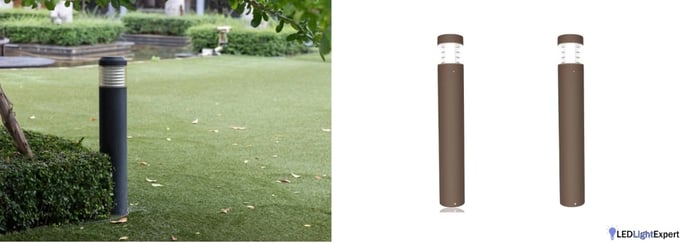
Round LED bollard light — the most versatile commercial form factor
Flat-Top and Louvered Bollards
Flat-top bollards use a horizontal cap with downward-facing louvers or slots that direct light strictly below the horizontal plane. This design can achieve full-cutoff performance when the listed optic and installation angle are correct. Louvered bollards are often specified for projects subject to dark-sky ordinances, DarkSky International (formerly the International Dark-Sky Association) compliance, or municipal lighting codes that restrict uplight. The louvers also reduce direct glare for pedestrians, making these ideal for walkways adjacent to residential areas.
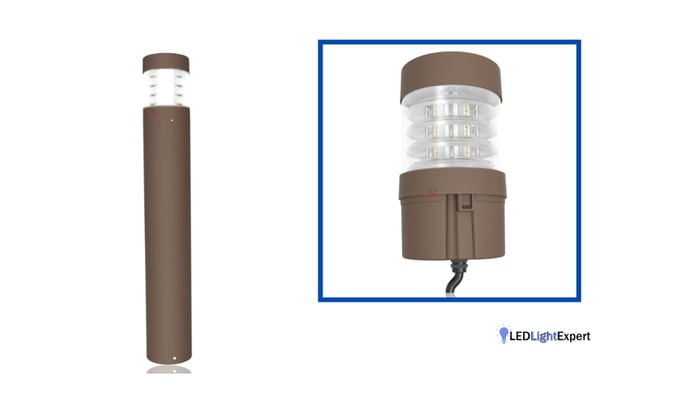
Flat-top louvered bollard — full-cutoff design for dark-sky compliance
Post-Top Style Bollards
Post-top bollards mount a luminaire head on top of a short bollard post, mimicking the appearance of a miniature post top light. These are common in retail centers, hospitality properties, and historic districts where the architectural character calls for a more traditional lighting aesthetic. Post-top bollards typically offer wider distribution than louvered models because the luminaire sits above the housing rather than inside it.

Post-top style LED bollard — traditional aesthetic for retail and hospitality
Optical Distribution Types
The optical distribution determines where the light goes. Commercial LED bollard lights are available in three primary patterns, and selecting the correct one is critical for achieving uniform coverage without wasted light or glare.
- 360° (Symmetric): Emits light in all directions around the bollard. Best for center-of-path installations, roundabouts, and open plazas where the bollard is surrounded by pedestrian space on all sides.
- 180° (Asymmetric / Half-Shield): Emits light on one side only. Used when the bollard is positioned against a wall, fence, or property edge, directing all output onto the walkway without spilling light onto adjacent landscape or buildings.
- Full Cutoff (Downlight): Directs all light below the horizontal plane with zero uplight. Required for dark-sky compliance and recommended for any site where glare control is a priority. Louvered bollards typically achieve full cutoff as part of their housing design.
Key Specifications: Lumens, Wattage, and IP Ratings
Bollard lights operate at lower wattages and lumen outputs than pole-mounted area lights because they illuminate at ground level over shorter throw distances. The specifications below represent the range you will find in commercial-grade LED bollard fixtures.
| Specification | Typical Commercial Range | Why It Matters |
|---|---|---|
| Wattage | 15–30W | Determines energy cost and driver sizing. Most commercial bollards fall in this range. |
| Lumen Output | 1,500–4,500 lm | Must match spacing and application. Over-specifying lumens creates glare at bollard height. |
| Efficacy | 100–160 lm/W | Higher efficacy = same light at lower wattage. Look for strong lumens per watt for better value. |
| Color Temperature | 3000K / 4000K / 5000K | 3000K for hospitality, 4000K for general commercial, 5000K for security. Tunable models offer all three. |
| CRI | 70–80+ | Higher CRI improves color accuracy for faces, signage, and landscaping. |
| IP Rating | IP65–IP67 | IP65 = dust-tight, water-jet resistant. IP66/67 for coastal, flood-prone, or wash-down environments. |
| Impact Rating | IK08–IK10 | IK08 resists 5-joule impact. IK10 resists 20 joules. Specify IK10 for public parks and high-traffic areas. |
| Operating Voltage | 120–277V AC | Universal input eliminates transformer requirements on commercial circuits. |
| L70 Rated Life | Long LED life rating | Actual years depend on dusk-to-dawn hours, heat, drivers, controls, and site conditions. |
| Height | 30–42 in (76–107 cm) | Taller bollards illuminate wider areas; shorter bollards provide more intimate, low-glare lighting. |
Key Takeaway: The most common mistake in bollard specification is over-lighting. A 24W LED bollard at 3,360 lumens produces more light at eye level than most people expect. Always verify the lumen output against your spacing plan and the IP rating against your site’s exposure conditions before ordering.
Spacing and Layout Guidelines
Proper spacing is the most critical factor in a bollard lighting layout. Too far apart creates dark patches between fixtures that defeat the purpose of the installation. Too close together wastes budget and creates excessive brightness that produces glare at pedestrian eye level.
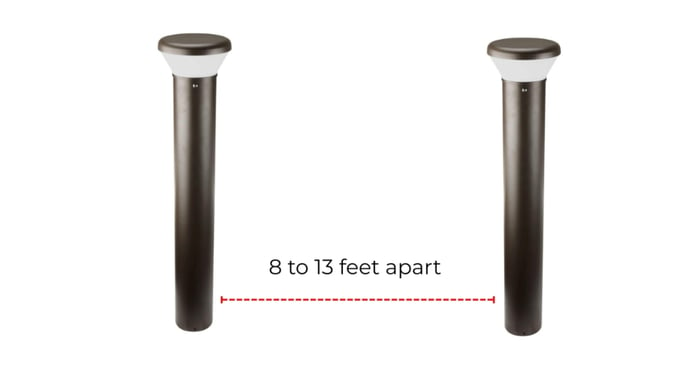
Bollard spacing depends on lumen output, optical distribution, and mounting height
General Spacing Rules
The IES recommends maintaining a minimum of 0.5 footcandles on walkways for pedestrian safety, with 1.0–2.0 footcandles for enhanced security areas. For commercial LED bollard lights in the 1,500–4,500 lumen range, these guidelines typically translate to the following spacing ranges.
| Application | Recommended Spacing | Target Footcandles | Notes |
|---|---|---|---|
| Walkways (standard) | 8–12 ft apart | 0.5–1.0 fc | Staggered placement on both sides for wider paths |
| Building entrances | 6–8 ft apart | 2.0–5.0 fc | Higher density at entry points for safety and wayfinding |
| Parking areas | 10–15 ft apart | 0.5–1.0 fc | Supplement with overhead pole lights for vehicle areas |
| Landscape accents | 12–20 ft apart | 0.2–0.5 fc | Lower light levels for ambiance, not task lighting |
| Security perimeters | 8–10 ft apart | 1.0–2.0 fc | Consistent coverage with no dark gaps between fixtures |
These ranges assume 360° distribution bollards at 36–42 inches mounting height. For 180° (asymmetric) bollards mounted on one side of a path, reduce spacing by approximately 25% because each fixture covers only one side of the bollard rather than a full circle.
The only reliable way to confirm spacing before installation is a photometric study using the actual .ies file for the specified bollard fixture. Spacing tables are starting points, not substitutes for a layout.
Commercial Applications
Commercial LED bollard lights appear in virtually every type of commercial, institutional, and municipal property. The common thread is pedestrian-scale lighting that provides safety and wayfinding without the visual weight of tall poles.
Corporate Campuses and Office Parks
Bollards line walkways between buildings, parking structures, and outdoor gathering areas. The specification priority here is visual consistency — matching color temperature and distribution across dozens or hundreds of fixtures to create a unified nighttime appearance. Tunable color temperature models (3000K/4000K/5000K) allow facility managers to adjust the look of the campus without replacing fixtures.
Retail Centers and Hospitality
Shopping centers, hotels, and restaurants use bollard lighting to create inviting pedestrian environments. Decorative post-top bollards and architectural round bollards are common here because aesthetics matter as much as illumination. Warm color temperatures (3000K) dominate hospitality applications. Landscape lighting often complements bollard fixtures in these settings to create layered lighting effects.
Healthcare and Education
Hospitals, clinics, and university campuses require consistent pathway illumination for patients, visitors, and students navigating between buildings at night. ADA compliance and egress lighting requirements often drive bollard placement in these environments. High CRI (80+) is important for healthcare settings where color accuracy affects patient comfort and staff visibility.
Municipal Parks and Public Spaces
Public parks, plazas, and transit stations rely on commercial LED bollard lights for pedestrian visibility in high-traffic areas. Impact resistance (IK08+) and vandal-resistant fasteners are critical specifications for public installations. Full-cutoff optics are often required by municipal code to limit light pollution in residential-adjacent parks.
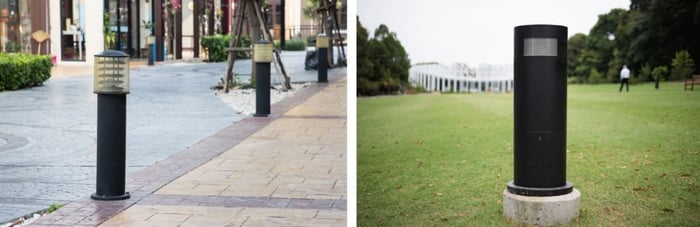
Commercial LED bollard lights in different styles for various application types
How to Specify the Right Commercial Bollard Light
Specifying commercial LED bollard lights correctly requires matching the fixture to the site conditions, code requirements, and performance expectations. Here is the decision sequence that experienced lighting designers follow.
1. Define the Application and Light Level Target
Start with the IES recommended illuminance for your application type: 0.5 fc minimum for basic walkways, 1.0–2.0 fc for enhanced security, 2.0–5.0 fc for building entrances. The target determines how much light each bollard needs to produce and how closely they must be spaced.
2. Choose the Optical Distribution
360° for center-of-path, 180° for edge-of-path, full cutoff for dark-sky areas. This decision is driven by site geometry and code requirements. If you are adjacent to residential properties or subject to a dark-sky ordinance, full cutoff is not optional — it is mandatory.
3. Verify Environmental Ratings
Match the IP rating to the installation environment. IP65 covers most commercial sites. Coastal, industrial, or flood-prone locations should specify IP66 or IP67. Specify IK10 impact resistance for any public-access installation where vandalism or accidental impact is a realistic concern.
4. Match the Electrical System
Confirm the bollard accepts your site’s line voltage (120V, 208V, 240V, or 277V). Universal 120–277V drivers handle all standard commercial voltages. If the project requires dimming or integration with a lighting control system, verify that the driver supports 0–10V dimming protocol.
5. Select Color Temperature
3000K for hospitality, residential-adjacent, and warm-aesthetic applications. 4000K for many general commercial sites. 5000K may be used where camera clarity is prioritized, though glare and local code should be checked. Tunable models (3000K/4000K/5000K selectable) are useful when the final aesthetic direction has not been confirmed at the time of ordering.
6. Run a Photometric Layout
Download the .ies file from the manufacturer and run a photometric layout in AGi32 or DIALux to verify that your spacing plan meets the target footcandle levels with acceptable uniformity. This step catches problems before fixtures ship — and before trenching begins. Our team provides free photometric studies for qualifying bollard lighting projects.
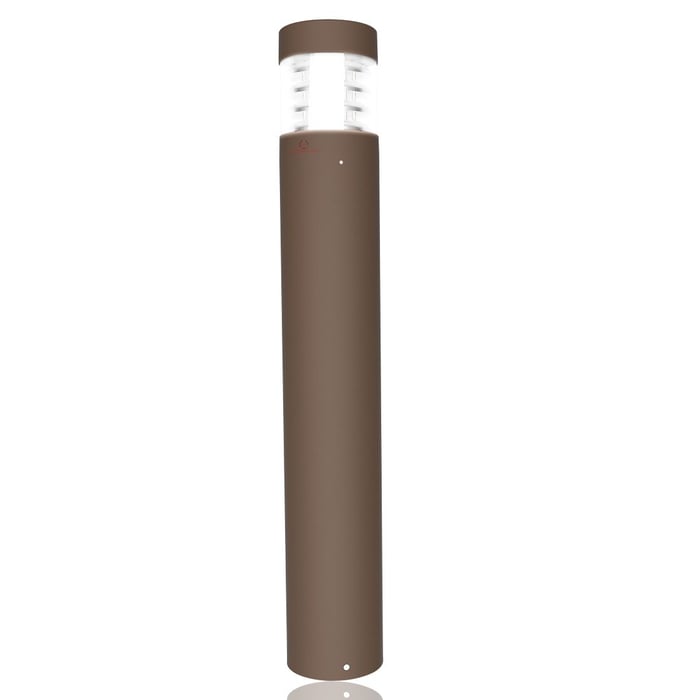
24W LED louvered flat-top bollard — commercial-grade with tunable color temperature
Energy Savings and Lifecycle Cost
The economic case for commercial LED bollard lights is straightforward. A typical 70W metal halide bollard consumes approximately 88W including ballast losses and produces around 3,500 initial lumens that degrade to roughly 2,400 lumens by mid-life. A 24W LED bollard can produce 3,360 lumens and maintain useful output over a long rated life when operated within its rated conditions.
| Metric | 70W Metal Halide Bollard | 24W LED Bollard | Advantage |
|---|---|---|---|
| System Wattage | 88W (incl. ballast) | 24W | 73% reduction |
| Annual Energy (4,380 hrs) | 385 kWh | 105 kWh | 280 kWh saved/fixture/yr |
| Annual Cost (@$0.12/kWh) | $46.24 | $12.61 | $33.63 saved/fixture/yr |
| Lamp Life | 10,000–15,000 hrs | Long rated LED life | Fewer lamp-replacement visits |
| Mid-Life Lumens | ~2,400 lm (degraded) | ~2,350 lm (L70 at end) | About equal to MH at mid-life, even at end of rated LED life |
| Maintenance Visits | Every 2–3 years | Lower routine maintenance | Reduces lamp and ballast replacement labor |
For a 50-bollard installation, the LED upgrade saves approximately $1,680 per year in energy alone. Add avoided lamp and ballast replacement costs (typically $80–$120 per fixture per relamping event, every 2–3 years for MH), and total annual savings depend on fixture count, utility rates, run hours, labor, and relamping cost. Most commercial LED bollard retrofits achieve payback in 2–4 years, and many utility companies offer rebates that accelerate that timeline further.
Key Takeaway: A 50-bollard LED retrofit saves approximately $1,680/year in energy and $1,500–$2,500/year in avoided maintenance, with typical payback in 2–4 years. Utility rebates can cut that payback period significantly — verify DLC listing before purchasing to qualify.
FAQs About Commercial LED Bollard Lights
For standard walkway illumination, space commercial LED bollard lights 8–12 feet apart. Building entrances and security areas may require 6–8 foot spacing for higher light levels. These ranges assume 360° distribution at 36–42 inches mounting height. The only way to confirm spacing with precision is a photometric study using the fixture’s .ies file — our team provides these free for any qualifying bollard lighting project.
IP65 is the minimum for any outdoor commercial bollard installation. It means the fixture is completely sealed against dust and protected against water jets from any direction. For coastal properties, car wash areas, flood-prone sites, or locations with frequent pressure washing, specify IP66 or IP67. The IP rating is stamped on the fixture spec sheet — verify it before specifying.
Yes. Most commercial LED bollard lights are designed as direct replacements for HID bollards and use the same in-ground mounting base or anchor bolt pattern. The LED fixture is typically lighter than the MH fixture it replaces, so existing foundations may be adequate when dimensions and condition check out. The key is verifying the base dimensions and anchor bolt spacing match, and confirming the existing wiring supports the LED driver’s input voltage range (120–277V universal drivers accept all standard commercial voltages).
4000K (neutral white) is the most widely specified color temperature for general commercial use. It provides strong visual acuity without the harsh blue cast of 5000K. For hospitality and residential-adjacent sites, 3000K creates a warmer, more welcoming atmosphere. For security applications, 5000K improves camera footage clarity. Tunable bollards that offer 3000K/4000K/5000K selection at the fixture let you decide on-site during installation — useful when the final direction hasn’t been confirmed at time of order.
Most utility rebate programs require DLC (DesignLights Consortium) listing to qualify for energy efficiency incentives. DLC-listed LED bollards have been independently tested and verified for efficacy, lumen maintenance, and color quality. Rebates vary by utility, product, and project type. Always check the DLC Qualified Products List and confirm eligibility with your local utility before purchasing.
Related Guides

About the Author


Need Help Choosing Commercial Bollard Lights?
Our lighting experts provide photometric studies for qualifying projects and can help you compare commercial LED bollard lights for your walkways, campus, or commercial property.
SHOP BOLLARD LIGHTS


