


Quick Answer: This tennis court example used eight NextGen Series LED fixtures per court to improve playing visibility and coverage. Review the fixture count, mounting pattern, photos, and results before planning a similar LED tennis court retrofit.
Tennis Center LED Light Installation - Actual Installation Example
We often get questions about sports light installs: what does it actually look and feel like? So during a recent project, we asked the installers to stop halfway to do some analysis. We brought the drone out for some clear aerial shots of day and night. We compared our LED lights to the existing metal halides so viewers could judge the difference in brightness, color, glare, and coverage from the photos and footage.
LED Tennis Court Lights - Actual Installation, Fc & Drone Footage - LED Sports light vs Metal Halide
8-light tennis court video above. 6-light court video below.
Tennis Court Lighting - 6 Light Setup - Replaced with 500 Watt NextGen Series LEDs - Aerial Drone Shot
Watch our case study video for actual footage of our NextGen Series lights in action.
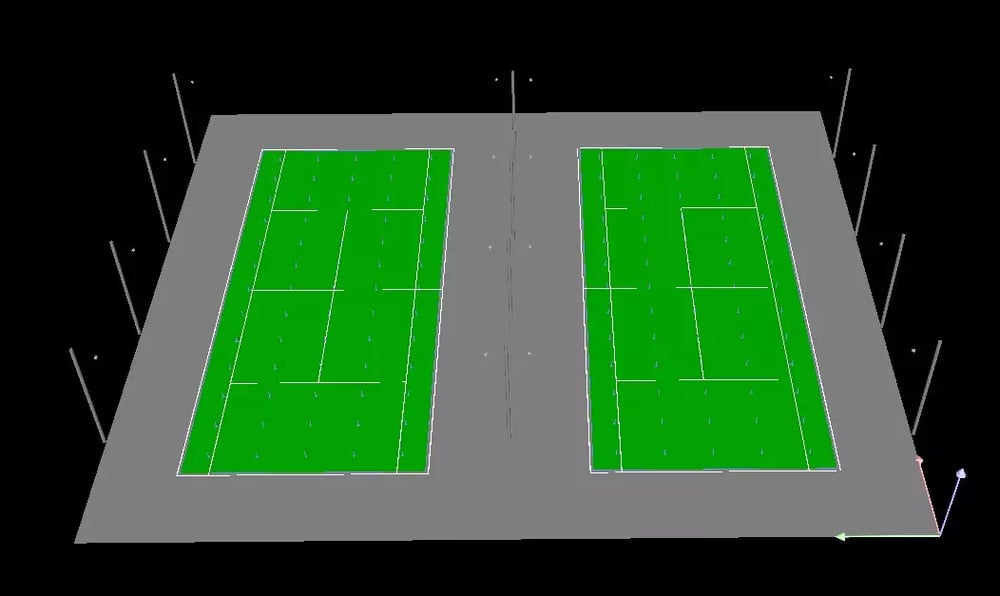
First, we did a computer photometric study to plan the fixture count, aiming, and expected light levels. Here is the actual computer photometric study we did for this customer:
Photometric Computer Light Study for Tennis Courts
You can see that we estimated about 44 fc with 0.7 uniformity. The actual install came in at about 50 fc with better than 0.7 uniformity. (Photometric studies are estimates, and this project came in above the modeled result.) Keep in mind that this is the horizontal footcandle on the ground. We do not use "floors" or vertical footcandles to report our numbers (although vertical uniformity is important, and we are big on that). Class I, II, or III lighting is defined by the USTA or the ITF based on footcandles and uniformity. The courts in the video would qualify as Class I because they do average 50fc and exceed .7 uniformity. Our 300 watt versions would get about 30 average with 50 max but still maintain that .7 uniformity and thus meet about Class II standards.
LED vs Metal Halide Side-by-Side Comparison
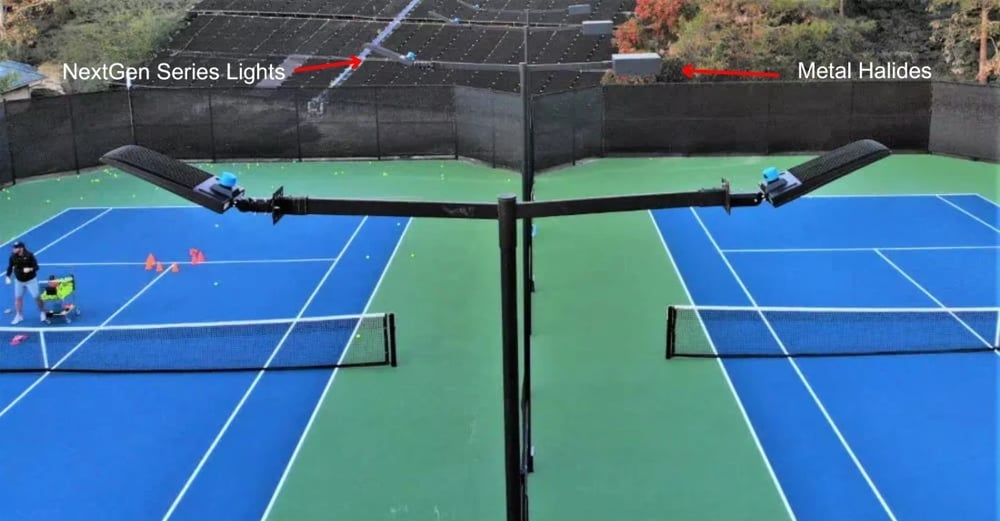
On the left is the court with the new 500 watt LED Tennis Court lights and on the right is the old metal halides. You can see we have one LED light up on the right court for testing and to use in this demonstration. These particular metal halide lights are most likely LSI Courtsiders and use a proprietary bracket. We used our part number 78-136 to adapt the existing poles to make them slip fit compatible. Slip fit is the industry standard so converting over to those makes the most sense.
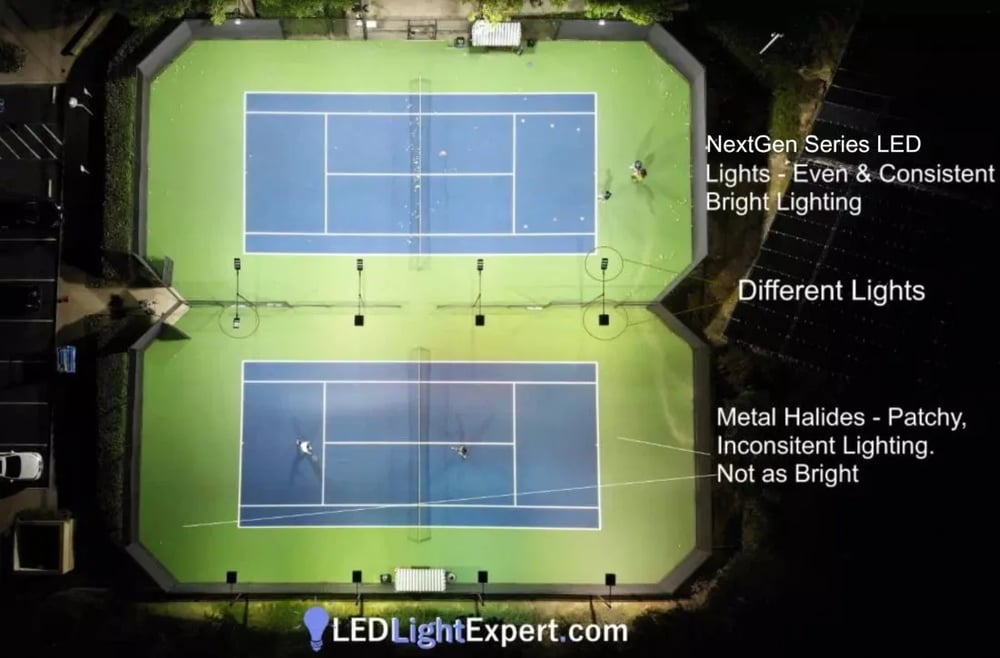
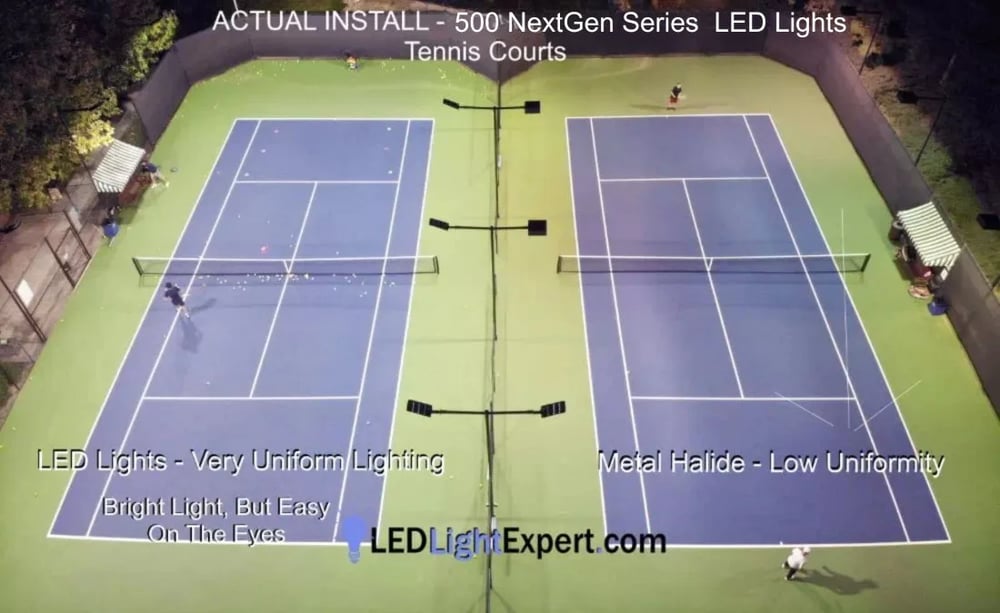
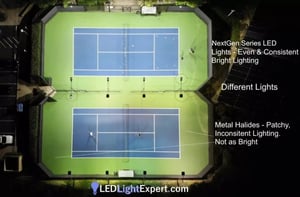
Aerial Drone Shot at Night
This is the drone aerial shot at night with all the lights on. Clearly the top court is noticeably brighter and much more even.
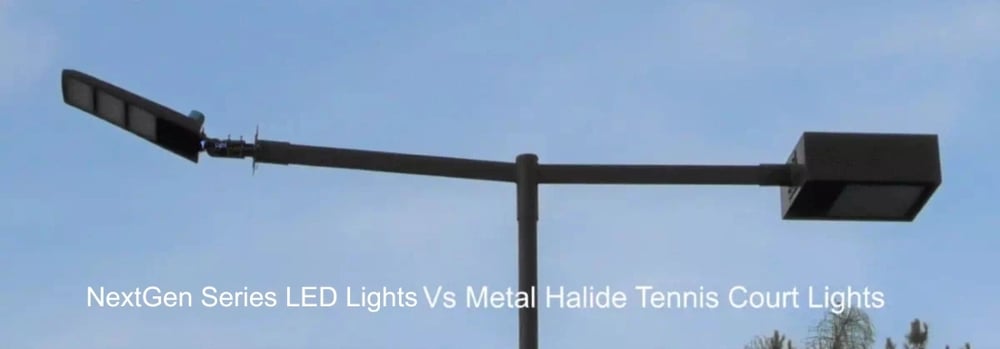
LED Luminaire vs Metal Halide Close-Up
Closer view of the LED luminaire installed with the 78-136 bracket vs an old metal halide box.
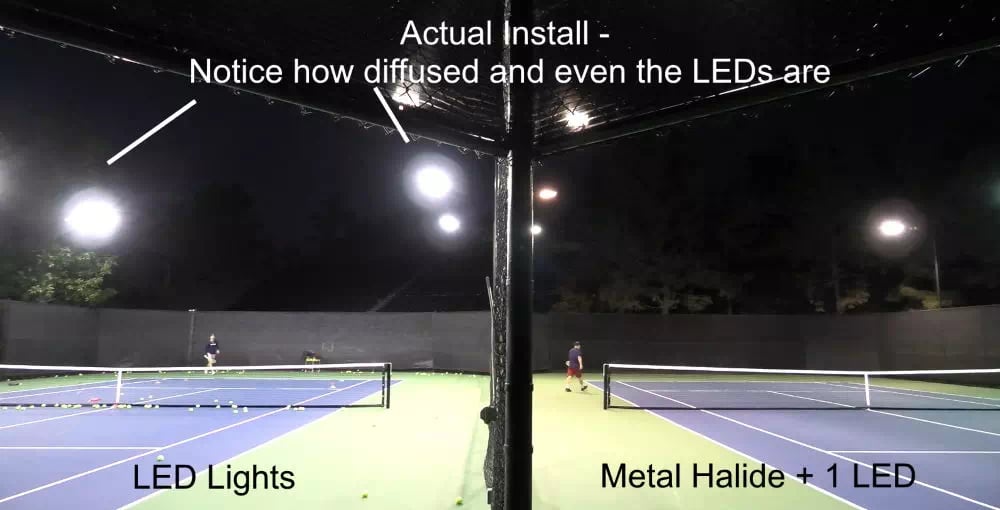
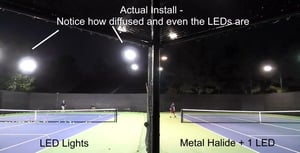
Side-by-Side Light Quality
Here is the side by side. The first light on the right is the test LED, but even still you can see that the left appears brighter. It is hard to see in the camera image, but the glare-control lens on the LEDs made the light easier on the eyes in this installation. The direct view of the arc tube in the metal halides makes them very harsh. Some LED companies attempt to use the same reflector technology, but it causes the same issues. The light needs to be diffused to properly soften it.
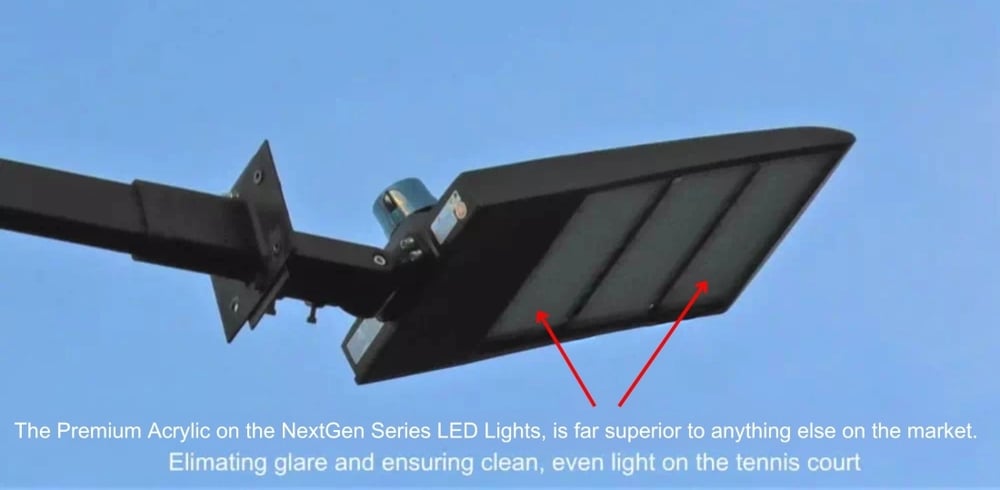
Premium Glare Lens Technology
The lights we used have a premium glare lens that dramatically improves the quality of the light. Soft and even distribution. Nothing else even comes close to the performance of these lenses.
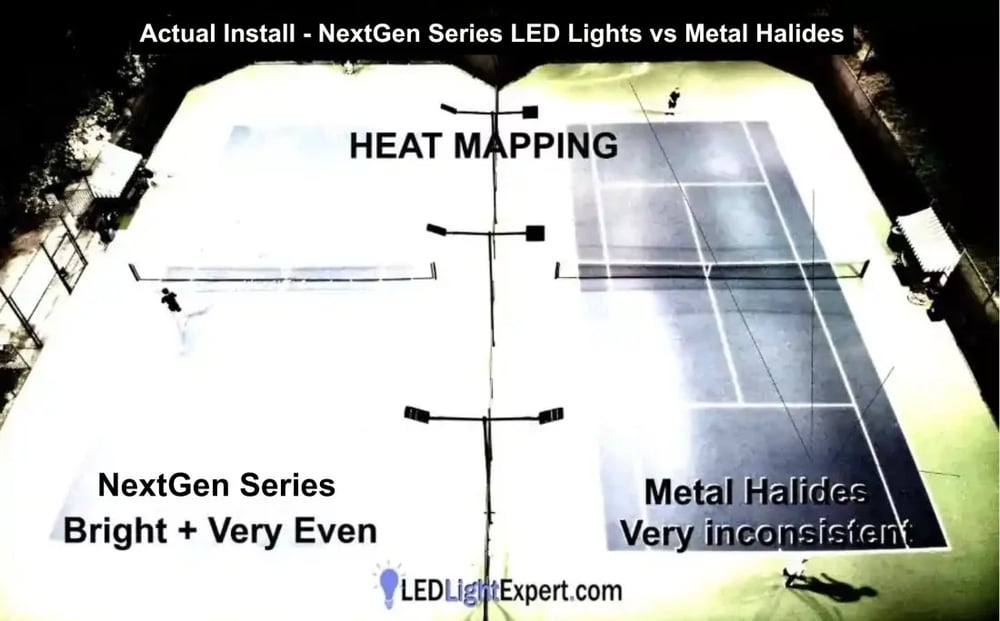
Brightness and Uniformity
The below picture shows brightness but more importantly it shows the uniformity of the lights.
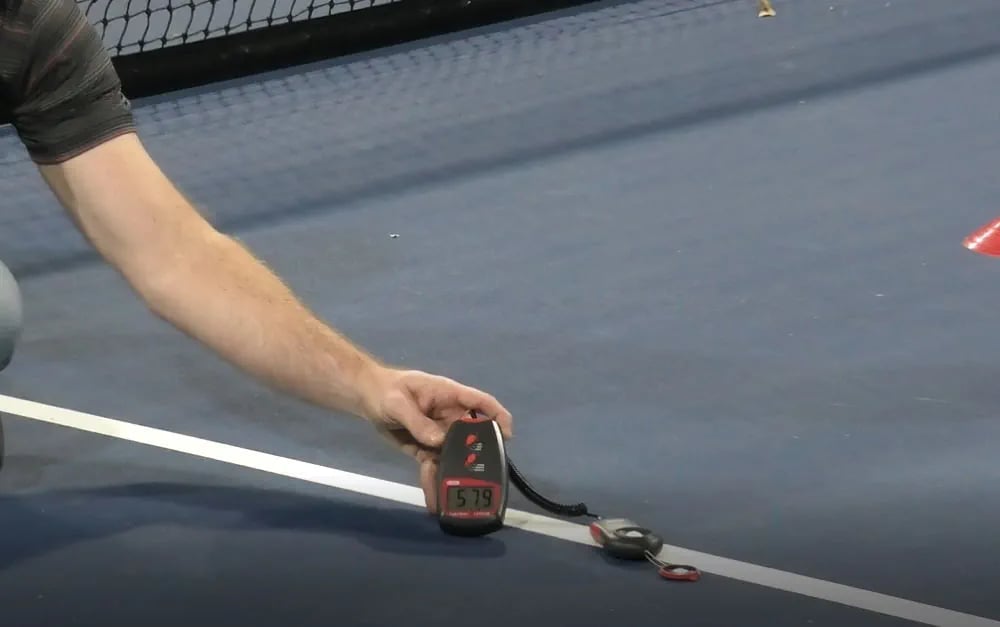
This image shows 58 fc on the court.
Photometric Analysis
From our computer photometric analysis, done before the install, we were able to calculate footcandle readings and optimize light head angles.
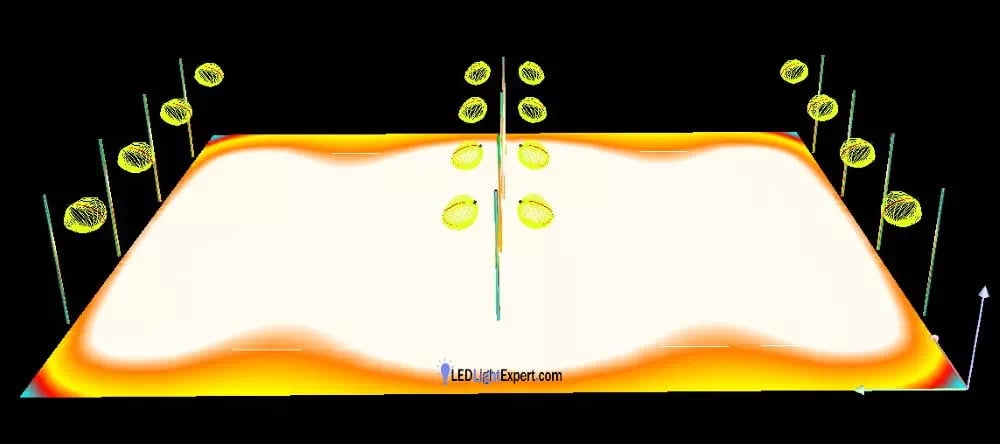
The study allows us to set each light and the correct angle for it.
Frequently Asked Questions About Tennis Court LED Lighting
In this installation case study, 8 lights per court were used with 450-500 watt NextGen Series LEDs, achieving 50fc average with above .7 uniformity (Class I standards per USTA/ITF). A 6 light setup is also possible with 500 watt NextGen Series LEDs for adequate coverage.
The photometric computer study estimated about 44fc with .7 uniformity. The actual install achieved about 50fc with above .7 uniformity, qualifying as Class I lighting per USTA/ITF standards. The 300 watt versions achieve about 30 average with 50 max while maintaining .7 uniformity, meeting approximately Class II standards.
Yes. In this case, the existing LSI Courtsider metal halide lights used a proprietary bracket. LED Light Expert used part number 78-136 to adapt the existing poles to slip fit compatible mounting, which is the industry standard. Converting to slip fit makes the most sense for long-term flexibility.
The premium glare lens can improve light quality by softening the beam and distributing light more evenly. Unlike metal halide reflectors where the direct view of the arc tube creates harsh glare, the LED glare lens diffuses the light to properly soften it, making the direct view of the fixture more comfortable for players than many older metal halide reflectors.
Related Articles


Need a Photometric Study for Your Tennis Court Lighting Project?
Our lighting experts provide computer photometric studies to plan LED tennis court lighting around court size, pole locations, glare, and target footcandles. Contact our team to review the project details.
CONTACT US


