1500 Watt Metal Halide LED Replacement

USA Based Experts in less than 60 seconds Call Now: 800-674-9420
On orders over $49.00
Up to 7 Years Free Warranty On LED Lights


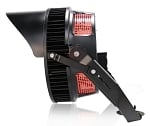
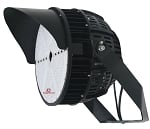
Replacing 1500 watt metal halide sports lights starts with the field, pole height, target light level, beam angle, and existing infrastructure. Many 1500 watt metal halide sports lights are being replaced with LED fixtures because LEDs can reduce wattage, improve beam control, and eliminate warm-up delays. A 500-watt LED sports light is a common starting comparison for a 1500-watt metal halide fixture, but the final replacement should be confirmed by delivered lumens, beam angle, pole height, and photometric layout.
The layout and beam angle carry much of the performance risk. Most baseball fields use a combination of wide and narrow beam angles to balance coverage and intensity. For instance, infield areas might require 50+ foot-candles, and outfield lighting can range from 20 to 30 foot-candles. The number of light fixtures required varies based on the level of play:
In addition to output, it's vital to consider mounting solutions. Stadium poles should be rated for wind, elevation, and site-specific conditions. LED fixtures for baseball field lighting can be mounted on existing poles or part of a turnkey system with new poles, wiring, and controls. Use LED sports lighting packages as a starting point, then verify fixture count, beam angle, and aiming with a field-specific layout.
Photometric planning is the right next step for most permanent field projects. It allows for precise placement and simulation of lighting levels, showing whether the field meets the target light levels, uniformity, and glare-control needs before fixtures are ordered.
Baseball stadium lights must deliver high lumen output while maintaining a precise light pattern to avoid spill light or glare. As a general rule:
High-CRI and flicker-aware LED fixtures can be important for professional games, especially those broadcasted in HD. Unlike metal halide lamps, LEDs offer instant-on capability, no warm-up time, and flicker-aware driver options, which can matter for slow-motion replays and televised coverage.


Whether retrofitting an existing field or designing a new stadium, LED baseball field lights offer practical advantages over outdated systems:
1500 watt metal halide systems require lamp and ballast replacement, often with bucket trucks or other elevated work access. With replacements increasing at major league sporting fields, municipal fields, high schools and colleges at such a rapid pace, prices have gotten more affordable, so many owners are comparing LED sports lighting as replacement costs and fixture performance improve. Ball parks, municipal fields, private sporting arenas and schools can see large energy reductions depending on the old system, LED wattage, ballast load, controls, and operating hours after replacing 1500 watt metal halide lights with LED sports lights.
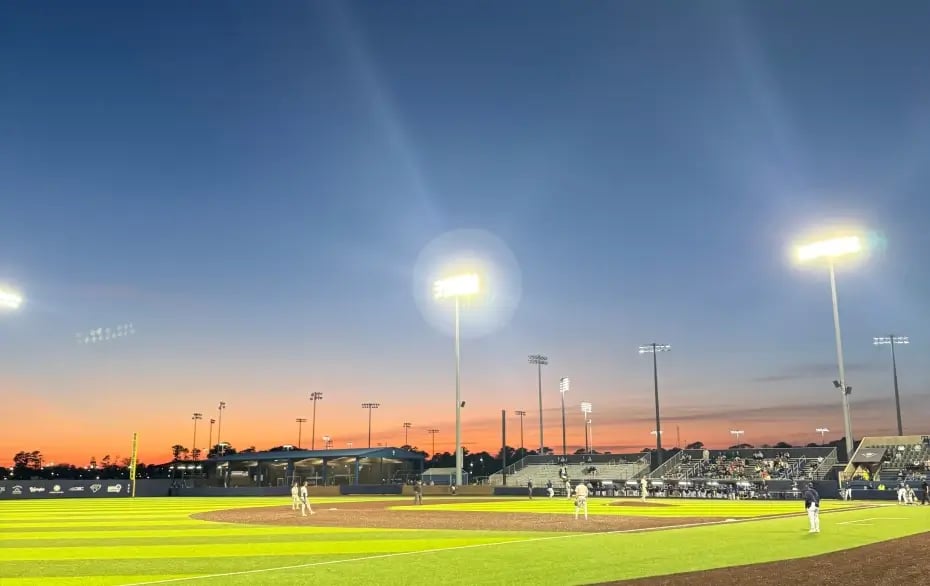
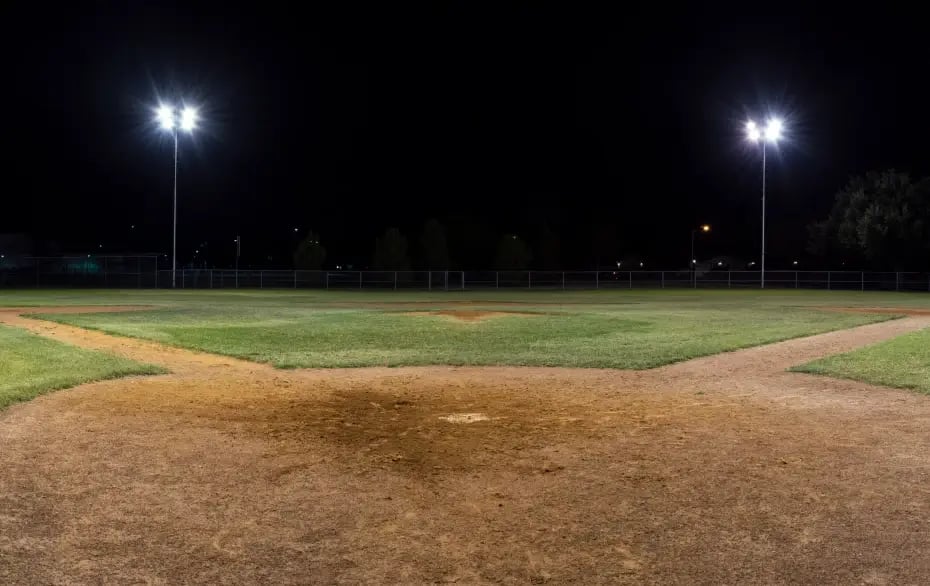
Historically, metal halide lights were used due to their high output, but modern fields are switching to LED baseball stadium lights, which offer greater efficiency, durability, and control.
It depends on the level of play, field dimensions, pole height, beam angle, and target foot-candles. Small recreational fields may use far fewer fixtures than high school, college, or professional venues, so the count should be confirmed with a layout rather than a fixed rule.
Yes. High-lumen 450W to 600W LED fixtures can often replace 1500W metal halide sports lights, reducing energy use when the beam angle and photometric layout still meet the field target.
LED lights turn on instantly, can reduce wattage, avoid lamp-and-ballast maintenance, and can be specified with driver options suited to high-definition broadcast needs.
A foot-candle (fc) is a unit of light intensity. Little League fields usually require 20–30 fc in the outfield and 30–50 fc in the infield, while Major League stadiums can exceed 200 fc across the entire field.
For lighting America’s favorite pastime, we deliver sports-lighting options for baseball fields, stadiums, and other high-output replacement projects. For projects replacing outdated metal halide lights or designing a new layout from scratch, our LED sports lighting systems are selected around target light levels, pole height, beam angle, controls, and operating cost.
LED Light Expert can help compare lighting packages, poles, photometric planning, and support options for projects from local parks to major stadiums.
Contact us today for expert guidance, field-specific lighting layouts, or help selecting the right baseball lights for your next project.
Contact UsA 1500 watt metal halide sports lighter does not draw 1500 watts. The lamp draws 1500, and the ballast adds another 50 to 100 watts on top, so the real connected load per fixture is closer to 1,550 to 1,600 watts. It also needs roughly 20 minutes to warm up to full output, and it cannot be restruck immediately after being switched off.
The LED replacement for a 1500 watt metal halide is a 450 to 500 watt fixture. That is not a typo and it is not marketing: wattage measures power consumed, not light produced, and LED produces roughly three times the light per watt that metal halide does. Making that swap saves about 75% of the energy cost on that fixture, which works out to 1,000 to 1,050 watts saved per pole head.
For lumen reference when comparing fixtures, use 50,000 lumens at the low end, 60,000 in the middle, and 80,000 at the high end. Mounting height and aiming angle both affect how much of that reaches the playing surface, so lumens alone will not tell you whether a fixture is right for your poles.
There is a second argument for replacement that gets overlooked. Metal halide loses up to 70% of its light output over the life of the lamp. A ten-year-old metal halide field is not producing anything close to its design lux, which is why fields that "seemed fine" often turn out to be badly underlit the moment someone puts a meter on them.
Beam angle should follow mounting height. Narrow 12 degree optics are used for genuinely high installs where the fixture has to throw a long way. A 500 watt LED sports light works well with a 30 degree beam at higher mounting heights, with wider beams used as the poles get shorter. Retrofit lamps for area-light applications run from that narrow 12 degree all the way out to near-omnidirectional distribution for covering large areas from a lower height.
On retrofit kits versus new fixtures, the useful dividing line sits around 750 watts. Below it, retrofit kits can make economic sense. Above 750 watt metal halide or HPS, retrofit kits are generally not cost effective. Some 480 watt retrofit models can be ordered, but for a 1500 watt sports lighter you are almost always better served by a new stadium light or LED area light. A 1000 watt metal halide can be retrofitted with LED and still show cost savings, or at minimum allow existing fixtures to be reused where access is difficult.
Two options worth specifying on any sports retrofit: 0-10V dimming, which lets a field run at reduced output for training and full output for match play, and 10 kilovolt surge protection. Pole-mounted sports fixtures sit high and exposed, and voltage transients from lightning and utility switching are a leading cause of premature driver failure.
Finally, check the rebates before ordering. Replacing metal halide sports lighting with efficient LED frequently qualifies for a utility rebate, and on a project with a dozen or more pole heads that rebate can materially change the payback period.
Pricing on a metal halide to LED conversion depends on whether you are reusing the poles and the crossarms or replacing the whole assembly. Reusing sound poles keeps the project to fixtures, mounts, and labour. Replacing poles brings foundations and electrical work into the budget and changes the order of magnitude.
What comes with every order:
For an accurate quote, send the number of fixtures, the existing lamp wattage, the mounting height, and a photo of the pole top if you have one. The pole top photo answers the mount question faster than any description, and the mount is where these projects most often hit a surprise.
Request PricingCall Now: (800) 674-9420


Dara Greaney is the CEO and President of LEDLightExpert.com, a leading company in commercial lighting solutions. Since 2015, he has led the company to achieve remarkable growth and recognition, including being an Inc5000 winner three times: No. 3783 in 2022, No. 2428 in 2021, and No. 531 in 2020.
Editing by David Peguero.
On orders over $49.00
Up to 7 Years Free Warranty On LED Lights