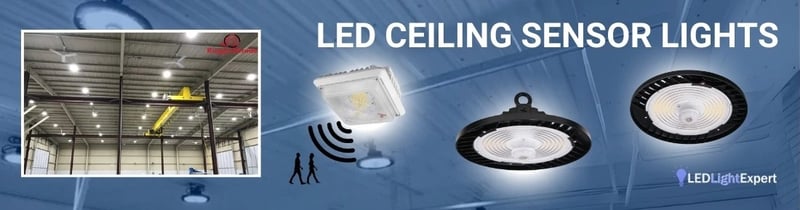
LED Ceiling Motion Sensor Lights

USA Based Experts in less than 60 seconds Call Now: 800-674-9420
On orders over $49.00
Up to 7 Years Free Warranty On LED Lights

Ceiling motion sensor lights combine overhead illumination with automatic control. They are useful in corridors, storage rooms, restrooms, stairwells, utility areas, garages, and other spaces where lights are often left on. The best fixture depends on ceiling height, detection pattern, timeout settings, dimming behavior, and room use.
PIR sensors detect changes in body heat and work well with clear line of sight. Microwave sensors can detect motion through some materials and may cover larger areas, but they need careful adjustment to avoid false triggers. Dual-technology sensors combine methods for more reliable detection.
Some fixtures switch fully off after vacancy. Others dim to a standby level, then return to full brightness when motion is detected. For safety areas such as stairwells and corridors, dim-to-standby is often preferred over full shutoff.
The most common mistakes are using the wrong sensor lens for the ceiling height, placing the fixture where shelves or partitions block detection, and setting timeouts so short that lights cycle while people are still present. Storage rooms and restrooms may need different settings than corridors or stairwells.
For energy savings without complaints, tune the standby level, timeout, and daylight threshold after installation. In spaces with safety concerns, keep a low background level instead of switching fully off.
After installation, walk the room and test the fixture from the actual entry points. Adjust sensitivity, timeout, and daylight settings before the space is turned over to users.
Motion sensor ceiling lighting is often associated with outdoor security, but the same control idea helps indoors in garages, hallways, closets, utility rooms, storage areas, restrooms, and light commercial spaces. The fixture should improve visibility and convenience without wasting energy when the room is empty. In a business setting, that can lower electricity use. In a home or small facility, it can also reduce trips to a wall switch when someone is carrying tools, groceries, boxes, or cleaning supplies.
The original guide called out three sensor families: passive infrared, microwave occupancy, and photoelectric light sensors. Passive infrared sensors detect changes in infrared energy from warm objects moving through the field of view. A Fresnel lens or mirror segment focuses that energy onto the sensing element, and the relay activates the light when motion is detected. PIR sensors are common because they are efficient and predictable, but they need line of sight and can miss small motion behind obstacles.
Microwave occupancy sensors emit microwave signals and read reflected changes, often using the Doppler effect to detect motion. They can be more sensitive than PIR and may detect motion through some materials, which is useful in certain ceiling applications but can also create false triggers if the sensor sees beyond the target area. Photoelectric sensors read ambient light. They can keep the light off when daylight is already sufficient or work with other controls so the fixture responds only when the room is both occupied and dark enough to need light.
Many LED motion sensor ceiling lights include adjustable brightness, selectable Kelvin, hold time, sensing distance, and remote-control programming. A practical setup usually starts with a comfortable light level, then sets hold time long enough that users are not left in the dark during normal activity. For garages and utility rooms, test the fixture from the entry door, vehicle path, and work area. For hallways and restrooms, verify that the sensor does not trigger from adjacent rooms unless that behavior is intended.
Useful sensor ceiling lighting saves energy by turning on automatically when movement is detected and turning down or off after the room is empty. It can also improve usability by lighting stairs, garages, storage rooms, and utility areas before someone reaches a switch. For security-sensitive areas, the sensor can bring attention to unexpected movement inside a property. For convenience, users do not have to handle a switch when entering with full hands.
Adjustable brightness, selectable color temperature, and remote programming make the fixture easier to tune after installation. Set the sensor so normal activity keeps the light on, then test the turn-off delay. Set the Kelvin color for the room rather than the fixture label. Warm white can be comfortable in residential areas, while cooler white may work better in task rooms. If the sensor triggers too easily, reduce sensitivity or narrow the field of view.
They work well in corridors, stairwells, storage rooms, restrooms, utility spaces, garages, and other areas with intermittent occupancy. Sensor coverage and timeout settings should match the room.
PIR sensors detect changes in body heat and need a clear line of sight. Microwave sensors detect motion through reflected signals and may cover larger areas, but they can trigger through some materials if not adjusted carefully.
Some models support dim-to-standby operation. That is useful in stairwells, corridors, and safety areas where a low background light level should remain on.
Each sensor has a rated mounting height and coverage pattern. High ceilings may need a high-bay sensor lens or a different fixture type to detect motion reliably.
Motion sensor ceiling lights can reduce wasted runtime in spaces with intermittent occupancy. Use the products above as a starting point, then confirm the product warranty, mounting, voltage, and controls before ordering.
Contact LED Light ExpertCall Now: (800) 674-9420
Dara Greaney is the CEO and President of LEDLightExpert.com, a leading company in commercial lighting solutions. Since 2015, he has led the company to achieve remarkable growth and recognition, including being an Inc5000 winner three times: No. 3783 in 2022, No. 2428 in 2021, and No. 531 in 2020.
Editing by David Peguero.
On orders over $49.00
Up to 7 Years Free Warranty On LED Lights