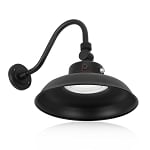
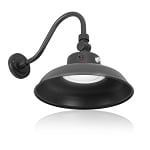
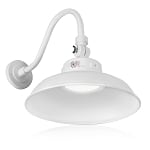
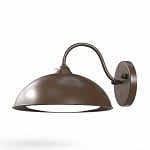
LED Gooseneck Lights

USA Based Experts in less than 60 seconds Call Now: 800-674-9420
On orders over $49.00
Up to 7 Years Free Warranty On LED Lights

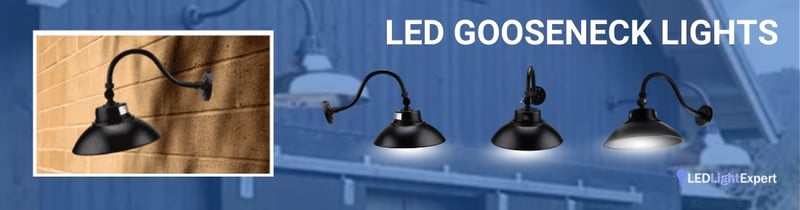
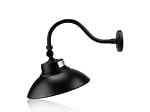
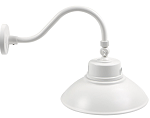
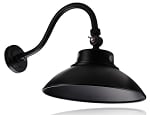
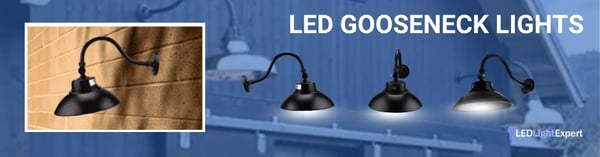
Gooseneck lighting is built around a simple idea: move the light source away from the wall, then aim it down at the sign, doorway, or work surface. The curved arm creates the familiar barn light profile, but the LED source makes the fixture more efficient and easier to maintain than older incandescent, CFL, or HID versions.
The category is most useful when you want visible, architectural lighting rather than a hidden flood light. Storefront signs, restaurant entrances, banks, supermarkets, barns, garages, porches, outdoor walkways, and commercial facades all use gooseneck fixtures. The light can highlight a vertical surface without washing the entire area in glare.
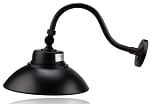
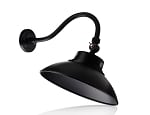
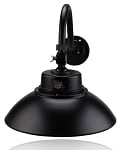
A gooseneck light has three core parts: the wall or ceiling mount, the curved arm, and the shade. Short arms keep the shade tight to the wall for small doors and compact signs. Longer arms, often in the 18 to 48 inch range, push the shade out so the beam can reach a taller sign face, a deeper awning, or a broader display area. Shade size also matters. Smaller shades keep the fixture visually light, while larger shades spread more light and reduce the hot spot directly under the lamp.
Check the mounting surface before choosing the fixture. A junction box, masonry wall, metal building, wood fascia, or sign raceway may need a different back plate, extension arm, or hardware package. Outdoor projects should use wet-rated construction, corrosion-resistant finish, sealed wiring, and a shade shape that keeps the beam pointed down where it is useful.
Most gooseneck projects are decided by distance and contrast. Small entry lights may only need low wattage and a warm 3000K look. Larger commercial signs can need higher output, a wider shade, or multiple fixtures spaced evenly across the sign face. A practical gooseneck range may run from lower-output decorative fixtures to higher-output sign lights, with many options falling between roughly 2,000 and 10,000 lumens. The correct fixture depends on sign height, viewing distance, mounting height, wattage, optics, and how much surrounding ambient light is already present.
Color temperature changes the mood and readability. 3000K keeps restaurants, barns, and hospitality spaces warm. 4000K gives a neutral white look for retail and office exteriors. 5000K can make sign lettering and security areas appear brighter, but it may feel too stark for decorative architecture. Photocells are common when the light should run from dusk to dawn without a timer, and shielded downward optics help reduce spill light for dark-sky-sensitive locations.
Use LED gooseneck lights when the fixture is part of the design, not just a source of light. They are a good fit for storefront signs, menu boards, building numbers, barn doors, garage entries, porches, pedestrian paths, and exterior walls that need a focused pool of light. For large parking lots, sports areas, or broad security coverage, a wall pack, flood light, or parking lot light is usually the better tool.
Plan the fixture around the arm, shade, mounting base, and target surface. The curved arm moves the shade away from the wall so light can wash down across signs, banners, porches, barns, restaurant entrances, supermarket fronts, banks, grocery stores, garages, and walkways. For homes, the same fixture style can work on front porches, back entries, garages, and covered outdoor areas when the light is aimed down and kept out of nearby windows.
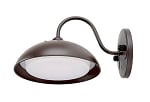
The classic S-shaped wall mount with a downward-facing shade is still the recognizable gooseneck form. Modern LED versions keep that architectural profile while adding lower energy use, longer service life, photocell options, and better control over color temperature and output. For outdoor use, look for wet-location construction, sealed wiring, and IP65-class protection when the fixture will see rain, dust, and temperature swings.
Finish choice is not only decorative. Black and brown remain common because they work on many storefronts and barns. Other finishes such as white, dark green, real copper, rust, matte black, red, galvanized steel, navy blue, and yellow can be used when the fixture is part of the architecture. Older guidance listed shade sizes around 7 to 12 inches, arm lengths around 18 to 48 inches, and reflector angles such as 45 and 90 degrees. Those details affect how far the light projects and how concentrated the beam looks on the sign face.
Gooseneck wattages have historically ranged from about 25 to 150 watts, with lumen output from roughly 2,000 to 10,000 lumens. Kelvin should follow the use: 2500K to 3000K gives a soft white and warm appearance, 3500K to 4100K gives a brighter white, and 5000K to 6500K moves toward a daylight look. Photocells are helpful for dusk-to-dawn operation because the light can turn on and off automatically without a manual switch, and dimming controls can reduce energy use when full output is not needed.
Use this checklist to compare different gooseneck fixtures before the order is placed. Confirm the attachment style, bulb or LED engine, curved arm, mounting base, shaft length, shade diameter, and shade category. Also check bend angle reflector, housing color, input voltage, lumen output, color temperature, photocell, dimming control, and outdoor rating. The classic wall-mounted gooseneck uses a downward shade, but the same family can include barn shades, bullet shades, warehouse shades, sign-light shades, and table or floor versions for indoor reading work.
For legacy compatibility, note whether the project is replacing a standard E26 medium-base lamp, a compact fluorescent GU24 lamp, a metal halide lamp, a high-pressure sodium lamp, or another high-intensity discharge source. For LED versions, review LED package, driver, heat management, and lumen-to-watt performance. Older buying notes referenced 2835 and 3030 LEDs, 135 lumens per watt, 50 to 300 volt input ranges, 60,000 hour life, and operating temperatures from -20 to 50 degrees. Treat those as comparison points and verify the product sheet for the current fixture.
Finish and beam choices affect both appearance and use. Common finishes include black, brown, white, dark green, real copper, rust, matte black, red, galvanized steel, navy blue, and yellow. Typical arm lengths may run from 18 to 48 inches, and shade diameters may run from 7 to 12 inches. Kelvin ranges can include 2500K to 3000K soft white, 3500K to 4100K bright white, and 5000K to 6500K daylight. Luminous flux may range from roughly 2,000 to 10,000 lumens. A photocell can act as a day-and-night duration sensor, turning the light on at dusk and off at dawn while reducing unnecessary energy consumption. Different customer locations also call for different color choices, kelvins, finishing details, and convenience features.
LED gooseneck lights are wall- or ceiling-mounted fixtures with a curved arm and a downward-facing shade. They are used to light signs, storefronts, barns, doors, walkways, and architectural details while keeping the fixture visible as part of the design.
Common uses include storefront signs, restaurant entrances, barns, garages, porches, banks, supermarkets, menu boards, and commercial building facades. They work best when the goal is directed accent or sign lighting rather than broad area lighting.
Choose arm length based on how far the shade must sit from the wall. Short arms work for compact doors and small signs. Longer arms, often 18 to 48 inches, help the beam reach larger signs, deep awnings, and taller wall surfaces.
They can be when the shade directs light downward and the fixture is aimed carefully. For dark-sky-sensitive areas, choose shielded optics, avoid over-lighting, use warmer Kelvin when appropriate, and keep light on the sign or walkway instead of into the sky or neighboring properties.
Match the arm, shade, output, finish, and controls to the sign or wall before ordering. Our lighting team can help compare fixtures for storefront, barn, restaurant, and exterior wall projects.

Contact LED Light ExpertCall Now: (800) 674-9420
Dara Greaney is the CEO and President of LEDLightExpert.com, a leading company in commercial lighting solutions. Since 2015, he has led the company to achieve remarkable growth and recognition, including being an Inc5000 winner three times: No. 3783 in 2022, No. 2428 in 2021, and No. 531 in 2020.
Editing by David Peguero.
On orders over $49.00
Up to 7 Years Free Warranty On LED Lights