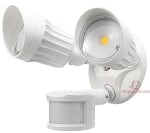
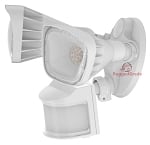
Motion Sensor Security Light

USA Based Experts in less than 60 seconds Call Now: 800-674-9420
On orders over $49.00
Up to 7 Years Free Warranty On LED Lights

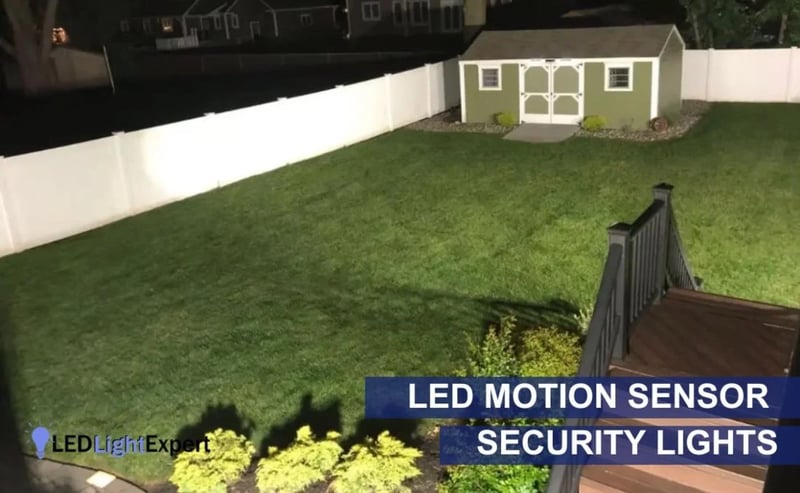
Motion sensor security lights activate automatically when movement is detected within their coverage zone. They provide instant illumination that improves nighttime visibility, lights pathways for safe navigation, and helps reduce unlit areas around building perimeters. Unlike traditional security lights that burn continuously throughout the night, motion-activated fixtures operate only when triggered. That can reduce wasted runtime compared with always-on alternatives and may extend LED service life through fewer operating hours. For commercial properties, parking areas, loading docks, and residential exteriors, motion sensor lights combine security effectiveness with practical energy management.
The most widely used motion detection technology in security lighting is the passive infrared (PIR) sensor. PIR sensors detect changes in infrared radiation — the heat energy emitted by people, animals, and vehicles — within their field of view. The sensor element is divided into multiple detection zones; when a heat signature moves across zone boundaries, the sensor registers motion and triggers the light. PIR sensors are passive devices that emit no energy of their own, making them energy-efficient and reliable for continuous outdoor monitoring.
Microwave sensors provide an alternative detection method by emitting low-power microwave pulses and measuring the frequency shift (Doppler effect) caused by moving objects. These sensors detect motion through lightweight materials like glass and thin walls, making them effective in covered or semi-enclosed areas where PIR sensors may have limited line-of-sight. Dual-technology sensors combine both PIR and microwave detection, requiring both sensors to confirm motion before activating the light — helping reduce false triggers from wind-blown debris, small animals, or temperature fluctuations.
Motion sensor security lights typically offer detection ranges from 30 to 70 feet, with some commercial-grade models reaching 100 feet or more. Detection angles range from 120 degrees (focused coverage for narrow areas like walkways) to 270 degrees or wider (broad coverage for corners and open areas). Most quality fixtures include three key adjustable settings: sensitivity (how much motion triggers activation), duration (how long the light stays on after the last detected motion, typically 10 seconds to 10 minutes), and lux level (the ambient light threshold below which the sensor becomes active, preventing daytime triggering).
For commercial applications, fixture placement strategy is as important as the individual sensor specifications. Overlapping detection zones between adjacent fixtures reduce blind spots. Mounting height affects both range and sensitivity; higher mounting extends range but may reduce sensitivity to smaller movements close to the ground. A site-specific lighting plan that accounts for building layout, entry points, landscaping, and traffic patterns helps identify coverage gaps before installation.
Brightness requirements vary significantly by application. A residential porch or side entry may need 800 to 1,500 lumens, while a commercial loading dock, parking area, or building perimeter may require 3,000 to 10,000+ lumens for adequate coverage and visibility needs. Match the fixture's lumen output to the area size and the distance at which you need clear visibility — higher lumen output is especially important for wide-area commercial security where camera systems also depend on ambient light levels for image quality.
Weather resistance is essential for any outdoor motion sensor fixture. Look for IP65 or higher ingress protection ratings, which indicate the fixture is sealed against dust and water jets from any direction. For coastal or high-humidity environments, marine-grade finishes and stainless steel hardware provide additional corrosion resistance. Operating temperature range matters in extreme climates — confirm the fixture and sensor are rated for the lowest winter temperatures at your installation site, as PIR sensor sensitivity can decrease in very cold conditions.
Hardwired motion sensor fixtures connect to the building's electrical system and provide the most reliable, consistent performance — no batteries to replace and no dependence on solar charging. They are the standard choice for commercial security applications and permanent residential installations. Solar-powered motion sensor lights offer installation flexibility for locations without existing electrical service, including fence lines, remote outbuildings, and garden paths. Their performance depends on adequate sun exposure for charging. Battery-powered fixtures serve as temporary or supplemental security lighting where neither hardwired nor solar options are practical.
A GFCI-protected circuit is often required for outdoor lighting; confirm local code before installation. Mount fixtures at 8 to 10 feet above ground for optimal PIR detection of human-height movement while minimizing false triggers from small animals. Aim the sensor away from heat sources (HVAC exhaust, dryer vents) and moving objects (trees, flags) that can cause false activations. For best results, position fixtures so that approaching motion crosses the sensor's field of view laterally rather than moving directly toward or away from the sensor — PIR sensors are most sensitive to lateral movement across detection zones.
Contact our lighting specialists for help selecting the right motion sensor security light for your project. We offer free photometric plans, bulk pricing, and expert guidance for commercial and residential security lighting upgrades.

Find answers to common questions about motion sensor security lights including features, installation, and specifications:
Motion sensor security lights use passive infrared (PIR) sensors to detect heat and movement from people, animals, and vehicles. When motion is detected within the sensor range, the light turns on automatically and stays on for a preset duration before turning off. Dual-technology models add microwave detection to reduce false triggers.
Most motion sensor security lights have a detection range of 30 to 70 feet with a detection angle of 120 to 270 degrees. Commercial-grade models can reach 100 feet or more. Range and angle vary by model and can usually be adjusted during installation to match the specific coverage area.
Yes, most motion sensor lights include adjustable sensitivity, duration (how long the light stays on, typically 10 seconds to 10 minutes), and lux level (ambient light threshold for activation). These settings let you customize performance to minimize false triggers while maintaining reliable detection.
Motion sensor security lights are a useful part of a layered security plan. Sudden illumination draws attention and helps reduce dark areas around your property. They also provide convenience by automatically lighting walkways, driveways, and entries as you approach.
Add safety and security with motion-activated LED lighting. Contact our specialists for help selecting the right motion sensor fixtures for your property.
Contact LED Light ExpertCall Now: (800) 674-9420
Dara Greaney is the CEO and President of LEDLightExpert.com, a leading company in commercial lighting solutions. Since 2015, he has led the company to achieve remarkable growth and recognition, including being an Inc5000 winner three times: No. 3783 in 2022, No. 2428 in 2021, and No. 531 in 2020.
Editing by David Peguero.
On orders over $49.00
Up to 7 Years Free Warranty On LED Lights