Batteries for LED Lights

USA Based Experts in less than 60 seconds Call Now: 800-674-9420
On orders over $49.00
Up to 7 Years Free Warranty On LED Lights

Batteries serve a critical role in LED lighting systems that must operate independently of the electrical grid. Common examples include emergency backup fixtures, solar-powered outdoor lights, and portable fixtures used in temporary or remote locations. The battery chemistry, capacity, and charging characteristics determine how long a fixture operates, how reliably it performs under demanding conditions, and how many years the battery lasts before requiring replacement. Selecting the right battery type for each LED application supports code compliance, consistent performance, and lower lifecycle cost when matched to the fixture and application.
Lithium iron phosphate (LiFePO4) batteries have become the common choice for commercial LED emergency and backup applications. They offer the longest service life (5 to 7 years), the highest energy density (more capacity in less weight and volume), and excellent thermal stability compared to other chemistries. LiFePO4 cells maintain consistent output voltage throughout their discharge cycle, delivering steady illumination from the moment of power failure through the end of the 90-minute emergency runtime required by building codes.
Nickel cadmium (NiCd) batteries remain in use for applications that demand extreme temperature tolerance. NiCd cells operate reliably from -20°F to 140°F. That makes them suitable for LED emergency fixtures in unheated warehouses, cold storage facilities, and outdoor enclosures where other battery chemistries may lose capacity. Their main drawbacks are lower energy density, memory effect if not fully discharged periodically, and environmental disposal concerns due to cadmium content.
Nickel metal hydride (NiMH) batteries provide a middle ground — better energy density than NiCd, no memory effect, and lower environmental impact — at a cost point between NiCd and LiFePO4. NiMH is commonly used in mid-range commercial emergency fixtures and rechargeable solar lighting applications where moderate temperature performance is acceptable.
Solar-powered LED landscape lights, pathway markers, and security fixtures use rechargeable batteries. The batteries charge from integrated photovoltaic panels during daylight hours and discharge to power the LED fixture after sunset. Most solar LED fixtures use LiFePO4 or NiMH cells rated for 500 to 2,000 charge-discharge cycles. Battery capacity determines runtime — a 3.7V 2,200mAh lithium cell can power a 1-watt LED path light for 6 to 8 hours on a full charge, while larger solar fixtures with 6,000 to 10,000mAh battery packs can run 10-watt fixtures through a full night.
NFPA 101 (Life Safety Code) and the International Building Code (IBC) require emergency lighting in commercial buildings to operate for a minimum of 90 minutes after normal power failure. Initial illumination along egress paths must reach at least 1 foot-candle average, with no less than 0.6 foot-candles at the end of the 90-minute period. Battery backup drivers integrated into LED fixtures fulfill this requirement by automatically switching to battery power when line voltage is lost, powering the fixture at a reduced wattage (typically 10 to 40 watts) sufficient to maintain code-required light levels along exit routes.
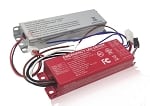
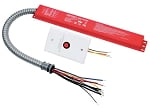
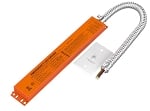
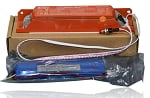
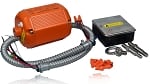
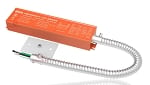
Emergency battery backup drivers are available for most common commercial LED fixture types. High bay UFO fixtures use 20 to 40 watt backup drivers that maintain working illumination in warehouses and manufacturing floors. Troffer and flat panel fixtures in offices use 10 to 15 watt backup drivers sized for corridor and open-office egress lighting. Vapor-tight fixtures in parking garages and industrial wet locations use 15 watt backup drivers rated for the same harsh environments as the fixture itself. Each backup driver includes a self-contained battery pack, charging circuit, and transfer switch in a compact module that mounts inside or adjacent to the fixture housing.
Building codes require regular testing of emergency lighting batteries to verify they can deliver the full 90-minute runtime. Monthly 30-second functional tests confirm the fixture transfers to battery power and produces light. Annual 90-minute full-duration tests verify the battery delivers adequate illumination through the entire required runtime. Most modern LED emergency fixtures include a push-button or pull-chain test switch. Some models also include self-testing circuits that perform and log tests automatically, simplifying compliance documentation for facility managers. When a battery fails the 90-minute test, the battery pack should be replaced promptly — most fixtures are designed with field-replaceable battery modules that do not require replacing the entire fixture.
whether the project is camping, hiking, or hosting a backyard gathering, a sturdy battery for LED lights helps keep portable and off-grid lighting available when the battery is matched to the fixture.
Find answers to common questions about batteries for LED lights including features, installation, and specifications:
LED emergency and backup lighting uses several battery types. Lithium iron phosphate, or LiFePO4, offers long life and high energy density. Nickel cadmium, or NiCd, handles extreme temperatures from -20°F to 140°F. Nickel metal hydride, or NiMH, balances performance and cost. Battery type depends on the fixture application, expected temperature range, and required runtime.
Emergency backup batteries in LED fixtures typically last 5-7 years for LiFePO4, 4-5 years for NiCd, and 3-4 years for NiMH before requiring replacement. Actual life depends on the number of charge/discharge cycles, ambient temperature, and maintenance. Most emergency fixtures include a test button to verify battery health.
In many fixtures the battery can be replaced, but the replacement must match the chemistry, voltage, capacity, connector, temperature rating, and fixture listing. Use the manufacturer-approved part when available and have qualified personnel service hardwired emergency fixtures.
NFPA 101 Life Safety Code and IBC require emergency lighting to operate for a minimum of 90 minutes after normal power failure. The initial illumination must be at least 1 foot-candle average along the egress path, decreasing to no less than 0.6 foot-candles at the end of the 90-minute period. Monthly and annual testing is required.
Replacement batteries for LED emergency lights, battery backup fixtures, and solar lighting systems. Compatible batteries help LED emergency, solar, and portable lighting operate when the fixture depends on stored power.
Contact LED Light ExpertCall Now: (800) 674-9420
Dara Greaney is the CEO and President of LEDLightExpert.com, a leading company in commercial lighting solutions. Since 2015, he has led the company to achieve remarkable growth and recognition, including being an Inc5000 winner three times: No. 3783 in 2022, No. 2428 in 2021, and No. 531 in 2020.
Editing by David Peguero.
On orders over $49.00
Up to 7 Years Free Warranty On LED Lights