


Quick Answer
Installing LED corn light bulbs is usually a ballast-bypass retrofit: power must be shut off, the old HID lamp removed, the ballast safely bypassed or removed, and the new LED corn bulb installed according to its wiring diagram. Many LED corn bulbs offer selectable color temperatures and can reduce wattage compared with older HID lamps, but lumen output, fixture fit, and electrical safety must be checked before installation.
How to Install an LED Corn Light Bulb - Actual Install Video
Case: Del Mar Fairgrounds is a world-class public facility that hosts a variety of activities on a vast swath of state-owned property. Among the activities and facilities is a golf center that includes a driving range, chipping area, putting green and a mini golf course for the kids. This is a complete practice and training complex that is fun for the entire family. For the longest time, the golf complex had used 250-WATT high pressure sodium bulbs for the mini golf. These are outdated, short-lasting, poor-quality lighting fixtures that consume a lot of energy and require frequent maintenance. The management of Del Mar Fairgrounds sought our help in upgrading the lighting system of the golf complex from the high-pressure sodium bulbs to LED Corn Light bulbs.
Corn LED Light Bulbs are a type of LED light that have a shape and appearance similar to an ear of corn. They are composed of many small LED chips that emit light in all directions, creating a bright and uniform illumination. LED Corn Light Bulbs are often used in spaces such as football stadiums, parking lots and, in this case, golf complexes. Besides the bright illumination, LED Corn Light Bulbs have some features such as DLC 5.1 certification, dimming capability, wattage and kelvin selection and color tunability.
Del Mar Fairgrounds allowed us to film the before, the installation process and the after installation. We installed new 80-WATT LED Corn Light Bulbs. The video below is a step-by-step guide of the installation.
The image below shows the clear difference between the antique high pressure sodium lights and the modern LED Corn light bulbs. The new 80-WATT LED bulb on the left appears noticeably brighter and whiter than the old 250-WATT high pressure sodium lamp on the right. The LED bulb also produces light that resembles daylight, which makes it easier to see, ideal for a wonderful golfing experience.

These LED corn light bulbs give you 4 color choices (3000K, 4000K, 5000K, 5700K), as opposed to the old 250-WATT HPS, which has a fixed color of about 2100K. Some 80-WATT LED bulbs offer a narrower 3000K-5000K range. Common choices are 3000K, 4000K, and 5000K. 3000K is a warm white, 4000K is a neutral, bright and crisp white, and 5000K and up produces a crisp, intense light with a slightly bluish white tone, ideal for outdoor lighting, commercial lighting, security lighting and for sporting activities.


An after LED Corn bulbs installation shot taken from the opposite, south-east corner (as most pictures were taken at the entrance) shows the cool-white, bright and clear illumination, revealing the aesthetics of the landscape and immersing the venue into a completely different atmosphere. These lighting fixtures are generating 9600 lumens:

For many facilities, replacing old HID metal halide or high-pressure sodium bulbs with LED corn bulbs can improve useful illumination, reduce wattage, and reduce lamp-maintenance work when the retrofit is matched to the fixture. Besides, the new LED Corn bulbs provide the option of choosing what color temperature you want to use that suits the environment and atmosphere of your facility or space. Our experts can help you compare ballast bypass, socket compatibility, color temperature, and fixture fit before starting a retrofit.
LED corn bulbs are versatile retrofit options, but installation should still be checked carefully. Many models fit existing mogul-base fixtures and sockets, making them useful in a range of applications when heat, orientation, enclosure rating, and wiring are compatible. You can use LED corn bulbs for indoor or outdoor lighting, such as in warehouses, factories, garages, parking lots, stadiums, parks, gardens, and more. Ballast-bypass LED corn bulbs do not use the old HID ballast, starter, or transformer, so a qualified electrician should remove or bypass those components and confirm line voltage at the socket before the bulb is energized.
Key Takeaway
LED corn light bulbs outperform older HID fixtures in brightness, energy efficiency, and lifespan. The Del Mar Fairgrounds installation demonstrates a 250W HPS-to-80W LED conversion that cut wattage by about two-thirds, reduced maintenance complexity, and enabled color temperature selection (3000K–5700K) so the site could choose the tone that fit visibility and appearance goals.
Project FAQs
Most LED corn bulb retrofits are ballast-bypass installations. The old HID ballast is removed or bypassed so line voltage feeds the LED bulb directly. Confirm the wiring diagram for the exact bulb and have a qualified electrician do the work.
This Del Mar Fairgrounds example used 80W LED corn bulbs to replace 250W high pressure sodium lamps. The right replacement wattage depends on fixture shape, mounting height, desired brightness, and whether light needs to spread in all directions.
For most commercial and outdoor retrofits, 4000K or 5000K is a practical starting point. 3000K is warmer and softer, while 5700K can feel sharper and cooler. Match the Kelvin choice to the task, location, and existing site appearance.
Related Articles
 LED Corn Light Bulbs Buying Guide
Expert guide to choosing the right LED corn light bulbs for your application, including wattage, color temperature, and brightness.
LED Corn Light Bulbs Buying Guide
Expert guide to choosing the right LED corn light bulbs for your application, including wattage, color temperature, and brightness.
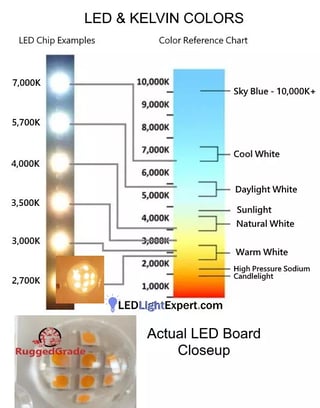 Kelvin Color Temperature Guide
Understand kelvin color temperatures (3000K to 5700K) and how they affect the mood and functionality of your lighting.
Kelvin Color Temperature Guide
Understand kelvin color temperatures (3000K to 5700K) and how they affect the mood and functionality of your lighting.
 Photometric Study Guide
How to read and request photometric studies for your LED lighting projects.
Photometric Study Guide
How to read and request photometric studies for your LED lighting projects.


Need Help Installing LED Corn Light Bulbs?
Our lighting experts can help you select the right LED corn bulbs and review fixture fit, ballast-bypass requirements, and electrician installation notes.
TALK TO THE EXPERTS


