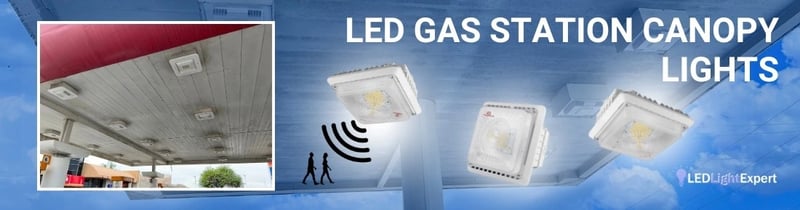
LED Gas Station Canopy Lights

USA Based Experts in less than 60 seconds Call Now: 800-674-9420
On orders over $49.00
Up to 7 Years Free Warranty On LED Lights

Gas station canopy lighting affects customer perception, pump-island visibility, camera performance, and operating cost. A well-lit fuel station can feel more usable after dark and helps drivers see pump islands, curbs, hoses, and store entrances at pump islands and convenience store entrances. Traditional high-intensity discharge (HID) fixtures—typically 150-400 watt metal halide lamps—have dominated gas station applications for decades, but they are costly to operate and require frequent maintenance. LED gas station lights can deliver comparable usable light with lower energy use and reduced maintenance compared with many HID systems. For station operators managing fuel margins measured in pennies per gallon, the shift to LED represents one of the strong capital improvements to evaluate, with payback depending on fixture cost, utility rates, rebates, and operating hours.
The Petroleum Equipment Institute (PEI) and the Illuminating Engineering Society (IES) establish minimum light levels for fuel station canopies based on safety, visibility, and security. Pump islands and fueling areas require 50 to 75 foot-candles (fc) of horizontal illuminance at ground level to enable drivers to see nozzles, hoses, and pump displays clearly and safely. Payment terminal areas demand 75 to 100 foot-candles to support surveillance camera performance and prevent fraudulent activity. The convenience store entrance typically requires 30 to 50 foot-candles for comfortable transition from outdoors to indoors. These levels apply across the entire canopy footprint—uniform coverage prevents dark corners where accidents or security incidents are more likely. Color temperature should fall between 4000 and 5000 Kelvin to deliver the clean, neutral white light that customers expect at modern facilities. Warmer color temperatures (3000K) can appear dated or dim; cooler temperatures (6000K+) create harsh glare that fatigues drivers. A 5000K LED canopy light strikes the balance between brightness perception and visual comfort, making it the standard specification for new fuel station construction and retrofit projects.
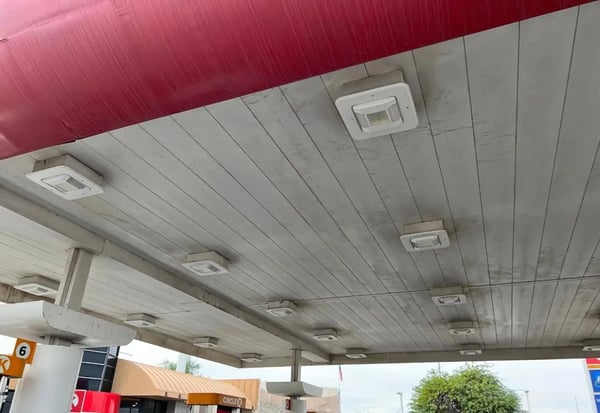
Gas station canopy lighting uses two primary fixture styles: surface-mounted and recessed. Surface-mounted canopy fixtures attach directly to the structural underside of the canopy, providing ease of installation and maintenance access. They are well suited for retrofit applications where existing conduit and mounting points are already in place. Recessed fixtures sit flush with the canopy soffit for a clean, integrated appearance and are standard in new construction where rough-in electrical is planned during structural installation. Both styles are available with 100 to 250 watt LED modules, with wattage selection depending on the fixture spacing, canopy dimensions, and required foot-candle levels. A typical 30-foot by 50-foot gas station canopy requires 8 to 12 fixtures positioned to eliminate shadows and dark zones around pump islands. Most gas station areas fall into the ordinary (non-hazardous) electrical classification because fuel vapors disperse into open air and do not concentrate under the canopy. However, certain fuel dispensers and enclosed storage areas may fall into Class I, Division 2 hazardous locations. Standard LED fixtures rated for ordinary locations are sufficient for canopy mounting; only dispensers and enclosed rooms require Class I Division 2 rated equipment. Verify the exact electrical classification with the pump manufacturer and local authority having jurisdiction before fixture selection.
Converting a gas station from metal halide to LED can reduce energy cost. A station operating twelve 250-watt metal halide fixtures (3,000 watts base load + 900 watts ballast loss = 3,900 watts total) consuming power 24 hours daily at $0.12 per kilowatt-hour spends approximately $4,100 per year on canopy lighting alone. Replacing those fixtures with twelve 100-watt LED models (1,200 watts total) cuts that cost to $1,260 annually, yielding $2,840 in net savings per station every year. Stations in areas with higher electricity rates or longer operating hours see savings approaching $5,000 to $7,000 per year. This financial argument drives rapid LED adoption across the fuel retail sector. Many LED canopy fixtures now qualify for DesignLights Consortium (DLC) certification, which enables gas station operators to access utility rebate programs. A typical utility rebate covers 20 to 40 percent of the fixture purchase price, accelerating payback timelines from 3 to 5 years down to 18 to 30 months. Operators are advised to check with their regional utility provider for rebate eligibility before finalizing purchasing decisions.
Dark sky compliance and light trespass regulations increasingly affect gas station lighting design, particularly in environmentally sensitive areas and suburban municipalities. LED fixtures support compliance by delivering directional light output that concentrates illumination on the pump island and canopy area while minimizing upward light and spillover onto adjacent properties. A well-designed LED canopy fixture with proper aiming and shielding can meet International Dark Sky Association (IDA) requirements while maintaining the 50+ foot-candle levels that fuel stations require. Petroleum industry codes such as the National Fire Protection Association (NFPA) and state fire marshal guidelines mandate corrosion resistance, proper grounding, and fail-safe wiring for fuel station electrical systems. LED fixtures meeting these standards are readily available and simplify compliance documentation for inspectors and insurance underwriters.
When selecting LED gas station lights, prioritize fixtures from manufacturers with direct experience in fuel retail environments. Request photometric data and foot-candle calculations for your specific canopy layout rather than relying on generic wattage recommendations. Verify that the fixture carries certifications for ordinary location (standard gas stations) or Class I Division 2 (if required by pump placement). Multi-voltage models (120-277V) offer flexibility for existing electrical infrastructure and reduce stocking complexity. Warranty coverage of 5 years or longer indicates manufacturer confidence in durability and provides financial protection if premature failures occur. Energy efficiency ratings (lumens per watt) of 120+ indicate modern LED technology; older designs may deliver only 80-100 lumens per watt and consume unnecessary power. Finally, request dimming or motion control options to enable adaptive lighting strategies that preserve energy during off-peak hours while maintaining safety during peak customer activity.
Find answers to common questions about LED gas station canopy lights including features, installation, and specifications:
LED gas station canopy lights are high-output, surface-mounted fixtures designed specifically for fuel station canopies. They replace metal halide canopy fixtures with energy-efficient LED modules that provide uniform illumination across the fueling area. LED canopy lights are IP65+ rated for weather resistance and feature instant-on capability for reliable performance.
Fuel station canopies typically need 30-50 foot-candles average at the pump level per Petroleum Equipment Institute (PEI) guidelines. Higher levels (50-75 fc) are recommended at payment terminals for security camera clarity. Most gas stations use 100-200W LED canopy fixtures, with 6-12 fixtures per canopy depending on canopy size and fixture spacing.
LED canopy lights typically save 50-70% on energy compared to metal halide. A typical gas station replacing twelve 400W metal halide canopy fixtures (4,800W total + 720W ballast loss) with twelve 150W LED fixtures (1,800W total) saves 3,720 watts. At long operating hours and higher fixture counts, annual savings can be substantial; calculate using the actual wattage, ballast draw, runtime, and utility rate.
Standard LED canopy lights are not explosion-proof. However, most gas station canopy areas are classified as ordinary (non-hazardous) locations because fuel vapors disperse quickly in the open-air canopy environment. Only enclosed fuel storage areas and certain dispenser zones require explosion-proof (Class I, Division 1 or 2) rated fixtures.
LED gas station canopy lights deliver bright, energy-efficient illumination for fuel stations. Replace metal halide fixtures and reduce energy use compared with many metal halide systems with 5-year warranties.
Contact LED Light ExpertA fuelling canopy is one of the few commercial spaces where the lighting is the storefront. Drivers select a station from the road at speed, largely on how bright and clean the forecourt looks, and the canopy is what they are actually seeing. That makes uniformity under the canopy as commercially important as the light level itself: a canopy with bright patches and dark gaps reads as neglected even when the average foot-candle figure is adequate.
Security is the second driver. Well-lit forecourts and pump islands remove the dark corners where incidents occur, which matters for customers at the pump after dark and for staff working alone. Camera coverage depends on it as well, since a camera can only resolve what the lighting gives it.
The efficiency case is straightforward. Switching a canopy to LED typically reduces power consumption by up to 75% against the metal halide and high-pressure sodium systems that came before, and because LED generates far less heat there is less thermal load inside the canopy housing itself. Many of these fixtures run 150,000 hours or more, which on a canopy running dusk to dawn removes relamping from the picture for many years - and canopy relamping means a lift, a closed pump lane, and a service call.
Weather and impact resistance round it out. Canopy fixtures sit exposed to wind-driven rain, road salt, and vibration from vehicle traffic, so sealed housings and secure mounting are specification items, not upgrades.
Canopy fixture pricing follows the lumen package and the mounting method. Recessed fixtures that sit flush into the canopy deck are a different product and a different price from surface-mount units, and the existing cutouts usually decide which applies. Most forecourt projects are multi-fixture, so quantity pricing applies.
What comes with every order:
To quote, send the number of pump islands, the canopy deck dimensions and height, how many fixtures are in place now and at what wattage, and whether they are recessed or surface mounted. Pump island count drives the layout more than total square footage does. For non-fuelling canopy work - drive-throughs, parking decks, covered entries - see LED canopy lights.
Request PricingCall Now: (800) 674-9420
Dara Greaney is the CEO and President of LEDLightExpert.com, a leading company in commercial lighting solutions. Since 2015, he has led the company to achieve remarkable growth and recognition, including being an Inc5000 winner three times: No. 3783 in 2022, No. 2428 in 2021, and No. 531 in 2020.
Editing by David Peguero.
On orders over $49.00
Up to 7 Years Free Warranty On LED Lights