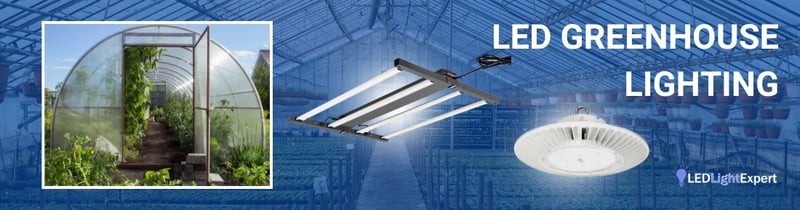
LED Greenhouse Lighting

USA Based Experts in less than 60 seconds Call Now: 800-674-9420
On orders over $49.00
Up to 7 Years Free Warranty On LED Lights

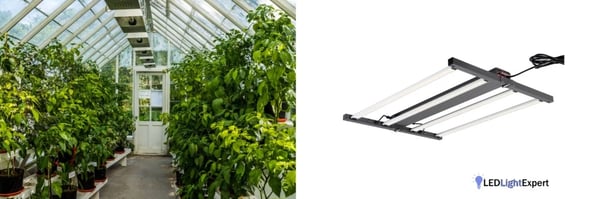
Commercial Greenhouse LED Lighting. Controlled-environment agriculture has reshaped the way commercial growers approach food and plant production. Greenhouses provide protection from unpredictable weather and allow crops to flourish in climates that might not naturally support them. But to manage production more consistently, light is one of the key production inputs. While sunlight is ideal, it's not always consistent or sufficient—especially in northern climates or during winter months. That’s where greenhouse lights come into play, with LED technology now common in supplemental lighting plans.
LED greenhouse lighting provides supplemental or sole-source light when natural sunlight does not meet the crop's target DLI. The goal is not simply to make the greenhouse look bright. Growers need usable plant light, measured through PPFD and DLI, matched to crop type, growth stage, mounting height, and photoperiod. When the lighting plan is right, LEDs can help maintain more consistent production through short days, cloudy weather, and dense planting layouts.
Compared with HPS or fluorescent systems, LED grow lights can reduce electricity use and put more usable spectrum on the crop with less unwanted heat. That can help with climate control, but it also means heating needs should be reviewed in colder regions. Greenhouse lighting is a system decision involving light, HVAC, irrigation, controls, and crop plan.
Plants use different wavelengths for photosynthesis and development. Blue light supports vegetative structure, red light supports flowering and fruiting, and full-spectrum white light gives workers better visual comfort while still supporting plant growth. The correct PPFD and DLI depend on the crop. Leafy greens, tomatoes, peppers, ornamentals, propagation areas, and cannabis operations all have different requirements.
Choose LED greenhouse lights around crop requirements and the building environment. Humidity, water exposure, mounting hardware, controls, and service access all matter. A fixture that works in a dry warehouse is not automatically suitable for a humid greenhouse.
Contact our lighting specialists for help selecting LED greenhouse lights by crop, DLI target, PPFD, spectrum, mounting height, controls, IP rating, and voltage. A practical plan should support plant quality and operating cost without overstating what lighting alone can do.
Greenhouse lighting plans often separate seedlings, vegetative growth, flowering, fruiting, propagation areas, leafy greens, tomatoes, peppers, ornamentals, and specialty crops because each crop and stage can need a different DLI, spectrum, photoperiod, and mounting height. Commercial growers and hobbyists should also review humidity, water exposure, daisy-chain wiring, dimmable output, IP65-rated fixtures where needed, and whether sunlight already meets part of the crop target.
Full-spectrum LED grow lights can support mixed crop areas and improve worker color visibility compared with red/blue-only fixtures. Adjustable red, blue, and far-red channels may be useful in controlled programs, but light recipes should be tied to the crop plan rather than treated as a universal yield promise.
LED greenhouse lights include full-spectrum grow lights designed for supplemental or sole-source lighting. Key features include adjustable spectrum (red, blue, far-red wavelengths), dimmable output for light intensity control, IP65+ ratings for humid environments, and daisy-chain capability for covering large growing areas.
Plants primarily use red (620-700nm) and blue (400-500nm) wavelengths for photosynthesis. Blue light promotes vegetative growth and compact structure. Red light drives flowering and fruiting. Far-red (700-750nm) influences plant stretching and flowering timing. Full-spectrum white LED grow lights provide a balanced mix suitable for all growth stages.
Light requirements vary by crop. Leafy greens need 12-18 mol/m²/day DLI (Daily Light Integral). Tomatoes and peppers need 20-30 mol/m²/day. Cannabis requires 30-50+ mol/m²/day. In greenhouses, LED supplemental lighting fills the gap between natural sunlight and the crop target DLI, especially during winter months and cloudy periods.
LED greenhouse lights can reduce electricity use compared with some HPS systems, but the savings depend on PPFD target, fixture efficiency, photoperiod, controls, crop plan, and utility rate. LEDs also change the heat balance in the greenhouse, so heating and cooling impacts should be reviewed by season and location.
Plan LED greenhouse lights around crop needs, target DLI, spectrum, dimming, controls, mounting height, and greenhouse humidity. LED Light Expert can help review the fixture plan without overstating what lighting alone can do.
Contact LED Light ExpertCall Now: (800) 674-9420
Dara Greaney is the CEO and President of LEDLightExpert.com, a leading company in commercial lighting solutions. Since 2015, he has led the company to achieve remarkable growth and recognition, including being an Inc5000 winner three times: No. 3783 in 2022, No. 2428 in 2021, and No. 531 in 2020.
Editing by David Peguero.
On orders over $49.00
Up to 7 Years Free Warranty On LED Lights