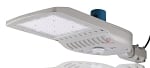
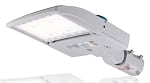
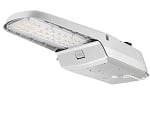
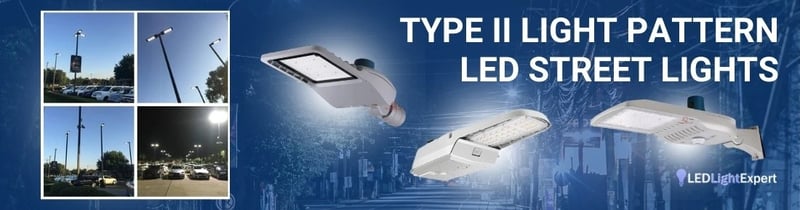
Type II Light Pattern LED Street Lights
USA Based Experts in less than 60 seconds Call Now: 800-674-9420
On orders over $49.00
Up to 7 Years Free Warranty On LED Lights

Type II light pattern LED street lights are used for narrow streets, sidewalks, alleys, and pathways where the fixture needs to throw light along the road more than across it. The IES Type II pattern is often referenced around 1.75 times mounting height, but actual coverage depends on the fixture, wattage, pole height, arm length, and layout.
Type II light distribution, as defined by the IESNA, projects a longer, narrower beam pattern used for roadways that are not extremely wide. The pattern illuminates an area up to 1.75 times the mounting height — a fixture at 20 feet covers roughly 35 feet across. This makes Type II well suited for two-lane residential streets, sidewalks, walking paths, and alleyways where consistent coverage is needed without excessive spillover onto neighboring properties.
Compared to other IESNA distribution types, Type II occupies the practical middle ground between Type I (narrow walkways only) and Type III (medium-wide streets and parking lots). Type IV provides forward-throw for perimeter lighting, while Type V delivers circular coverage for open spaces. For narrow streets and pathways, Type II can deliver targeted illumination that improves visibility while helping reduce light trespass and wasted energy. LED street lights in various distribution patterns serve different roadway widths. See our street lights buyer’s guide for detailed comparisons.


Type II LED street lights serve municipalities, commercial properties, and residential communities seeking optimized roadway illumination. Narrow residential streets benefit from targeted coverage that keeps light on the road without disturbing homeowners. Sidewalks and walking paths gain more consistent pedestrian-level illumination when the layout is correct. Parking lot perimeters receive focused edge lighting without wasting energy on empty adjacent areas. Highway on/off-ramps may use concentrated distribution to help drivers see signs, lane edges, and merge areas.
Type II light distribution produces a relatively narrow, elongated light pattern designed primarily for street and roadway lighting on narrow streets, walkways, and pathways. The pattern extends further along the road than it does across it, providing efficient illumination without excessive light spread onto adjacent properties.
Type II LED street lights are well suited for narrow residential streets, two-lane roads, walking paths, bike trails, and sidewalks. They are also used for parking areas adjacent to buildings where you want light directed along the road rather than spread widely. The narrow pattern minimizes light trespass onto neighboring properties.
Type I is the narrowest pattern, for walkways and center-of-road mounting. Type II is slightly wider, for narrow streets. Type III covers medium streets and parking areas. Type IV is wide, for perimeter lighting. Type V is symmetrical, for large area coverage. Choose the pattern that matches your road width and pole placement.
Type II LED street lights are available in multiple wattages. Residential streets with 25-30 foot poles may use 50-100W fixtures, while wider two-lane roads may need 100-150W or more depending on spacing, optics, and target light levels. Higher wattages are used for arterial roads with higher mounting heights or wider spacing between poles.
Type II light pattern LED street lights can fit narrow streets and pathways when the pole height, road width, optic, wattage, and light-trespass goals match. DLC listing and rebate eligibility vary by product and utility program.
Contact LED Light ExpertIES distribution types describe the shape of the light pattern a fixture throws onto the ground, viewed from above. They are the single most useful specification for roadway and area lighting, and they are routinely ignored in favour of wattage, which is why so many installations end up with light on the neighbouring property and dark patches on the road.
The practical test between Type II and Type III is the ratio of area width to mounting height. If the road or path is narrow compared with how high the fixture sits, Type II is right. If the road carries more width than the mounting height comfortably covers, Type III will hold uniformity better.
Beyond distribution, the specifications that matter on a street or roadway fixture are ingress protection, service life, controls, and how well the optic contains spill. Fixtures in this class are typically built to IP65 or IP67, which covers heavy rain and dust, and are rated for over 50,000 hours of service - a meaningful figure on a fixture that requires a bucket truck and a lane closure to reach.
Energy use runs 50 to 80% below the HID fixtures being replaced, with the range depending on what is coming out and how the new installation is controlled. Photocells and motion sensors support automatic dimming, which on a residential street or a path used only in the early evening is where the larger share of the saving actually comes from.
The distribution argument is also a light-pollution argument. Directing light only where it is needed minimises dark spots on the road and spill onto adjacent property at the same time, which matters increasingly where dark-sky ordinances apply.
Street lighting is almost always bought in quantity, and municipal and HOA buyers frequently need net-30 or purchase order terms rather than a card payment. Both are available and are easier to arrange before the quote than after.
What comes with every order:
To specify correctly, send the roadway or path width, the mounting height, the pole spacing, and the wattage being replaced. Those four figures determine whether Type II is genuinely the right distribution or whether Type III would hold uniformity better, and it is worth confirming before an order of any size.
Request PricingCall Now: (800) 674-9420
Dara Greaney is the CEO and President of LEDLightExpert.com, a leading company in commercial lighting solutions. Since 2015, he has led the company to achieve remarkable growth and recognition, including being an Inc5000 winner three times: No. 3783 in 2022, No. 2428 in 2021, and No. 531 in 2020.
Editing by David Peguero.
On orders over $49.00
Up to 7 Years Free Warranty On LED Lights