Light Switches

USA Based Experts in less than 60 seconds Call Now: 800-674-9420
On orders over $49.00
Up to 7 Years Free Warranty On LED Lights

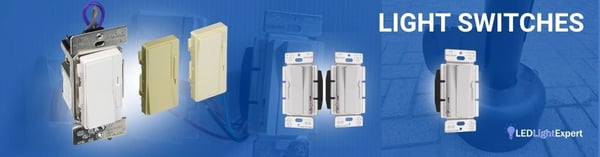
Lighting controls regulate when, where, and how much light operates in a building or outdoor space. From simple on/off switches to networked sensor systems, the right controls can reduce runtime, improve usability, and help commercial facilities plan around adopted energy-code requirements such as ASHRAE 90.1, IECC, or California Title 24 where those standards apply. LED Light Expert carries occupancy sensors, vacancy sensors, dimmer switches, photocells, timer switches, and programmable controls designed for commercial and industrial LED lighting systems.
Occupancy sensors detect human presence in a space and automatically turn lights on when motion is detected and off when the area is vacant. These sensors use one of two primary detection technologies: passive infrared (PIR), which detects body heat, and microwave, which emits a signal and measures changes in the reflected pattern. Dual-technology sensors combine both methods for higher accuracy and fewer false triggers in challenging environments.
Vacancy sensors operate differently — they require a manual switch to turn lights on but shut off automatically when the space is unoccupied. This approach saves more energy in areas where lighting is not always needed upon entry, such as private offices, restrooms, and storage rooms. Many commercial energy codes require occupancy or vacancy sensing in specific building areas, depending on the adopted code and project scope.
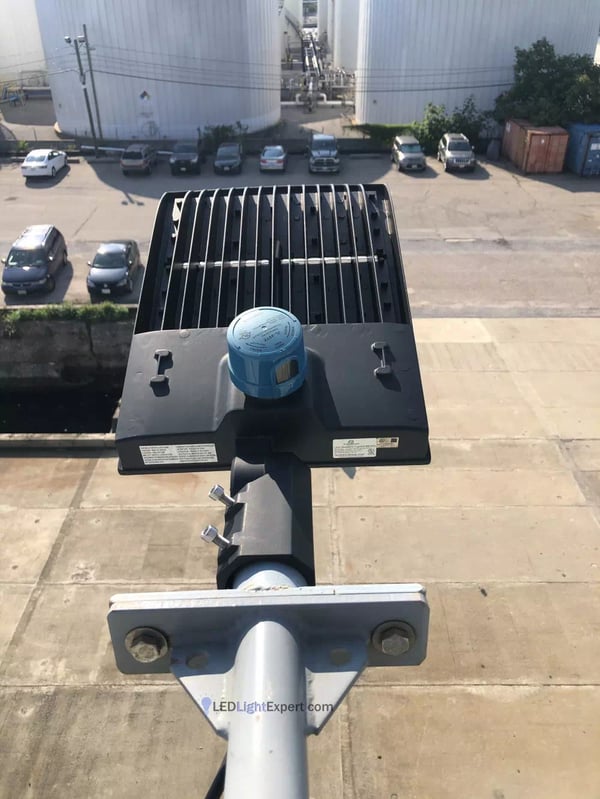
Photocells measure ambient light levels and automatically activate fixtures at dusk and deactivate them at dawn. These sensors are standard on outdoor lighting installations including parking lot lights, wall packs, and area lights. Photocells eliminate the need for manual switching of exterior lighting and ensure consistent operation regardless of seasonal changes in daylight hours.
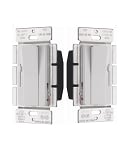
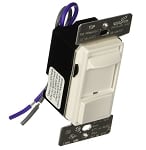
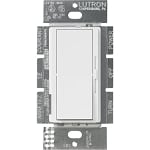
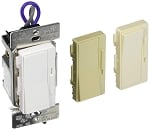
Dimmer switches regulate the amount of electrical current reaching a fixture, allowing users to adjust light output from full brightness down to a low level. For LED fixtures, it is essential to use dimmers specifically rated for LED loads — standard incandescent dimmers can cause flickering, buzzing, or premature driver failure when paired with LED fixtures. LED-compatible dimmers provide smooth, flicker-free dimming performance across the full adjustment range.
Timer switches automate lighting schedules based on time-of-day programming. Commercial facilities use timers to control interior and exterior lighting on predictable schedules, reducing energy waste from lights left on during unoccupied hours. Programmable timers with multiple scheduling channels can manage different lighting zones independently within the same building.
Selecting lighting controls starts with understanding the application, the building's electrical system, and the applicable energy code requirements. Most commercial new construction and major renovation projects must include occupancy sensing and, in many jurisdictions, daylight harvesting controls. Verify compatibility between the control device and the LED fixture or driver — particularly for dimming applications, where the dimmer must match the driver's dimming protocol (0-10V, TRIAC, or ELV). For outdoor installations, confirm that photocells and motion sensors are rated for the environmental conditions and voltage of the circuit they will control.
Lighting control projects should start with the space type, fixture driver, voltage, code requirement, and the behavior users expect. A private office may need vacancy control. A warehouse aisle may need occupancy sensing. An outdoor wall pack may need a photocell, timer, or motion sensor with dimming.
Repairability also matters. Confirm replacement sensors, dimmers, drivers, relays, and covers are available before standardizing on a control system across a large building.
PIR sensors need line of sight to detect body heat. Microwave sensors can cover larger areas but may require careful adjustment to avoid false triggers. Dimmers must match the LED driver protocol, such as 0-10V, TRIAC, ELV, or a listed proprietary system.
Commission controls after installation. Test timeout, daylight threshold, dimming range, and manual override from the locations people actually use.
Lighting controls can be simple switches, dimmers, photosensors, occupancy detectors, vacancy sensors, time clocks, relays, or networked devices with microprocessors. A control system may monitor energy use, report savings, respond to daylight, or follow programmed schedules. The right function depends on the space, code, user preference, and fixture driver.
PIR detectors use a sensor chip that sees changes in infrared energy. When a person moves through the protected area, the hot spot on the chip changes, and the electronics trigger the relay or control input. Microwave sensors work differently: they emit a signal, analyze the echo from stationary objects, and trigger when movement changes the returned signal.
More complex systems may connect lighting, alarm input, water sensors, sound commands, smart-home devices, and computer-programmed preferences. For commercial lighting, keep the system understandable. Too many features can confuse users and make troubleshooting harder.
Before installing controls, consider repair parts, spare devices, compatibility, energy consumption of the control itself, and whether the device is permitted by the adopted code. Commissioning should verify that the detector range, dimming flow, timeout, and manual override work in the actual room.
Every control device has an input, a decision point, and an output. The input may be motion, daylight, time, a manual switch, an alarm signal, a smart-home command, a water sensor, or a computer-programmed schedule. The output may open or close a relay, send a dimming signal, change a fixture driver, or trigger a connected circuit. Thinking through that flow makes the system easier to install and troubleshoot.
Detector placement should be tested in the actual room or exterior area. PIR sensors need a clear view of moving heat sources. Microwave sensors read reflected signal changes and may react through some materials. Photosensors need a location where fixture light will not fool the sensor. Shelving, glass, doors, partitions, distance, ceiling height, and stationary objects can all change the result.
Advanced controls can use microprocessors, programmed preferences, network gateways, sound commands, user scenes, or building-management software. Those functions can enable useful savings and visual control, but complexity has a cost. Keep override behavior, repair parts, permitted wiring methods, and the adopted regulation clear before standardizing on a control package.
Common controls include wall switches, LED-rated dimmers, occupancy sensors, vacancy sensors, photocells, time clocks, 0-10V dimming controls, and networked systems for larger buildings.
An occupancy sensor can turn lights on and off automatically. A vacancy sensor requires manual-on operation and turns lights off when the space is empty. Vacancy control can save more energy in rooms where lights are not always needed.
No. Use a dimmer that matches the fixture or driver type, such as TRIAC, ELV, 0-10V, or another listed control method. The wrong dimmer can cause flicker, buzzing, limited range, or driver failure.
Many commercial projects require some combination of occupancy sensing, daylight response, scheduling, manual control, or automatic shutoff. Requirements depend on the adopted energy code and space type.
Use the products above as a starting point, then confirm fixture driver type, voltage, dimming protocol, sensor coverage, code requirements, and override behavior before ordering controls.
Contact LED Light ExpertCall Now: (800) 674-9420
Dara Greaney is the CEO and President of LEDLightExpert.com, a leading company in commercial lighting solutions. Since 2015, he has led the company to achieve remarkable growth and recognition, including being an Inc5000 winner three times: No. 3783 in 2022, No. 2428 in 2021, and No. 531 in 2020.
Editing by David Peguero.
On orders over $49.00
Up to 7 Years Free Warranty On LED Lights