


Quick Answer: Why Switch to LED Lighting?
LED lighting can use much less energy than incandescent, fluorescent, metal halide, and HPS systems when replacements are selected correctly. LEDs offer long rated life, strong color-rendering options, instant-on operation, and broad fixture availability for commercial and industrial applications.
Everything You Need to Know About LED Lighting in 2026
LED lighting can reduce energy use compared with many traditional bulbs, lasts longer in many applications, and is available in high-CRI options for better color rendering. Businesses and homeowners are making the switch because LED fixtures now cover most common residential, commercial, outdoor, and industrial applications. Whether you are upgrading a warehouse, parking lot, office, or residence, this guide covers everything you need to know about LED lighting: the benefits, the different types of fixtures, how LED compares to older technologies, and what to look for before making a purchase.
Benefits of LED Lighting
Key takeaway: LED lighting can use less energy than traditional lighting, lasts longer in many applications, and may pay for itself over time. According to ENERGY STAR, widespread use of LEDs by 2027 could cut U.S. electricity use by the annual output of 44 large electric power plants.
Compared to incandescent bulbs, fluorescent tubes, metal halide, and high-pressure sodium (HPS) fixtures, LED lighting delivers measurable advantages across five key areas:
Energy Efficiency
LED lights convert far more of their electricity into visible light than incandescent bulbs, which waste about 90% as heat. A 60-watt incandescent bulb can be replaced by a 10-watt LED bulb producing the same 800 lumens — that is an 83% reduction in energy consumption. LED fixtures also last 20,000 to 50,000 hours — many years at typical residential or commercial runtimes — reducing maintenance and replacement work. Learn more in our LED energy savings calculator.
Light Quality
LED lighting offers a high color rendering index (CRI) — up to 95 — which means colors appear natural and vivid under LED light. LEDs also come in a wide range of color temperatures from warm white (2,700K) through neutral (4,000K) to cool daylight (5,000K–6,500K), letting you match the light to the purpose of the space.
Design Flexibility
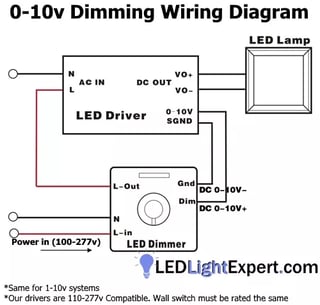
LED technology fits into virtually any form factor: high bay fixtures, flood lights, wall packs, corn bulb retrofits, strips, panels, and smart-connected devices. Most commercial LED fixtures also support 0-10V dimming for precise brightness control.
Safety
LED lights emit no ultraviolet (UV) radiation and contain no mercury or lead. They generate far less heat than incandescent or halogen lamps, reducing fire risk and making them safe for enclosed or insulation-contact (IC) rated fixtures.
Graceful End of Life
Unlike traditional bulbs that fail suddenly, LEDs dim gradually over time. This predictable depreciation curve allows facilities managers to plan replacements proactively rather than reacting to unexpected outages.
Types of LED Lighting
Key takeaway: LED lighting fixtures are purpose-built for specific environments. High bays for 15–45 ft ceilings, flood lights for outdoor security, parking lot lights for area coverage, wall packs for perimeters, corn bulbs for socket retrofits, and wall/vanity lights for interiors. Choosing the right type depends on mounting height, beam spread, IP rating, and lumen output.
Here are the six most common types of commercial and industrial LED lighting:
High Bay Lights
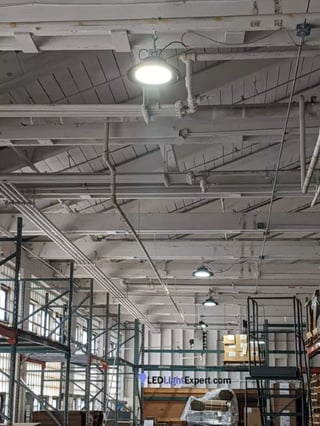
Designed for ceilings 15–45 ft. Common for warehouses, manufacturing floors, and gymnasiums. Available in UFO (round) and linear form factors. Typical output: 10,000–60,000+ lumens.
Flood Lights
Wide-beam outdoor fixtures for security, sports courts, building facades, and loading docks. Available with motion sensors for added energy savings. Typical output: 4,000–100,000+ lumens.
Parking Lot Lights
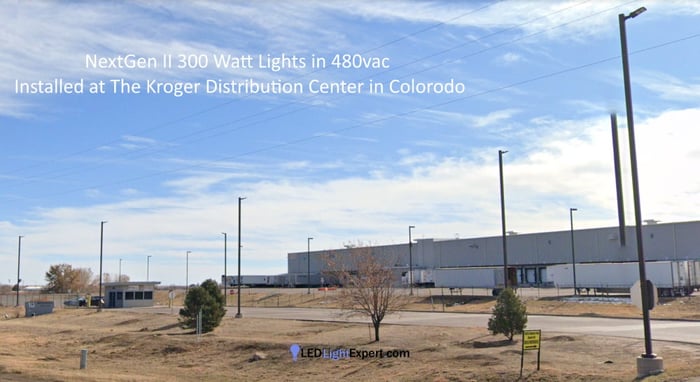
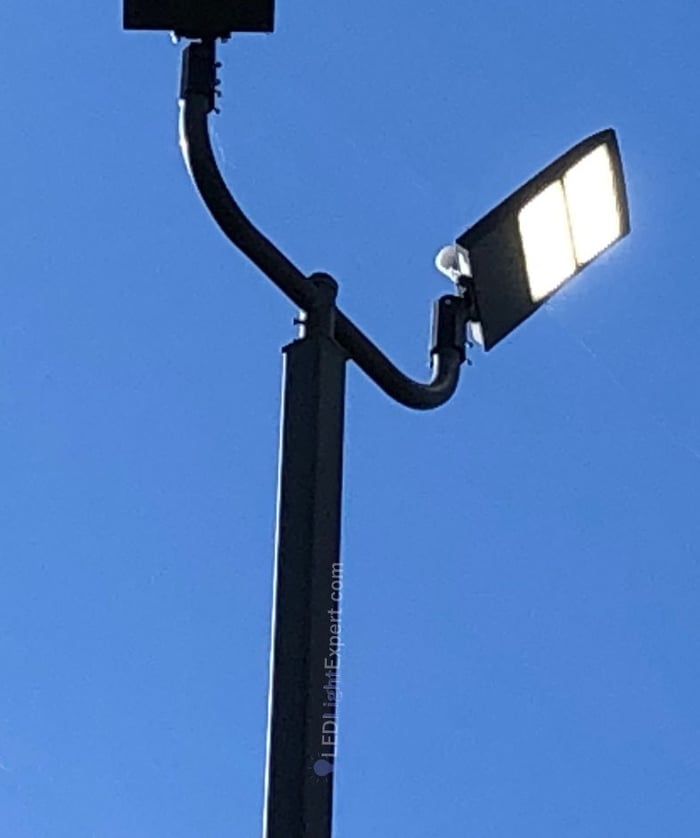
Area lights mounted on poles for parking lots, roadways, and campuses. Designed for even light distribution with minimal glare. Many support 480V high-voltage input. Typical output: 8,000–60,000+ lumens.
Wall Packs
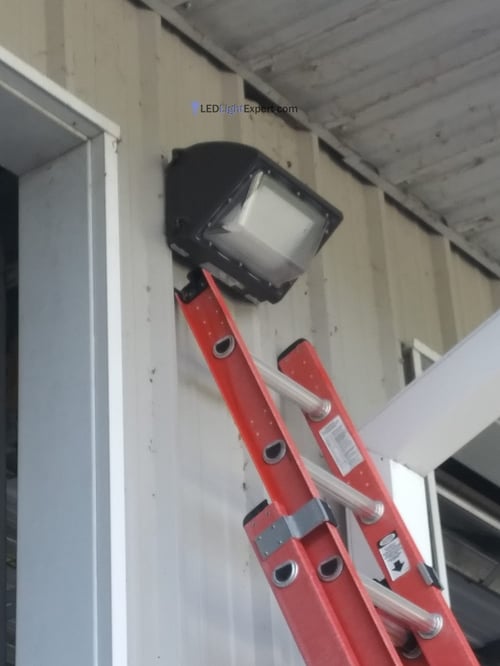
Building-mounted perimeter fixtures for entrances, walkways, and security lighting. Compact design, often with photocells for dusk-to-dawn operation. Typical output: 1,500–15,000 lumens.
Corn Bulb Retrofits
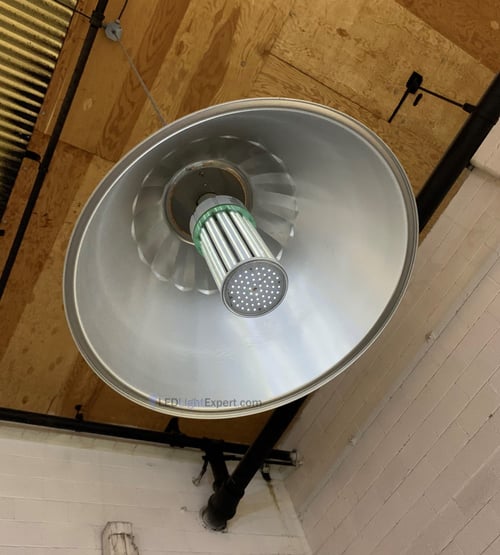
Direct-replacement LED corn bulbs that fit existing E39 mogul or E26 sockets. No fixture replacement needed — ideal for fast ROI on shoebox, post-top, and high-bay retrofits. Typical output: 2,000–30,000+ lumens.
Wall & Vanity Lights
Decorative and functional wall-mounted LED fixtures for commercial interiors and exteriors. Include barn lights, sconces, and architectural wash lights. Typical output: 800–8,000 lumens.
LED Lighting vs. Traditional Lighting Technologies
Understanding how LED lighting compares to incandescent, fluorescent, metal halide, and high-pressure sodium helps justify the switch. The table below compares the five most common lighting technologies across the metrics that matter most:
| Metric | LED | Incandescent | Fluorescent / CFL | Metal Halide | HPS |
|---|---|---|---|---|---|
| Lifespan | 30,000–50,000 hrs | 1,000–2,000 hrs | 8,000–15,000 hrs | 10,000–20,000 hrs | 18,000–24,000 hrs |
| Efficiency (lm/W) | 100–200 lm/W | 10–17 lm/W | 50–100 lm/W | 75–100 lm/W | 80–140 lm/W |
| CRI | 80–95+ | 100 (reference) | 50–85 | 60–70 | 22–25 |
| Warm-Up Time | Instant | Instant | 30 sec – 3 min | 5–15 min | 5–10 min |
| Dimmable | Yes (0-10V) | Yes (basic) | Limited | No | No |
| Mercury Content | None | None | Yes (1–5 mg) | Yes | Yes |
| Maintenance | Very Low | Very High | Moderate | High (ballast) | High (ballast) |
| Common Application | Broad applications | Residential accent | Office / retail | Sports / retail (legacy) | Roadway (legacy) |
Key takeaway: LED lighting often compares favorably with traditional technologies on efficiency, rated life, and maintenance — while offering instant-on performance and full dimming capability that metal halide and HPS cannot provide. At 100–200 lumens per watt, modern LEDs are 6–12 times more efficient than incandescent and up to about 1.4 times as efficient as the best HPS fixtures.
Common Uses of LED Lighting
LED lighting works in many residential, commercial, and industrial applications. The most common use cases include:
- Warehouse and industrial: LED warehouse lights and high bays provide uniform, high-lumen illumination for large open spaces with ceiling heights from 15 to 45+ feet.
- Parking lots and roadways: LED parking lot lights deliver even light distribution with IES Type III or V patterns, reducing dark spots and improving safety.
- Building perimeters: LED wall packs and flood lights provide security illumination with optional photocells and motion sensors for dusk-to-dawn automation.
- Sports courts and fields: High-output LED fixtures replace 1,000W+ metal halide systems with instant-on, flicker-free illumination for tennis courts, ball fields, and arenas.
- Retrofit and replacement: LED corn bulbs drop into existing sockets to upgrade shoebox, post-top, and acorn fixtures without rewiring.
- Landscape and decorative: LED landscape lighting and barn lights enhance curb appeal and outdoor ambiance with weather-rated, long-lasting fixtures.
- Office and retail: LED panels, troffers, and track lights provide high-CRI illumination that enhances product displays and reduces eye strain for employees.
LED Lighting Design and Layout Considerations
A proper lighting layout helps the right amount of light reach each area with less waste and fewer dark spots. Key factors in any LED lighting design include:
- Mounting height: Determines the fixture type and optic (beam angle). Higher ceilings require narrow-beam, high-lumen fixtures. See our beam angle and NEMA classifications guide.
- Foot-candle requirements: Different tasks need different light levels. Warehouses typically need 30–50 fc, offices 30–50 fc, parking lots 5–10 fc (1–2 fc for basic, low-use lots). Use our footcandles guide to determine your target.
- Color temperature: Match the Kelvin rating to the function — warm (3000K) for hospitality, neutral (4000K) for offices, cool (5000K) for industrial and outdoor.
- Controls and dimming: 0-10V dimming paired with occupancy sensors and daylight harvesting can increase energy savings by 30–50% beyond the LED upgrade itself.
- Voltage: Verify your building voltage (120V, 277V, or 480V) before ordering. Multi-voltage drivers (120–277V) cover most applications; 480V requires a dedicated driver.
Outdoor LED Lighting
Outdoor LED lighting serves two purposes: aesthetics and security. For security applications, LED flood lights with motion sensors and photocells activate only when needed, saving energy while deterring intruders. For decorative and landscape applications, fixtures with automatic timers or smart controls create dynamic scenes while minimizing light pollution. Always choose fixtures with appropriate IP ratings (IP65+ for wet locations) and use deflectors or full-cutoff optics to prevent light trespass onto neighboring properties.
Commercial and Industrial LED Lighting
The quality and quantity of light in a workplace directly affects productivity, safety, and well-being. When selecting commercial LED lighting, consider CRI requirements (80+ minimum, 90+ for retail and food service), light output in lumens (match to your footcandle targets), directional lighting (direct vs. indirect), and smart controls for automated scheduling and occupancy-based dimming.
2026 LED Lighting Trends and Market Data
The LED lighting industry continues to evolve rapidly. Here are the key trends and data points shaping LED lighting decisions in 2026:
- Market growth: LED lighting is now a mature market with broad commercial and industrial adoption. Buyers should focus on fixture quality, driver reliability, optics, controls, warranty, and support.
- Efficacy improvements: Modern commercial LEDs now achieve 130–200+ lumens per watt, up from roughly 100 lm/W a decade ago.
- Smart and IoT integration: Connected LED lighting systems with occupancy sensing, daylight harvesting, and building automation integration are becoming the default for new commercial construction. These systems can reduce lighting energy use by an additional 30–50% beyond the LED upgrade itself.
- Tunable white and human-centric lighting: Color-tunable LED fixtures that adjust Kelvin temperature throughout the day to support circadian rhythms are gaining adoption in offices, healthcare, and educational facilities.
- Utility rebates: DLC-listed LED products continue to qualify for utility rebates in most markets, though rebate amounts are gradually declining as LED becomes the baseline technology. Check current rebate rules before assuming a project qualifies.
- Tariffs and pricing: Fixture pricing can change with tariffs, freight, and component availability, so larger projects should confirm quote validity and lead times.
What to Look For When Considering LED Lighting
Key takeaway: Do not buy LED lighting based on price alone. The 10 factors below — lumens, color temperature, CRI, DLC certification, dimming, voltage, IP rating, warranty, photometrics, and total cost of ownership — separate a good LED investment from a costly mistake.
Before purchasing LED lighting for any project, use this checklist to ensure you are comparing products on the metrics that matter. These are the questions experienced lighting professionals ask:
- Lumens, not watts: Compare fixtures by total lumens and lumens per watt (efficacy). Higher lm/W means more light for less energy. Look for high lm/W ratings when efficiency is a priority.
- Color temperature (Kelvin): Decide on warm (3000K), neutral (4000K), or cool (5000K) before shopping. Many modern fixtures offer color-selectable (tunable) options — one SKU covers multiple Kelvin preferences.
- CRI rating: Minimum 80 CRI for general use. Retail, food service, and healthcare should target 90+ CRI for accurate color representation.
- DLC or ENERGY STAR certification: DLC-listed fixtures qualify for utility rebates that can reduce your upfront cost by 30–50%. Check your local utility's rebate program before purchasing.
- Dimming compatibility: Confirm the fixture supports 0-10V dimming if you plan to use dimmers, occupancy sensors, or daylight harvesting controls.
- Operating voltage: Match the driver to your building's voltage (120V, 277V, or 480V). Multi-voltage drivers (120–277V) offer flexibility; 480V sites need purpose-built LED drivers.
- IP and environment rating: Outdoor and wet-location fixtures need IP65 or higher. Dusty environments (wood shops, grain elevators) should use IP65+ sealed fixtures.
- Warranty and L70 lifespan: Look for a minimum 5-year warranty. The L70 rating tells you how many hours until the fixture dims to 70% of its original output — 50,000+ hours is the benchmark.
- Photometric data: For large projects, request IES photometric files so your electrician or lighting designer can create an accurate layout showing light levels at every point in the space.
- Total cost of ownership: Factor in energy savings, maintenance reduction, rebate eligibility, and lifespan — not just the purchase price. LED can pay for itself over time depending on runtime, rates, labor, controls, rebates, and fixture cost.
Frequently Asked Questions About LED Lighting
LED lighting offers five key advantages: energy efficiency (less energy than incandescent when wattage and controls are matched correctly), long lifespan (20,000–50,000 hours), high color rendering (CRI up to 95), compact and flexible design for any fixture type, and improved safety with no UV radiation, mercury, or excessive heat. LEDs also dim slowly over time rather than burning out suddenly.
LED lighting often outperforms metal halide (MH) and high-pressure sodium (HPS) in efficiency, controllability, and color-rendering options. LEDs last 50,000+ hours versus 10,000–24,000 for MH/HPS, reach full brightness instantly with no warm-up, offer CRI of 80–95 versus 65 for MH and 22 for HPS, and use 40–60% less energy. LEDs can remove ballast replacement from the maintenance plan and reduce frequent re-lamping.
Color temperature depends on your application. Warm white (2700K–3000K) creates a cozy atmosphere for hospitality and residential spaces. Neutral white (4000K) is common for offices and retail. Cool daylight (5000K) is the standard for warehouses, parking lots, and industrial facilities where visibility and alertness matter most. Many modern LED fixtures offer tunable or color-selectable options.
Watts measure energy consumption while lumens measure light output. With traditional lighting, higher watts meant more light. LED lighting is far more efficient — a 10-watt LED produces the same 800 lumens as a 60-watt incandescent bulb. Always compare LED fixtures by lumens (brightness) and lumens per watt (efficiency) rather than wattage alone.
The main types of commercial and industrial LED lighting include: high bay lights for warehouses and large spaces, flood lights for outdoor security and sports, parking lot lights for area lighting, wall packs for building perimeters, corn bulb retrofits for existing fixtures, and panel or troffer lights for offices.
Most businesses save 40–70% on energy costs by switching from traditional lighting to LED. A typical 400-watt metal halide fixture replaced with a 150-watt LED saves approximately $110 per year per fixture at $0.10/kWh running 12 hours per day. With 50,000-hour lifespans, LED fixtures can reduce frequent re-lamping labor costs. Many LED upgrades can pay back over time, depending on runtime, utility rates, controls, labor, and fixture cost. Use our energy savings calculator to estimate your ROI.
Key factors include lumens and lumens per watt (efficiency), color temperature (2700K–5000K), CRI rating (80+ minimum, 90+ for retail), dimming compatibility (0-10V is most common for commercial), DLC certification for utility rebates, IP rating for outdoor use, operating voltage, warranty length (5+ years minimum), and whether the manufacturer provides photometric data for your layout.
Yes, most commercial LED fixtures support 0-10V dimming, which uses two low-voltage control wires to adjust brightness from 100% down to 10% or lower. Many fixtures are also available with integrated motion sensors or are compatible with external occupancy sensors. Combining dimming with motion sensors can increase energy savings by an additional 30–50% beyond the LED upgrade itself.
Related Articles

About the Author


Need Help Choosing LED Lighting?
Our lighting experts can help you select the right LED fixtures for any commercial, industrial, or residential project.
TALK TO THE EXPERTS


