

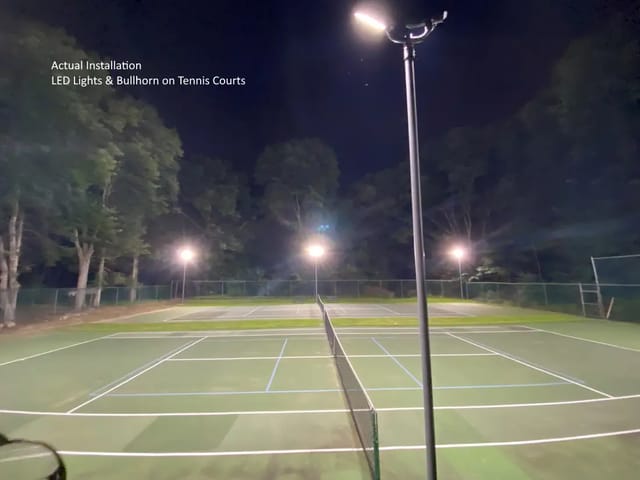
Start with the court, sport, pole locations, and photometric layout, then select fixtures and controls.
Sport Court Lighting Guide
Sport court lighting is about ball tracking and visual comfort, not simply putting bright fixtures on poles. Tennis, basketball, pickleball, volleyball, and multi-use courts each need a layout that considers court dimensions, pole setbacks, mounting height, aiming, glare, spill, uniformity, and nearby homes.
What to Check First
- Identify the sport, level of play, court dimensions, pole locations, and nearby property lines.
- Use photometrics to review light levels, uniformity, vertical visibility, glare, spill, and dark corners.
- Confirm pole wind load, fixture EPA, electrical work, controls, and local requirements before installation.
Application Decision Table
| Use Case | Practical Guidance |
|---|---|
| Residential court | Prioritize glare control, neighbor impact, pole setbacks, and easy controls. |
| Club or park court | Use a layout with consistent coverage, service access, and scheduling controls. |
| Multi-sport court | Aiming and uniformity must work across more than one playing pattern. |
Specification Checklist
- Court dimensions
- Pole height and setback
- Fixture distribution
- Aiming plan
- Uniformity and glare
- Controls and curfew
Common Mistakes to Avoid
- Using fixed footcandle numbers without a court layout.
- Mounting lights too low and creating player glare.
- Promising fixed value or glare-free play without photometrics.
Sport Court Lighting Should Be Designed From the Court Outward
A sport court lighting plan should start with the court dimensions, sport, level of play, pole setbacks, mounting height, target light level, uniformity, glare, spill light, and neighbor impact. The fixture count comes later, after the aiming and pole layout are clear.
| Court type | Planning focus |
|---|---|
| Basketball | Uniform light across the key, perimeter, and backboard area. |
| Tennis or pickleball | Low glare, good vertical visibility, and careful pole placement outside play. |
| Volleyball | Ball tracking, pole height, and avoiding glare in jump/serve sightlines. |
| Residential courts | Spill control, timers, warmer CCT where appropriate, and neighbor boundaries. |
More Details to Consider
Sport court lighting should be planned around the sport, court size, player sightlines, pole locations, mounting height, glare, spill light, and neighbor impact. A backyard half court, a club tennis court, and a municipal pickleball court should not use the same rule of thumb.
Pole height and fixture aiming matter as much as wattage. Higher poles can improve uniformity and reduce harsh angles, but the pole, foundation, wind load, wiring, and local rules still need to support the design.
Use photometrics for serious projects and review the result after dark. The court should have usable light on the playing surface, enough vertical visibility for the ball, and controlled glare for players, spectators, and nearby properties.
Frequently Asked Questions
- How do you light a sport court?
- Start with the court, sport, pole locations, and photometric layout, then select fixtures and controls.
- What pole height is best?
- It depends on the court, setbacks, fixture optics, and glare target.
- Do neighbors matter?
- Yes. Shielding, aiming, CCT, curfew controls, and pole placement can reduce spill and complaints.
- Can existing poles be reused?
- Sometimes, but pole condition, wind load, EPA, height, and wiring should be reviewed.

Ready to Upgrade Your LED Lighting?
Our lighting specialists can help compare fixtures, confirm light levels, and quote products that fit the site.
Call 800-674-9420 or email [email protected]
Monday-Friday, 8am-5pm PST

About the Author
Dara Greaney is founder and CEO of LED Light Expert with deep expertise in commercial LED lighting, retrofits, and photometric planning.
Editing by David Peguero

Trusted by Thousands
Our customers love us — and we love them back.


-
 Free Shipping
On orders over $49.00
-
 Free Extended Warranty
Up to 7 Years Free Warranty On LED Lights
-
100% Satisfaction Guarantee
