A bullhorn wall mount plays a direct role in fixture stability, beam accuracy, and long-term reliability. In commercial exterior lighting applications, the mounting system carries not only the weight of the luminaires but also the dynamic forces created by wind, vibration, and temperature shifts.
Improper mounting hardware can result in fixture sagging, misalignment, premature fastener failure, and unnecessary strain on building structures. In parking lots, loading docks, and large building facades, misaligned fixtures reduce uniformity and create dark zones that impact visibility and liability exposure.
A wall mount bullhorn is not simply a bracket. It functions as a structural extension of the building envelope and must be selected accordingly — sized against fixture weight, wind-driven moment load, and the strength of the wall it attaches to.
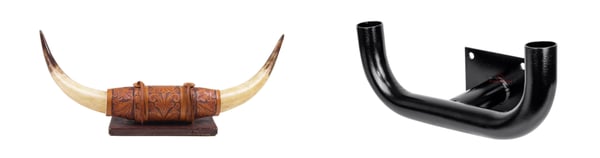
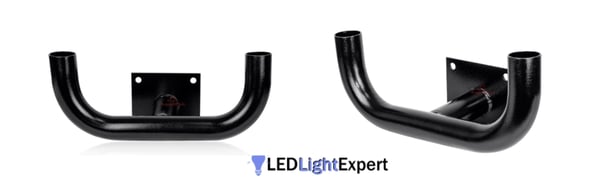
Bullhorn adapter example.
What is a bull horn wall mount?
Basic design and function. A
bullhorn wall mount is a fixed wall-mounted bracket designed to support one or more area lights, flood lights, or shoebox fixtures. The defining characteristic is the dual-arm or multi-arm configuration extending outward from a central mounting plate. These horizontal arms resemble a bull's horns, allowing multiple luminaires to be installed from a single wall attachment point.
The central backplate anchors directly to a structural wall surface. From that plate, one or more steel arms extend outward to carry lighting fixtures. The configuration may include two, three, or four arms depending on application requirements.
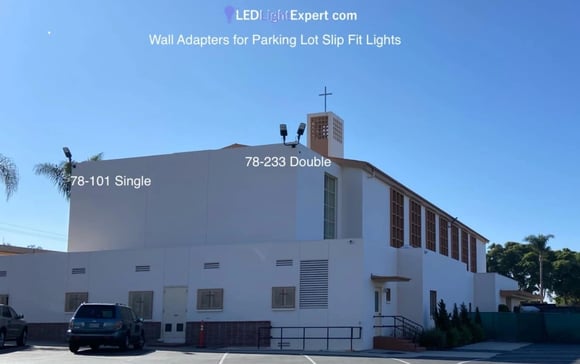
This mounting method allows multiple fixtures to project light outward and downward from a vertical structure without the need for a pole. In many commercial retrofits, it provides a cost-effective alternative to installing new light poles — standalone poles add 60 to 120 feet of trenching, a concrete foundation, conduit runs, and a pole base permit, which together commonly add $3,000 to $8,000 per mounting location.
How it differs from slip fitter and straight arm mounts.
A slip fitter mount is designed to attach a fixture to the top of a round pole. It slides over the pole and secures with set screws. It is commonly used in parking lot pole lighting applications, where the 2-3/8 inch OD tenon is the industry standard.
A straight arm mount, in contrast, supports a single fixture and extends straight out from a wall. It does not branch into multiple arms. Straight arms are common for building-mounted shoebox lights or single wall-mounted area lights.
A bullhorn wall mount differs in three key ways: it supports multiple fixtures from one wall plate, provides wider distribution coverage without additional mounting points, and increases structural load at a single connection location. Because multiple fixtures share one mounting plate, load distribution and structural anchoring become more critical than with single straight arm systems.
Because multiple fixtures share one mounting plate, load distribution and structural anchoring become more critical than with a single straight-arm system. The math scales quickly — doubling the fixtures doesn't just double the weight, it can more than double the moment load at the plate if the arms project further to prevent optical overlap.
Typical commercial use cases.
Bull horn wall mounts show up in three commercial environments most often. In parking lots, when a building sits adjacent to
open parking areas, fixtures can be mounted on exterior walls rather than installing standalone poles — cutting trenching, pole base construction, and conduit runs. On building exteriors, large warehouses, distribution centers, and retail buildings use multi-arm configurations to illuminate wide exterior zones from high mounting heights. At
loading dock areas, bull horn mounts allow several fixtures to be aimed strategically for dock doors, truck bays, and pedestrian paths — overlapping beam patterns that eliminate shadows between bays.
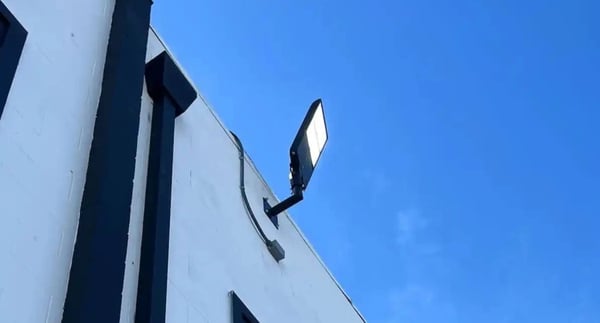
Wall-mounted bullhorn projecting light outward and downward without a pole.
Weight capacity and structural strength
Importance of load rating. Load rating is a foundational consideration when selecting a bullhorn wall mount. Each fixture adds static weight to the mounting arms. In multi-fixture configurations, total weight accumulates quickly.
Commercial LED area lights often weigh between 5 kg and 20 kg per fixture depending on wattage and housing material — roughly 11 to 45 pounds. A dual or triple fixture configuration can place significant demand on the mounting plate and arms.
Manufacturers typically specify maximum supported weight or recommended fixture limits. Exceeding this rating risks metal fatigue, plate deformation, or fastener stress over time. What actually breaks mounts, though, is the moment load — fixture weight multiplied by arm length. A 20-pound fixture on a 24-inch arm creates 480 pound-inches of bending moment at the plate. Add wind pressure and that number can double or triple in exposed locations.
Structural strength must be evaluated in two parts: arm strength under bending load, and backplate strength at the wall interface. The backplate must distribute load evenly across anchor points. Thin plates or undersized hardware may introduce flex under stress — and flex is how anchors fatigue out over three to five years of weather cycling.
Accounting for wind load and vibration.
Wind load is frequently underestimated in exterior wall-mounted lighting. Fixtures act as surface area collectors. Strong wind events generate lateral forces that transfer through the arms into the mounting plate.
Higher mounting heights increase wind pressure exposure. Large shoebox fixtures create additional drag compared to compact flood lights. In addition to wind, vibration from nearby traffic, industrial machinery, or repeated door impact in loading dock environments can gradually loosen hardware if the mount lacks rigidity.
Effective Projected Area (EPA) is the industry term for the square-foot area the wind "sees" when it hits a fixture — a typical 240W LED shoebox has an EPA of 0.9 to 1.2 square feet. ASCE 7-22 (Minimum Design Loads for Buildings and Other Structures) gives the design methodology. Basic wind speeds range from 85 to 170 mph depending on the region, with most of the continental United States falling between 105 and 130 mph for standard risk category buildings. In a 120 mph Exposure C zone, a single 1.0 square foot EPA fixture can see 35 to 45 pounds of lateral force during design wind events. Multiplied across a quad-arm configuration and lever-armed 30 inches out from the wall, that becomes a 4,200+ pound-inch moment load at the plate — a number that drives anchor selection more than fixture weight ever will.
When evaluating a Bullhorn Wall Lights Mount, structural considerations should include fixture frontal area (EPA), local wind conditions, mounting height, and wall substrate type. Steel thickness and weld quality directly influence resistance to long-term stress — specify AWS D1.1 weld compliance in the procurement documents.
Matching mount strength to fixture size and quantity.
Selecting a wall mount bullhorn requires matching mount capacity to number of fixtures, individual fixture weight, and fixture size and wind profile. Oversizing the mount relative to fixture weight provides added margin against structural fatigue. Undersizing creates unnecessary risk that won't show up until five years later when a weld cracks.
For example: two small 100W LED fixtures impose a different load profile than two 300W high-output shoebox lights. Three compact flood lights may weigh less than one large area light but create greater wind drag due to multiple exposed surfaces. Structural planning should evaluate total effective load — static weight plus wind-induced moment — rather than simply counting fixtures. Commercial installations benefit from reviewing combined fixture weight, arm length, and projected wind exposure before finalizing the bullhorn wall mount selection.
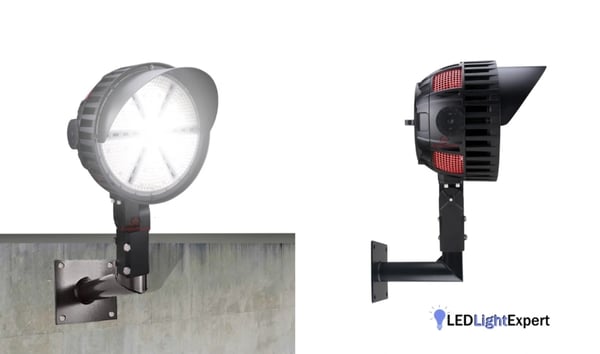
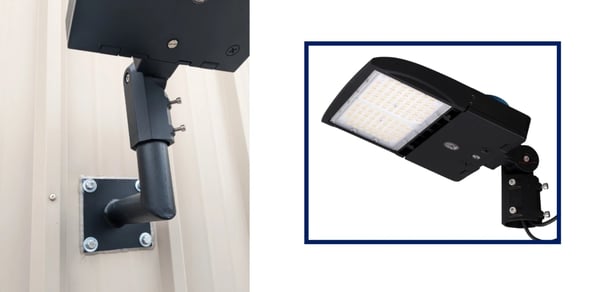
Single-arm bullhorn adapter — LED sports light example.
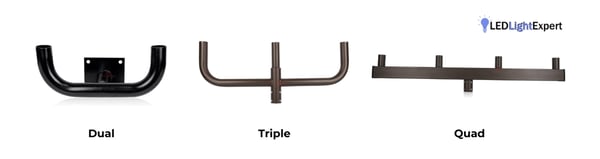
Arm count: single, dual, triple, or quad
Single, dual, triple, or quad arm options. The number of arms on a
bullhorn wall mount determines how many fixtures can be supported from a single mounting plate. Commercial applications typically offer single, dual, triple, or quad arm configurations.
A single-arm configuration functions similarly to a straight arm but may provide additional reinforcement at the plate. It is used in situations where structural constraints limit load capacity or where light coverage needs are narrow.
Dual-arm bullhorn wall mount systems are common for mid-sized parking areas and building perimeters. Two fixtures mounted symmetrically increase coverage without requiring additional wall penetrations.
Triple and quad arm configurations are designed for wide distribution needs. Large warehouses, distribution facilities, and commercial campuses often use multi-arm setups to replace pole-mounted lighting along exterior walls. However, each additional arm increases bending load at the wall connection — and the increase is often non-linear, since longer or heavier arms compound both gravity load and wind-driven moment.
More arms provide greater lighting reach, but they also amplify structural demands. Selection must reflect both lighting objectives and wall capacity.
Light distribution and coverage planning.
Fixture count should be determined through photometric planning rather than visual estimation. A wall mount bullhorn allows multiple fixtures to project outward, but the spacing and aiming angles affect uniformity.
Proper configuration requires evaluating mounting height (typical commercial wall-mounts land between 18 and 35 feet above grade), fixture beam angle (Type II medium for asymmetric asphalt wash, Type III for wider parking coverage, Type V for open yards), overlap between light patterns at the target plane, and distance from wall to target area.
In parking lots, dual-arm systems may aim fixtures at slight outward angles to reduce dark zones directly beneath the mounting point — typically 15 to 30 degrees off the wall normal. In loading dock areas, multiple arms may be aimed downward and slightly outward to eliminate shadows between bays and keep dock workers visible to truck drivers.
Over-concentration of fixtures in one location can create high-intensity zones near the wall and insufficient light farther out. Photometric analysis helps determine whether additional wall-mounted positions are required rather than increasing arm count at a single location.
A Bullhorn Wall Lights Mount should support the lighting layout strategy, not replace it.
Balancing aesthetics with functionality.
Commercial buildings often require lighting that supports brand image and architectural consistency. Large multi-arm systems can appear industrial, particularly on retail or office facades.
Architectural teams may prefer fewer arms distributed across multiple mounting locations to maintain symmetry. In contrast, industrial facilities typically prioritize coverage and durability over appearance.
Arm length, spacing, and overall projection distance influence how visible the structure appears against the building. Powder-coated finishes and color matching can help integrate the mount visually with wall surfaces — RAL 9005 black, 9004 signal black, or architectural bronze are the common specifications for recessing hardware visually.
Functional performance must remain the priority. Reducing arm count for visual reasons without adjusting lighting design may compromise coverage and uniformity — the result is worse illumination and a nervous facilities manager.
Arm count determines fixture capacity — and concentrates moment load at the plate.
Material and durability of Bullhorn Wall Lights Mount
Steel vs aluminum construction. Material selection affects strength, longevity, and weight capacity. Most bullhorn wall mount systems are constructed from steel due to its higher tensile strength and resistance to bending under load — typically hot-rolled carbon steel (A36 or A500 Grade B).
Steel mounts are well suited for multi-fixture configurations and higher wattage luminaires. The rigidity of steel reduces flexing under wind stress, especially in triple or quad arm designs where small amounts of flex amplify into meaningful deflection at the fixture end.
Aluminum mounts offer lighter weight and natural corrosion resistance. They are typically used in lower-load applications or where structural wall limitations require reduced mounting weight — 6061-T6 aluminum is common for single-arm and compact dual-arm configurations.
Steel is generally preferred in commercial exterior installations where structural reliability under wind and vibration is a concern. Stainless steel (AISI 304 or AISI 316) shows up in coastal and industrial-exposure installations — 316 has significantly better chloride resistance than 304 (Pitting Resistance Equivalent Number around 24 vs 19), which matters when the fixture spends its life within a mile of salt water.
Powder-coated finishes for corrosion resistance.
Exterior wall-mounted lighting systems face continuous exposure to moisture, UV radiation, and airborne contaminants. Surface protection is essential.
Powder-coated finishes create a durable protective layer that resists chipping and corrosion. Compared to standard painted finishes, powder coating bonds more evenly and withstands prolonged weather exposure. The spec language matters: AAMA 2604 is the standard commercial grade — five years of South Florida exposure without significant degradation. AAMA 2605 is the premium architectural spec — ten years of South Florida exposure, and what most architects specify for visible commercial hardware.
In coastal environments or areas with high humidity, corrosion resistance becomes even more important. Steel bullhorn wall mount systems without proper coating may develop surface rust that weakens structural integrity over time. Hot-dip galvanizing per ASTM A123 is another approach — a 3.9 to 5.9 mil zinc layer applied before any finish coat, giving decades of corrosion resistance even if the top coat is scratched.
Finish quality should be evaluated alongside material strength. A structurally sound mount can still fail prematurely if corrosion compromises welds or fastener points.
Outdoor weather resistance considerations.
Beyond corrosion, outdoor performance involves resistance to freeze-thaw cycles, thermal expansion and contraction, UV degradation, and water infiltration at mounting points.
Temperature fluctuations cause expansion and contraction of metal components. Steel moves roughly 0.0000065 inches per inch per degree Fahrenheit, so a 100°F annual swing produces small but cumulative cycling over a 20-year service life. Over time, repeated movement can loosen improperly installed hardware if lock washers or thread-locking compound were skipped.
Wall penetration points should be sealed to prevent moisture from entering the building envelope. While the Bullhorn Wall Lights Mount itself does not provide sealing, its installation must account for water management — moisture that gets behind the mounting plate will corrode anchors from the inside-out, which is the failure mode that catches people by surprise.
In regions prone to heavy storms, structural hardware such as anchor bolts and backing plates must match the mount's load capacity. Mount strength is only as reliable as the anchoring system supporting it.
Wall mount bullhorn - dual tenon adapter - LED Light Expert.
Compatibility with light fixtures
Slip fitter compatibility. Many commercial LED area lights are designed with slip fitter mounting options. When pairing a bullhorn wall mount with slip fitter fixtures, arm diameter must match the fixture's slip fitting collar.
Standard outer diameters commonly include 60 mm or 76 mm arms, but exact sizing varies by manufacturer — 2-3/8 inch OD is the most common US outdoor pole tenon, with 3-inch (76 mm) used for higher-load fixtures. Improper diameter matching prevents secure attachment and may require adapters, and shims should not be used to bridge a mismatch — if the collar doesn't seat correctly, the fixture will rotate under wind.
Slip fitter compatibility allows angle adjustment during installation. This is useful when aiming fixtures outward from a building facade to achieve consistent coverage.
Compatibility verification should include arm diameter, minimum insertion depth (at least 2 inches), set screw clearance (set screws must bite into the tenon, not onto a weld bead), and fixture weight rating relative to arm capacity.
Direct mount compatibility.
Some fixtures use
direct mount brackets instead of slip fitters. In these cases, the wall mount bullhorn must provide a compatible flat mounting surface or cross-arm drilling pattern.
Direct mount configurations are common for flood lights or specialty luminaires. These fixtures may attach using U-brackets, yoke brackets, or custom mounting plates.
Arm spacing and drilling alignment must match fixture hardware requirements. Adapting incompatible systems can introduce stress points or reduce structural integrity — any field-drilled hole needs to be cold-galvanized and sealed to prevent corrosion propagation from the hole perimeter.
Bolt pattern alignment and hardware requirements.
Hardware alignment is often overlooked during procurement. Bolt hole spacing on the fixture must align with the mounting arm or plate design.
Pre-drilled arms simplify installation but limit flexibility. Custom drilling may void manufacturer warranty or reduce corrosion resistance if protective coatings are damaged.
Hardware selection should consider bolt grade and corrosion resistance (Grade 5 or 8 for load-bearing, hot-dip galvanized or stainless for exposure), washer size to distribute load, and locking mechanisms to prevent loosening under vibration — nylon insert nuts, thread-locker, or double nuts are the standard approaches.
A properly matched Bullhorn Wall Lights Mount eliminates the need for field modifications and reduces installation time while maintaining structural integrity.
Single-arm bullhorn adapter — slip-fit flood light configuration.
Mounting surface considerations for Bullhorn Wall Lights Mount
Wall material. The structural performance of a bullhorn wall mount depends heavily on the wall substrate supporting it. The mounting plate transfers static and dynamic loads directly into the building structure. Not all exterior wall materials are suited for multi-fixture configurations without reinforcement.
Concrete walls provide the most reliable base. Solid poured concrete or reinforced concrete block offers high compressive strength and consistent anchor performance. These surfaces are well suited for dual, triple, or quad arm configurations when proper anchors are used.
Brick veneer presents more complexity. Anchoring directly into brick without engaging the structural backing can result in cracking or pull-out under load. In veneer applications, anchors should extend through the brick into structural framing or concrete behind the facade — typically with longer expansion anchors or through-bolted threaded rod sized to the clear distance through the veneer.
Metal siding systems require special attention. Light-gauge steel panels are not structural. Mounting a Bullhorn Wall Lights Mount directly to metal siding without reinforcing to internal framing members will lead to deflection and potential failure. Structural steel columns or reinforced framing behind the siding must carry the load, usually through backing plates on the interior face.
Mount selection must reflect the strength of the underlying building structure, not simply the visible exterior material.
Anchor requirements and reinforcement.
Anchors are responsible for securing the wall mount bullhorn to the building. The size, grade, and embedment depth of anchors must match the total projected load.
For concrete installations, expansion anchors or wedge anchors are commonly used. Embedment depth should align with manufacturer recommendations and account for expected wind forces — 1/2-inch wedge anchors (ASTM F1554 Grade 36 or 55) at 3-1/4 to 4-1/2 inch embedment are the standard specification for single and dual-arm mounts, stepping up to 5/8-inch anchors at 5-inch embedment for triple and quad configurations, or switching to adhesive-anchored threaded rod (ASTM F1554 Grade 55 or 105) for higher tension capacity.
In hollow block or masonry, sleeve anchors or through-bolts with backing plates may be required. Reinforcement plates inside the wall cavity distribute load across a larger surface area and reduce point stress — and prevent an anchor from pulling through a single block under wind-driven moment.
Load evaluation should include total fixture weight, arm projection distance, wind exposure, and mounting height. The longer the arm projection, the greater the bending moment at the mounting plate. Reinforcement may be necessary in high-load conditions to prevent plate flex or anchor fatigue. Torque values matter too — a 1/2-inch Grade 5 bolt typically gets 60 to 90 foot-pounds, 5/8-inch Grade 5 to 120 to 180 foot-pounds. Skip the torque spec and you get either loose bolts or stripped threads.
Ignoring anchor design undermines the structural rating of the bullhorn wall mount itself.
Proper sealing to prevent water intrusion.
Wall penetrations must be sealed to maintain building envelope integrity. While the mount provides structural support, installation quality determines water resistance.
Sealant should be applied around anchor penetrations and behind the mounting plate. Gasket materials or exterior-grade silicone can prevent moisture from entering through bolt holes — ASTM C920 Class 50 is the minimum specification, with butyl tape behind the backplate providing an additional barrier on flat-wall installations.
Improper sealing can allow water to migrate into insulation cavities or interior wall systems. Over time, moisture intrusion can weaken structural components and compromise anchor integrity — steel anchors corroded from the inside can look fine on the surface and still have lost half their tensile capacity.
A properly installed Bullhorn Wall Lights Mount integrates structural anchoring with water management practices.
Longer arm projection = greater bending moment at the mounting plate.
Wind load and environmental factors for Bullhorn Wall Lights Mount
Importance in coastal or high-wind areas. Wind exposure significantly influences bullhorn wall mount selection. Coastal regions and open terrain environments experience higher sustained wind speeds and gust conditions.
Lighting fixtures mounted on extended arms act as wind catch surfaces. Larger fixtures create greater resistance, increasing lateral force at the mounting plate. ASCE 7-22 exposure categories B (suburban/urban), C (open terrain with scattered obstructions), and D (flat unobstructed areas or near large water bodies) determine the wind pressure multiplier — a fixture in Exposure D sees roughly 20 to 40 percent more wind pressure than the same fixture in Exposure B.
In coastal environments, salt exposure adds corrosion stress. Even powder-coated steel systems require careful material selection and maintenance planning to resist surface degradation — AISI 316 stainless fasteners and AAMA 2605 finishes are the standard coastal spec.
High-wind areas may require reduced arm length (shorter moment arm), heavier gauge steel (3/16 inch vs 1/8 inch plate), reinforced mounting plates with gusseting, and upgraded anchor systems.
Selecting a Bullhorn Wall Lights Mount without evaluating environmental exposure increases risk of long-term structural stress.
Local building codes and compliance.
Exterior lighting installations must comply with local building requirements. Wind exposure ratings, anchoring methods, and structural attachments may be subject to inspection depending on jurisdiction — the authority-having-jurisdiction typically references IBC Chapter 16 (structural design) and ASCE 7-22 for wind loads.
While the mount itself may be structurally rated by the manufacturer, compliance depends on proper installation relative to local wind zone classifications and building type.
Commercial projects often require documentation confirming that mounting systems and anchoring methods align with site-specific structural criteria.
Load calculations should consider design wind speed for the region (the ASCE 7-22 wind speed map is the authoritative source), exposure category, mounting height above grade, and building surface type.
Failure to account for local compliance requirements can delay project approvals or create liability exposure when the inevitable named storm rolls through.
Structural engineer considerations for larger installations.
Large-scale commercial projects frequently involve multiple multi-arm wall mount bullhorn installations at elevated heights. In these cases, consultation with a structural engineer may be appropriate.
Engineering review becomes particularly relevant when installing triple or quad arm configurations, mounting high-wattage fixtures with significant wind profile, anchoring to non-standard wall assemblies (EIFS, insulated metal panels, brick veneer, metal siding), or installing above significant pedestrian or vehicle traffic areas where a detachment would create a life-safety hazard.
Structural engineers evaluate load paths and confirm that building framing can support imposed forces. For major warehouse or distribution center installations, this step supports risk mitigation and long-term safety — and the stamped calculations provide the documentation that facilities insurance carriers increasingly require. Engineering fees for a straightforward wall-mount review typically run $1,500 to $4,000 per project, which is inexpensive insurance against a fixture coming loose at 30 feet above a parking lot.
Proper structural planning strengthens the performance reliability of the bullhorn wall mount over its service life.
A good decision on buying a bull horn wall mount starts with the real installation conditions, not just the product name. Check the application, mounting height, voltage, light level, glare, controls, wet or dust exposure, service access, and whether a photometric layout or qualified installer is needed before ordering.





 Free Shipping
 Free Extended Warranty