

Quick Answer
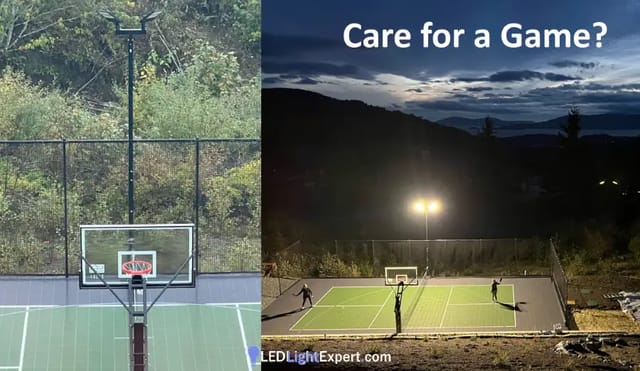
LED court lights can be a strong alternative to metal halide when the design accounts for sport, pole height, aiming, glare, uniformity, spill, and controls.
LED Court Lights vs Metal Halide
LED court lights can be a strong alternative to metal halide when the design accounts for sport, pole height, aiming, glare, uniformity, spill, and controls. The comparison should be made with photometrics, not only fixture wattage.
What to Check First
- Confirm sport, court size, play level, pole locations, mounting height, and target light levels.
- Review glare, spill, uniformity, CCT, CRI, flicker, controls, and aiming.
- Compare maintenance access and warm-up/restrike needs with the existing metal halide system.
Application Decision Table
| Use Case | Practical Guidance |
|---|---|
| Tennis or pickleball | Uniformity, glare, and ball tracking are more important than raw output. |
| Basketball court | Vertical light and spill control may matter at the perimeter. |
| Multi-use court | Use controls and aiming that support more than one activity. |
Common Mistakes to Avoid
- Claiming an LED wattage is automatically equivalent to a metal halide wattage.
- Ignoring glare from player sight lines.
- Making clinical or treatment-style claims from general sports lighting.
Why Courts Moved From Metal Halide to LED
Court lighting depends on visibility, uniformity, glare control, aiming, and instant usability. Metal halide can produce a lot of light, but it has warm-up time, restrike delay, lumen depreciation, and ongoing relamping needs. LED court lights can provide instant-on operation, better controls, and more precise optics when the layout is designed correctly.
| Factor | LED court light advantage |
|---|---|
| Warm-up | Instant light for practices, parks, and scheduled use. |
| Controls | Dimming, zones, timers, and occupancy schedules are easier to manage. |
| Maintenance | Longer service intervals reduce lift work and court downtime. |
| Visibility | Good optics and CRI can improve ball tracking and court comfort. |
Frequently Asked Questions
- What is the main point of LED Court Lights vs Metal Halide?
- LED court lights can be a strong alternative to metal halide when the design accounts for sport, pole height, aiming, glare, uniformity, spill, and controls.
- What should I check first?
- Confirm sport, court size, play level, pole locations, mounting height, and target light levels.
- Do controls matter?
- Yes. Dimming, timers, sensors, photocells, and schedules can change both performance and operating cost.
- When should I ask for help?
- Ask for help when wiring, photometrics, mounting, glare, safety listing, or product compatibility affects the project.
More Details to Consider
LED court lights can be a strong replacement for metal halide when the layout is designed around the sport. Tennis, pickleball, basketball, and multi-use courts each need attention to pole height, fixture aiming, uniformity, glare, spill light, CCT, CRI, and controls.
The energy comparison should be made with delivered light, not only wattage. A lower-watt LED can often replace a higher-watt metal halide fixture, but the result depends on optics, mounting height, beam angle, and the target light level on the court.
LEDs also help with operation. They turn on instantly, work well with timers and dimming, and avoid HID warm-up or restrike delays. Maintenance can be reduced because there are no HID lamps and ballasts to relamp on a normal cycle, although drivers, surge protection, aiming hardware, and controls still need inspection.
Avoid blanket claims that LEDs produce no heat, no glare, no flicker, or no health risk. A good court-lighting project uses photometrics, glare review, and proper controls so players can track the ball comfortably and neighbors are not hit with unnecessary spill light.

Ready to Upgrade Your LED Lighting?
Our lighting specialists can help compare options, confirm light levels, and quote products that fit the site.
Call 800-674-9420 or email [email protected]
Monday-Friday, 8am-5pm PST

About the Author
Dara Greaney is founder and CEO of LED Light Expert with deep expertise in commercial LED lighting, retrofits, and photometric planning.
Editing by David Peguero

Trusted by Thousands
Our customers love us — and we love them back.


-
 Free Shipping
On orders over $49.00
-
 Free Extended Warranty
Up to 7 Years Free Warranty On LED Lights
-
100% Satisfaction Guarantee
