


No. PAR describes the wavelength range, while PPFD describes intensity at the plant surface.
Grow Light Spectrum Guide
Grow lights are not judged the same way as room lights. Human lighting often uses lumens and Kelvin. Plant lighting needs PAR, PPF, PPFD, DLI, spectrum, photoperiod, distance, and crop stage. Kelvin can describe how white light looks to people, but it does not tell you how many useful photons reach a plant canopy.
What to Check First
- Use PAR, PPF, PPFD, and DLI when comparing serious grow lighting.
- Match spectrum and duration to seedlings, leafy growth, flowering, or fruiting.
- Set fixture distance so plants receive enough light without heat stress or uneven coverage.
Application Decision Table
| Use Case | Practical Guidance |
|---|---|
| Seedlings | Often need long daily light duration and even coverage to avoid stretching. |
| Leafy greens | Blue and balanced white light can support compact vegetative growth. |
| Flowering or fruiting plants | Red, far-red, intensity, and photoperiod can matter, depending on the crop. |
Terms to Know
- PAR describes the plant-usable wavelength range.
- PPF describes photon output from the fixture.
- PPFD describes photons reaching a surface each second.
- DLI describes total daily light delivered to the crop.
- Photoperiod describes the light and dark schedule.
Common Mistakes to Avoid
- Using lumens as the main plant-growth metric.
- Confusing Kelvin with PAR output.
- Putting fixtures too close or too far from the canopy.
PAR, PPFD, and Kelvin Are Not the Same
Kelvin describes how white light looks to people. PAR describes the wavelength range plants use for photosynthesis. PPFD describes how much useful light reaches a plant surface each second. A grow light plan should consider spectrum, intensity, distance, photoperiod, coverage, and plant stage together.
| Term | Meaning |
|---|---|
| Kelvin | Human color appearance of white light. |
| PAR | Photosynthetically active radiation range for plant growth. |
| PPFD | Useful light arriving at the plant canopy. |
| DLI | Total useful light received over a day. |
Grow Light Spectrums: Understanding Kelvin, PAR, and Spectrum for Great Growth
When looking at buying LED grow lights, you need to understand two fundamental things: 1. what kind of light you are using, and 2. how much of it. In this article we dive into the kind of light, starting with the spectrum. This is a critical concept for getting the right light for your plants, vegetables, or cannabis.
Light spectrum is the range of wavelengths a light source produces. In this aspect, "light" denotes the visible wavelengths of the EM spectrum visible to the human eye, from 380-740 nanometers (nm). Infra-red (700-1000+ nm), far-red (700-850 nm), and ultraviolet (100-400 nm) wavelengths are known as radiation. As a plant grower, the interest is in the wavelengths relevant to the plants. Plants can detect wavelengths that include far-red radiation (700-850 nm), PAR (400-700 nm), the visible portion of the spectrum (380-740 nm), and ultraviolet radiation (260-380 nm). Plants use light for photomorphogenesis and photosynthesis. For photosynthesis, plants predominantly use light in the 400-700 nm range. That range is called Photosynthetically Active Radiation and has blue, red, and green wavebands. The fundamental photosynthetic pigments are chlorophyll a and b, which strongly absorb blue light (400-500 nm), red light (600-700 nm), and, minimally, green light.
Plants contain photoreceptors that trigger various growth features when activated by photons of specific wavelengths. LED lighting technology provides supplemental light to natural light for the growth of plants.
Blue (400-500 nm) and Red (600-700 nm) Wavelengths
Blue light has a characteristic effect on plant flowering and growth. In higher ratios it increases overall plant quality in ornamental and leafy green crops. A minimal amount of blue light is needed for normal plant development. In combination with the red waveband it promotes production of secondary metabolites, root development, better nutrition, and plant compactness. Its use lowers the need for chemical plant growth regulators (PGRs). It also enhances stomatal opening and chlorophyll accumulation, improving plant health, and boosts secondary metabolic compounds associated with taste, aroma, and flavor. Blue light has been shown to increase terpene retention in some cannabis plants, and it amps up resin and oils.
Red light is a highly effective waveband for promoting plant biomass growth and stimulating photosynthesis. Under red light alone, plants grow tall and stretched with thin leaves - a poor growth pattern. Added to blue light in the correct amount, the balanced light produces compactness. Red is mostly applied for stretching plants when longer internodal spacing is needed and for bulking up plants in early development.

What Is a Full Spectrum Grow Light?
Full spectrum is a term used to imply that a grow light closely resembles sunlight. The source has a spectrum with energy from ultraviolet to infrared, similar to natural daylight. Its appearance is usually white, but not every light that emits white light is a full spectrum grow light. The wavelengths in this band include the visible 400-720 nm range plus invisible wavelengths such as ultraviolet and infrared.
Full spectrum grow lights mimic sunlight with intensity matching conventional HPS lamps. Industrial-grade grow fixtures are almost always full spectrum, with a top-rated LED chip built to hold the spectrum for 50,000 hours. Poor-quality ones dissipate fast.
What Is Spectrum?
Light spectrum can mean the range of wavelengths of EM radiation our eyes are sensitive to (the visible spectrum) or a plot of light intensity vs. wavelength. Simply put, it is the several different wavelengths of energy generated by a light source. Nanometers (nm) are the units for measuring light, with each nanometer representing a band of light energy, or a wavelength of light.
What Is PAR?
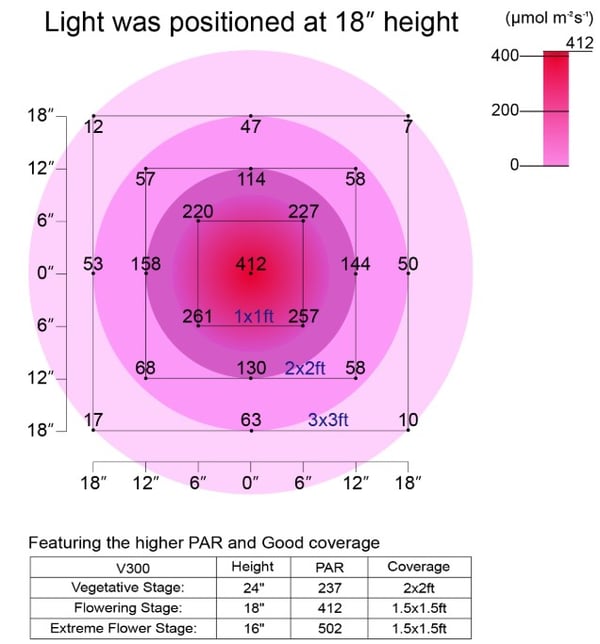
PAR stands for Photosynthetically Active Radiation, a designation for the spectrum of grow lights with color ranges of light from 400-700 nm that are usable by plants for photosynthesis. PAR is typically measured as PPFD - photosynthetic photon flux density - in units of µmol m-2 s-1. It can also be expressed as total photon flux (PPF), which counts all the photons in the PAR range that exit a bulb or fixture. With significant caveats, the higher the PPFD over the total growing footprint, generally the better it grows plants. Too much PAR, however, is wasteful and can damage plants.
PAR measurements do not account for the relative usefulness of specific wavelengths to the plant. Even within the PAR range, some photons are more useful due to the leaves' preferential absorption of different spectra. A high PAR alone does not indicate proper plant growth; the spectrum must be considered. PAR also assumes all photons outside the 400-700 nm range are useless in photosynthesis.
Plants, however, use some light outside PAR - like far-red beyond 700 nm - to increase photosynthetic efficiency, and below 400 nm, UV light enhances secondary metabolites like THC, terpenes, vitamins, and CBD. PAR measurements can vary significantly across a light's footprint, so any single PPFD reading is not sufficiently informative. It is by measuring PAR over the whole footprint at the proper hanging distance, and looking at the whole spectrum, that you can make meaningful comparisons.
What Spectrum Is Best for Cannabis?
For cannabis grow lights, the spectrum is more variable than for other plants. This is attributed to maximizing yields, increasing flowering, regulating THC levels, and maintaining overall uniformity. Beyond the visible color range, cannabis responds well to wavelengths past the PAR range. Full spectrum LEDs are beneficial for adding specific doses of far-red (700-850 nm) and ultraviolet (100-400 nm) wavelengths beyond PAR.
For example, an increase in far-red (750-780 nm) helps stimulate flowering and stem growth, a trait growers want. In minimal amounts, blue light helps prevent leaf shrinkage and uneven stem elongation. For cannabis, there is no single spectrum - varying light exposure enhances plant morphology across growth stages.
Ideal for Small Plants
Spectrum choice is determined by how specific plants use the PAR range for photosynthesis, plus wavelengths beyond 400-700 nm. For small plants, red and blue light accelerate flowering, speed the growth rate, and increase nutrition. Whether the light is supplementary or the sole source (indoor use) also affects which grow light spectrums to use. Photosynthetic efficiency happens at the blue and red peaks, meaning small plants absorb these spectrums during growth.
More Details to Consider
Grow-light spectrum should be discussed with plant-light terms, not just color names. PAR describes the wavelengths plants use for photosynthesis, while PPF, PPFD, DLI, photoperiod, and fixture efficiency describe how much useful light the plant receives and for how long.
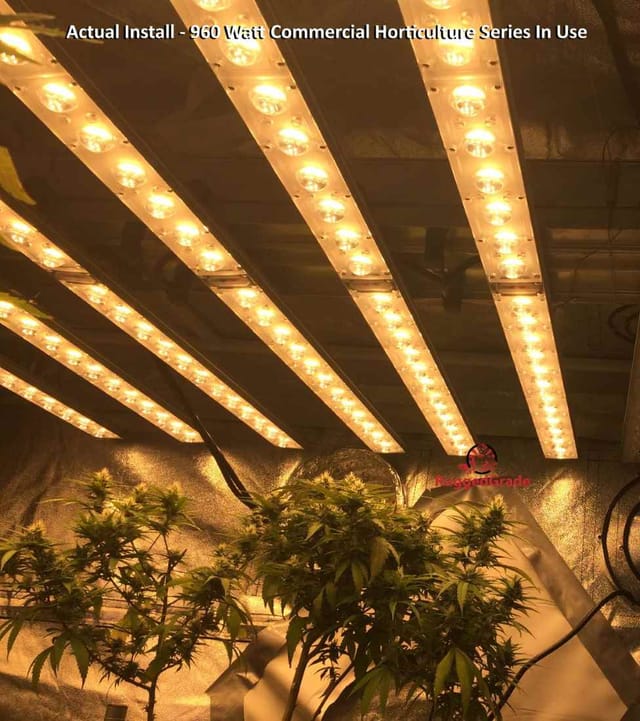
Kelvin can help describe how white light appears to people, but it is not enough to compare grow lights. Review the spectrum chart, PPFD map, hanging height, dimming range, heat load, and crop stage before choosing a fixture.
Different plants and growth stages need different intensity and schedules. Spectrum can matter, but plant genetics, nutrients, temperature, humidity, airflow, CO2, and grower skill also affect results. Avoid yield promises based on spectrum alone.
Frequently Asked Questions
- Is PAR the same as PPFD?
- No. PAR describes the wavelength range, while PPFD describes intensity at the plant surface.
- Do plants use lumens?
- Lumens are based on human vision and are less useful for plant lighting decisions.
- Does Kelvin matter for grow lights?
- Kelvin can describe appearance, but plant response depends more on spectrum and photon delivery.
- How long should grow lights run?
- The correct photoperiod depends on the plant, growth stage, natural light, and growing goal.

Ready to Upgrade Your LED Lighting?
Our lighting specialists can help compare fixtures, confirm light levels, and quote products that fit the site.
Call 800-674-9420 or email [email protected]
Monday-Friday, 8am-5pm PST

About the Author
Dara Greaney is founder and CEO of LED Light Expert with deep expertise in commercial LED lighting, retrofits, and photometric planning.
Editing by David Peguero
2 Comments
shining
Red light helps to stimulate flowering and cannabis stem growth, which is really something I don’t know, thanks for sharing
Sales
Thanks for reaching out. Please feel free to reach out to us directly at 800-674-9420 or [email protected] for pricing/quotes or product info at any time
Pat
Would a full spectrum grow light have the same effect on the human body as sun light?
Sales
Thanks for reaching out. Please feel free to reach out to us directly at 800-674-9420 or [email protected] for pricing/quotes or product info at any time


