

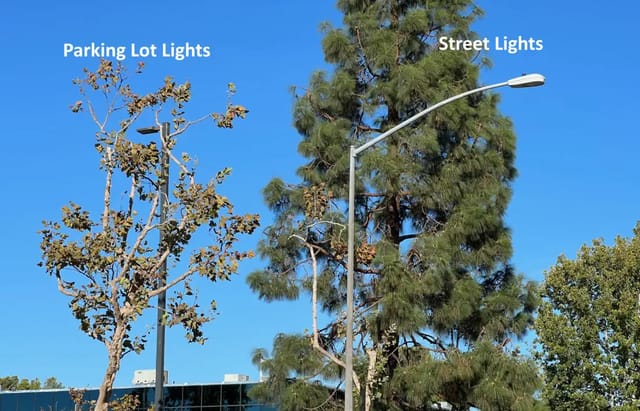
No. They can share LED technology, but optics, layout, mounting, and use cases differ.
Street Lights vs Parking Lot Lights
Street lights and parking lot lights can look similar, but they solve different layout problems. Street lighting usually follows road geometry, lanes, sidewalks, intersections, and municipal requirements. Parking lot lighting usually focuses on vehicle circulation, pedestrian routes, stalls, entrances, storefronts, and property edges.
What to Check First
- Define whether the fixture is lighting a roadway, parking field, pedestrian route, or mixed site.
- Compare distribution pattern, mounting height, pole spacing, glare control, spill light, CCT, and controls.
- Use photometrics when public safety, code, neighbors, or uniformity matter.
Application Decision Table
| Use Case | Practical Guidance |
|---|---|
| Street lighting | Often uses roadway distributions and pole spacing tied to lanes, sidewalks, and intersections. |
| Parking lot lighting | Often uses area distributions for stalls, drive lanes, entrances, and walking routes. |
| Mixed site | May need both fixture types or optics, coordinated in one layout. |
Specification Checklist
- Distribution type
- Pole height and spacing
- BUG or glare data
- CCT and shielding
- Controls
- Maintenance access
Common Mistakes to Avoid
- Using one fixture type everywhere on a mixed site.
- Ignoring pedestrian routes and property edges.
- Creating glare while trying to increase brightness.
The Difference Is the Lighting Geometry
Street lights and parking lot lights can look similar, but they solve different layouts. Street lights usually follow a roadway, sidewalk, or curb line and use optics that push light along a path. Parking lot lights cover open areas with parked cars, pedestrians, drive aisles, entries, and perimeter spill-light concerns.
| Feature | Street light | Parking lot light |
|---|---|---|
| Primary target | Roadway, sidewalk, intersection, or path. | Open parking area, drive aisle, pedestrian route, or perimeter. |
| Typical optics | Roadway-oriented Type II or Type III style distributions. | Area-light Type III, IV, or V distributions depending on pole position. |
| Planning concern | Driver visibility, lane uniformity, glare, and pole spacing. | Uniformity, security, vehicle/pedestrian visibility, spill, and entrances. |
| Fixture choice | Often cobra-head or roadway fixtures. | Often shoebox/area fixtures on poles or wall-mounted fixtures. |
More Details to Consider
Street lights and parking lot lights often share LED components, but they solve different geometry problems. Street lighting follows roadways, sidewalks, intersections, and lanes; parking lot lighting covers stalls, drive aisles, entrances, pedestrians, and property edges.
The biggest difference is usually optical distribution. Roadway fixtures may use Type II or Type III patterns to push light along a road, while parking areas often use Type III, IV, or V depending on pole position and lot shape.
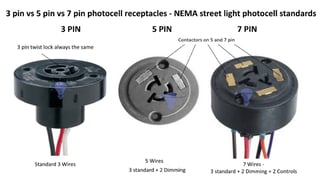
Before substituting one for the other, check pole height, arm or tenon fit, distribution, glare, spill light, CCT, photocell or control type, and the target areas in a photometric layout.
Frequently Asked Questions
- Are street lights and parking lot lights the same?
- No. They can share LED technology, but optics, layout, mounting, and use cases differ.
- Can street lights be used in parking lots?
- Sometimes, but the distribution and layout must fit the lot.
- What should be checked first?
- Check the site geometry, pole layout, target areas, glare, spill, and maintenance needs.
- Do controls matter?
- Yes. Photocells, schedules, dimming, and occupancy settings affect performance and energy use.

Ready to Upgrade Your LED Lighting?
Our lighting specialists can help compare fixtures, confirm light levels, and quote products that fit the site.
Call 800-674-9420 or email [email protected]
Monday-Friday, 8am-5pm PST

About the Author
Dara Greaney is founder and CEO of LED Light Expert with deep expertise in commercial LED lighting, retrofits, and photometric planning.
Editing by David Peguero

Trusted by Thousands
Our customers love us — and we love them back.


-
 Free Shipping
On orders over $49.00
-
 Free Extended Warranty
Up to 7 Years Free Warranty On LED Lights
-
100% Satisfaction Guarantee
