


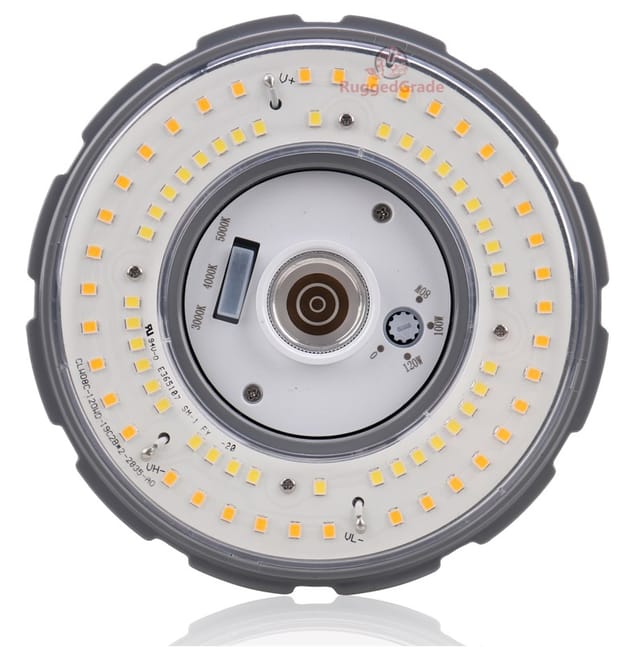
Kelvin selectable lights are LED fixtures with two or more color temperatures built into the same product. A switch on the fixture or the driver picks the setting, most often 3000K, 4000K, or 5000K, with some families running from 2200K to 6000K. The LEDs never change color. The selector changes which set of diodes is energized, so the color gets decided on the job site instead of guessed at on the order.
What Are Kelvin Selectable or Color Selectable Lights?
Kelvin selectable lights are made with distinct white light settings to enable you to adjust the color of the light at the fixture itself, typically 3000K warm or 5000K daylight. They can adjust between different color temperatures with a switch on the housing, a jumper on the driver, or on some models a remote. Nothing about the wiring or the install changes. The selection happens inside the fixture.
These selectable lights are manufactured with pre-set color temperature steps that run from warm through daylight white, not a continuous slider. Also, these lights are not manufactured with red, blue, or green channels. They are not color-changing fixtures. Their dominant light color is white that can be shifted along the Kelvin scale to produce the result you want. These selectable lights are distinct from tunable lights based on their blending degree.
These LED light fixtures and LED corn light bulbs are manufactured with a color temperature range from 2200 to 6000 kelvins, depending on the family. You can see the full line on our Kelvin selectable lights page. Sometimes people find difficulty selecting between settings that look almost identical on a spec sheet. Our technical team is always available to help you make that call before you order.
Do I Want Tunable LED Lights
Tunable lights allow you to choose three different Kelvins from a single fixture, and the word gets used loosely in catalogs, so it is worth being precise. A Kelvin selectable fixture has two or more fixed CCT steps, chosen once, usually at installation, and then left alone. A tunable white system is built for ongoing control: the color temperature moves on a dimmer, a scene, or a lighting control system while the space is occupied.
For most commercial work, selectable is the one you actually want. A warehouse, a parking lot, a shop, a wall pack over a back door, none of these need the color temperature to change during the day. What they need is one part number that covers several jobs. Tunable white earns its cost in spaces where light is part of the experience or the schedule: hospitality, healthcare, circadian applications, studios, high-end retail.
The Kelvin switch also frequently sits alongside a wattage selectable switch, so a single unit covers several power and color combinations. That is where the inventory math starts to get compelling for a contractor.
Can be 3000K, 4000K, 5000K, or could be just 4000K, 5000K
These lights are not always the same, the kelvin selectable lights can be anywhere from 2 to 6 different kelvins. They can be 3000, 4000, 5000, or maybe just 4000k and 5000 Kelvins. Others reach down to 2200K or up to 5700K. The variety in these kelvins provides you with real options for the space, so read the spec sheet before you assume the setting you want is on the switch.
The specific numbers are not arbitrary. ANSI C78.377 defines the chromaticity ranges for nominal white CCTs in solid-state lighting, which is why manufacturers cluster on 2700K, 3000K, 3500K, 4000K, 5000K, 5700K and 6500K rather than picking round numbers at random. The 2024 revision added 1800K and 2000K to cover outdoor and special-application products, so the warm end of the Kelvin scale is still expanding.
| Kelvin setting | What it looks like | Where it belongs |
|---|---|---|
| 2200K | Deep amber warm, close to the look of high pressure sodium | Dark-sky and wildlife-sensitive sites, hospitality accents |
| 3000K | Warm color that reflects golden yellow | Homes, hospitality, lobbies, offices that want a relaxed feel |
| 4000K | Cool white, neutral and precise | Garages, retail, general work areas, mixed-use interiors |
| 5000K | Pure white, close to daylight | Warehouses, security, parking lots, detail and task work |
| 5700K | Bright daylight with a slight blue cast | Sports lighting and industrial visibility work |
The 3000 Kelvin light produces a warm color that reflects golden yellow. The warmer light produces a cozy and relaxed environment that suits a lobby, a restaurant, or a front office. The 5000 kelvin produces a pure white light that promotes an energetic ambiance in the room. The 5000 Kelvin light can be used if you require to illuminate your facility to reveal extraordinary detail, which is why it dominates warehouses, parking lots, and inspection work. The 4000 Kelvin setting sits between the two and produces the cool white most people call neutral, and it can trigger vibrancy and precision in the people working under it. These Kelvin selectable lights allow you to tune your environment according to your desired preference without reordering a single fixture. They also provide flexibility if you desire to use one fixture family across multi-functional spaces.
One thing the Kelvin switch does not do is change how bright the light is. Brightness is lumens. Color temperature is appearance. They are independent, and a 5000K fixture is not brighter than the same fixture at 3000K because it looks whiter. In practice most selectable fixtures vary by a few percent in delivered lumens between settings, and a good spec sheet lists the lumens at each setting rather than one headline number.
Understanding the color temperature range of the light fixture is crucial in improving your lighting experience, and it is only half of the picture. The color temperature produced also corresponds to the color rendering index, which determines how you view colored objects under illumination. Two fixtures at the same 4000K can render a red safety sign very differently at 70 CRI and at 90 CRI, so read both numbers on the spec sheet. The color temperature guide goes deeper on how the two interact.
How Does It Work?
Answer: A double or more set of LEDs on board. It might have 3000K and 5000K, and then it uses both to blend for 4000K. A double set of LEDs is connected to the circuit board of the light fixture, and the mechanism is a good deal simpler than most people assume.
The circuit board might be installed with 3000 and 5000 Kelvin LEDs on the same board. The resultant effect is the production of light that averages 4000 Kelvin. Therefore, the light fixture will produce a clean white that reads bright and neutral in the space. Most of the color temperatures produced arise from the average temperatures produced from the individual LEDs that are lit at that moment.
As a customer, you must understand the color temperature output for the LEDs used in the lighting fixture, because the middle setting is a blend rather than a purpose-built 4000K diode. Its CRI and delivered lumens can differ slightly from the endpoints. Ask for the numbers at each setting, not just the nominal one.
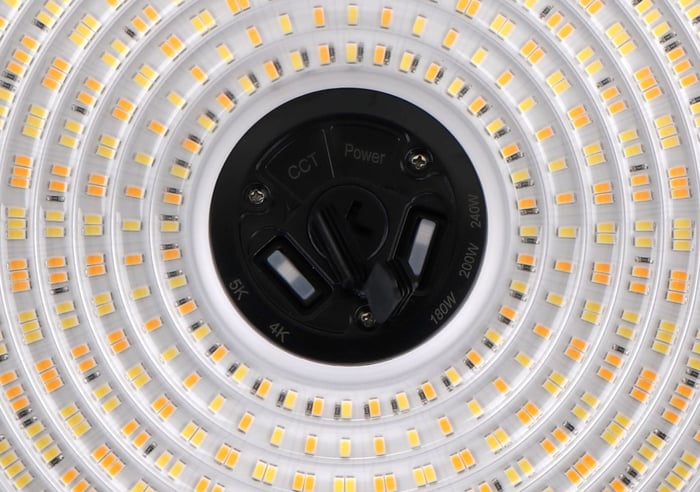
A close up view of the Titan 5 Series UFO with new color and wattage selectable
The LEDs do not change colors. The system changes which LEDs are on.
Some people think that kelvin selectable lights are complex in their functionality, especially with color transitions. They are not. These LEDs themselves do not change colors, because an LED die emits one color temperature for its entire life. They change the LEDs that are connected at any given moment.
They do not function as dimmers but instead have LEDs that emit light corresponding to the specific color temperature. Some people also think that these lights are manufactured with color mixing features which is not the case. Therefore, you can adjust the color temperature produced for your space depending on the LED light switched on. This critical feature gives you complete control over how the space reads without changing the fixture, and there is nothing extra inside it to fail.
Why is this popular?
More choices for customers The popularity of the Kelvin selectable lights has also been attributed to numerous choices available for customers. The different color temperatures produced by these lights give you the choice to change colors, even after they have been installed. For electricians, this is a life saver. Customers only know what they want, AFTER they have been installed, and a selectable fixture turns what would have been a callback and a restock into a flip of a switch on a ladder.
Easier for customers who are not sure. Plenty of buyers cannot picture the difference between 3000K and 5000K from a catalog photo, and no photo is honest about it anyway. A selectable fixture moves the decision off the purchase order and onto the job site, where you can see it on the actual wall, at the actual mounting height, next to the actual finishes.
Less SKUs for lighting companies Kelvin selectable lights have fewer SKUs for the different lighting companies. SKUs are stock-keeping unit codes used by lighting companies to monitor their sales and inventory. Most of these SKU codes are fed with product information, such as size, color, brand, and style. Kelvin selectable lights are manufactured in varieties to provide the customer with their preference, which would normally multiply those codes. However, they are made with fewer specific features, providing fewer SKU codes, and that keeps more of the catalog in stock and shortens lead times.

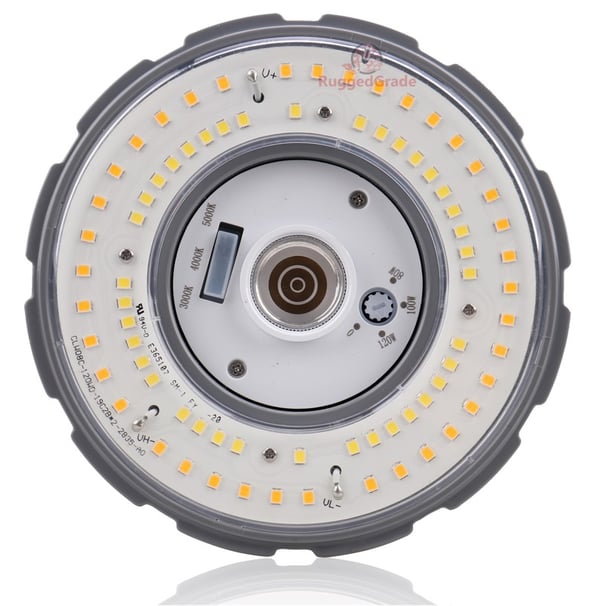
New Revati series has both wattage or power selection and 3 Kelvin selection right onboard
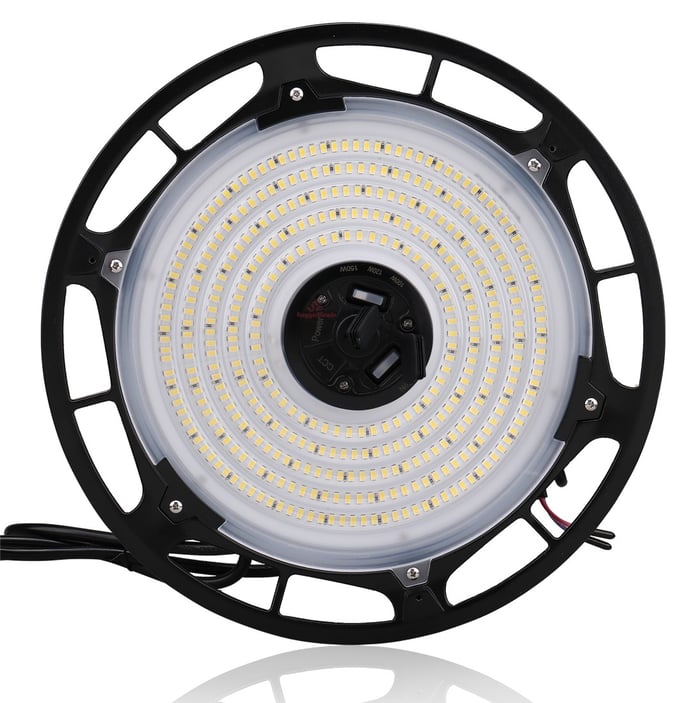
Titan V CS Series UFO High Bay Light
What Kind of Lights Have them
Selectable color temperature now shows up across most major commercial fixture families:
- High Bay Lights - Titan 5 series
- LED Corn Light Bulbs - Aries 3 CS Series
- LED Parking Lot Lights - Revati Series
- LED Wall Pack Lights - Durado III CS Series
- LED flood lights - Kivo CS Series
- and more
Decide if Kelvin selectable or color temperature selectable is right for you
The kelvin selectable lights are easier for customers who are unsure about their facility's light fixture preference. Have you been wondering what color temperature to install for your lighting needs? Have you constantly desired to adjust your facility's illumination depending on the occasion? If either question lands, the switch is doing real work for you.
If you already know the answer, a fixed-CCT fixture is fine and often costs a little less. A warehouse that will be 5000K forever does not need the option. Where there is any doubt, or where you are buying for several buildings at once, the selectable version is worth the small premium, because the cost of guessing wrong is a return, a restock, or a crew back on site.
You can see the full range on our Kelvin selectable lights page. If you already know the color you want, start with a specific temperature such as 3000K LED corn light bulbs, 4000K, or 5000K.
Tunable Technology is a trademark of RuggedGrade Lighting.
More Details to Consider
Kelvin selectable lights let the installer choose the kelvin setting on site, usually with a switch on the fixture or the driver. They earn their keep when the final look is uncertain, when a space may change use, or when a facility wants one fixture model standardized across several areas and buildings.
Selectable CCT is different from full tunable lighting. A selectable fixture is usually set during installation and left alone. Tunable white systems are designed for ongoing user control through dimmers, scenes, or a lighting-control system.
Document the final setting after installation. Light output can vary slightly by CCT, and mixed settings in the same room or aisle can look accidental. Labeling the selected wattage and Kelvin setting helps future maintenance match the original layout.
Frequently Asked Questions
- What are Kelvin selectable lights?
- LED fixtures built with two or more color temperatures on the same board. A switch on the fixture or the driver selects which set of LEDs is energized, most commonly 3000K, 4000K, or 5000K.
- What does selectable CCT mean?
- CCT stands for correlated color temperature and is measured in kelvins. A selectable CCT fixture lets you choose among preset kelvin settings at the fixture instead of ordering one fixed color temperature from the factory.
- What does 5000K mean in lighting?
- 5000K is a pure white close to natural daylight. It is the usual choice for warehouses, parking lots, security lighting, and any task where fine detail matters. It is not brighter than 3000K; it only looks whiter.
- Is Kelvin the same as brightness?
- No. Kelvin describes how the light appears and lumens describe how much light is produced. Most selectable fixtures vary only a few percent in delivered lumens between settings.
- Are selectable and tunable lights the same?
- No. Selectable fixtures step between preset color temperatures and are usually set once at installation. Tunable white systems are built for ongoing user control through dimmers, scenes, or a lighting control system.
- Can I change the Kelvin setting after the light is installed?
- Yes, as long as the switch is still reachable. That is the main reason electricians favor them. Mount the fixture so the selector stays accessible, and label the setting you chose so whoever services it next can match it.


Ready to upgrade? Tell us the space and we will size it with you.
Our lighting specialists can help compare fixtures, confirm light levels, and quote products that fit the site.
Call 800-674-9420 or email [email protected]
Monday-Friday, 8am-5pm PST

About the Author
Dara Greaney is founder and CEO of LED Light Expert with deep expertise in commercial LED lighting, retrofits, and photometric planning.
Editing by David Peguero
1 Comments
rcgold
What a great product


