Car dealerships rely on strong visual presentation, customer trust, and a polished environment to drive sales. Lighting plays a major role in all three. The right system brings vehicles to life with accurate color, eliminates harsh shadows, and creates an inviting atmosphere for shoppers. Investing in car dealership lighting is not just about brightness. It is about creating an environment where vehicles look their best, where customers feel confident making a purchase, and where staff can work safely and efficiently.
Many dealerships overlook lighting until they begin losing sales opportunities or receiving high power bills. A planned budget helps avoid those challenges. It brings clarity to the costs involved, identifies areas of improvement, and stretches dollars further through strategic upgrades like
LED lighting for car dealerships. Dealership owners and facility managers who budget proactively can capture long-term savings and boost their competitive edge in a crowded market.
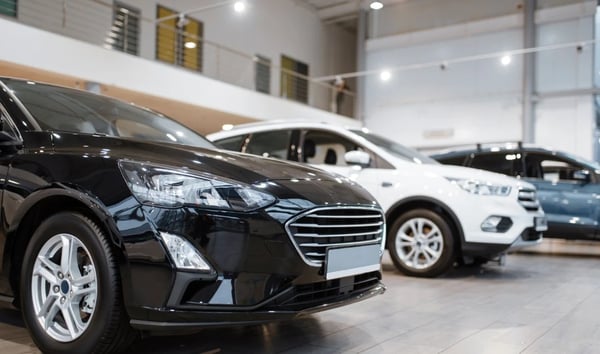
A thoughtful lighting plan also improves the mood and professionalism of a dealership. It presents a brand that is polished, modern, and trustworthy. Shoppers decide quickly whether a dealership feels worth exploring, and lighting is part of that perception. A dull or outdated layout can make vehicles look older or damaged. A bright, consistent layout showcases the true condition and value of each car.
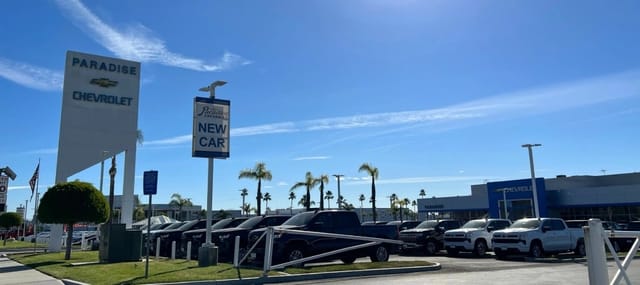
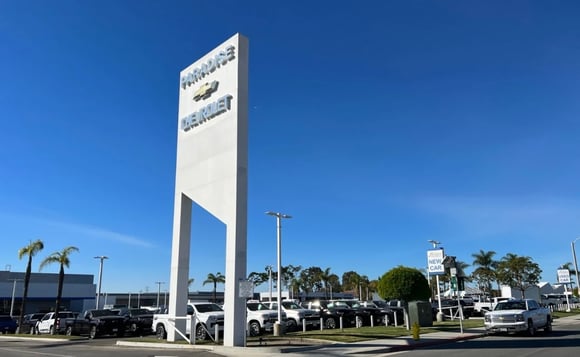
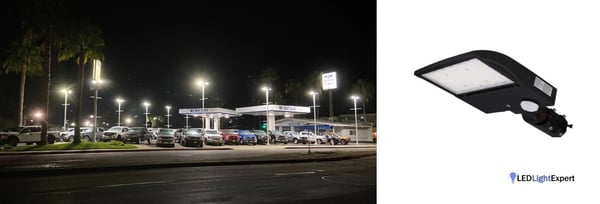
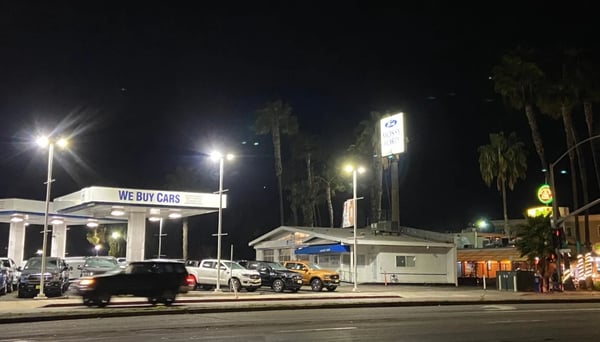
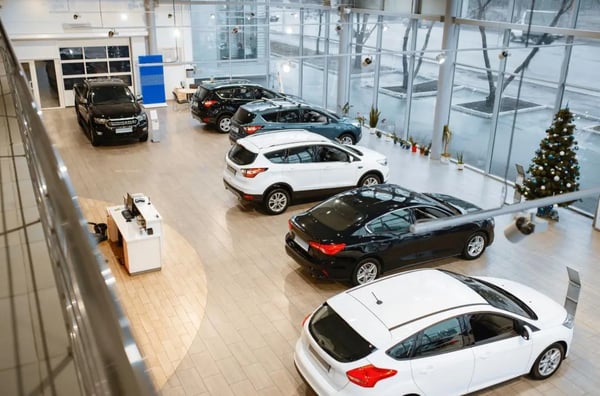
Car dealership lights installation - LED Light Expert.
Why Lighting Budgets Matter for Car Dealerships
Lighting is not just an operational line item. It is part of the customer experience and directly affects how vehicles appear on the lot and in the showroom. Car dealership building lighting influences the atmosphere and transparency of a business. It supports customer decision making and improves the efficiency of staff. That means lighting is not simply a maintenance concern. It is a strategic investment with measurable impact on close rates, service-bay throughput, utility expense, and insurance exposure.
First impressions and curb appeal
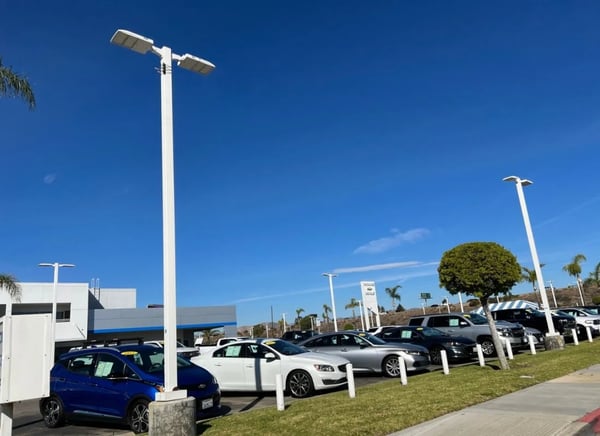
Customers often make a judgment before stepping out of their vehicle. Outdoor lighting can create an inviting environment or a discouraging one. Bright, well distributed light makes the entire lot feel safer and more appealing. LED lighting for car dealerships delivers consistent output that highlights vehicle details and finishes without the pink-orange warm-up color shift typical of metal halide. A poorly lit dealership can appear closed or rundown and may push customers away before they have a chance to explore the inventory.
Impact on vehicle visibility and color accuracy
Lighting affects how paint colors look and how buyers perceive the quality of a vehicle.
LED fixtures with CRI 90+ and R9 (deep red) values above 50 render metallic reds, candy paints, and leather interiors accurately. At 4000-5000K the output mirrors natural daylight without the yellow cast that makes silver look gray. This accuracy builds trust and prevents the "it looked different in the lot" complaint that drives post-sale friction. Strong, consistent lighting removes that doubt and supports close rates on premium trim packages where color is a purchase driver.
Safety, security, and after-hours visibility
A dealership may have visitors at night. Many also operate service departments in the early morning or late evening. Security cameras work better under strong lighting, and staff feel safer. Customers are also more comfortable browsing after hours when the lot is bright and visible. Strong, uniform lighting improves visibility for staff, customers, cameras, vehicles, and lot activity. It also helps the property look monitored and cared for. Insurance carriers increasingly ask for uniform footcandle coverage on outdoor lots; falling below 2 footcandles at the perimeter can affect both claims and premium rates.
Energy and maintenance cost considerations
Lighting can be a major expense without the right fixtures. LED upgrades reduce utility bills and cut replacement frequency. Traditional bulbs burn out faster and require more maintenance. LEDs produce less heat and consume less electricity, which lowers long term operating costs. That means budgeting should not focus only on upfront spending but also on total cost of ownership. A 150W LED shoebox replacing a 400W metal halide saves roughly 308W per fixture; at 12 hours per night and $0.12/kWh, that is about $135 per fixture per year — or roughly $6,700 annually across 50 pole fixtures before factoring in eliminated lamp and ballast replacements.
Car dealership building lighting influences the atmosphere and transparency of a business.
Key Areas That Impact Your Lighting Budget
Outdoor lighting costs
Outdoor areas require careful planning because they cover large spaces and often need higher wattage fixtures. The number of poles, spacing, and fixture type all influence your budget. Parking lot and vehicle display lighting is usually the largest outdoor cost category. These areas need bright, uniform distribution so customers can inspect vehicles closely without shadows or glare.
Pole mounted LED lights are common for dealership lots. Taller poles reduce the number of fixtures needed, but they may also increase installation and wiring costs. Shorter poles increase fixture count but offer more focused light. Typical display-row spacing runs 3 to 3.5 times pole height (a 25-foot pole covers a ~75-88 foot radius at usable footcandles). Understanding pole height, beam angle (Type III or Type V Square for display rows, Type II for driveways), and spacing allows you to budget more accurately.
Perimeter and security lighting supports cameras and deters theft. This lighting must be reliable and consistent during late hours. LEDs are a smart investment here because they last longer and perform better in a range of temperatures — many LED fixtures carry -40°F cold-start ratings while metal halide loses significant output below freezing. Dark-sky zoning ordinances increasingly require BUG ratings of B1-U0-G1 or better, which a quality LED shoebox can meet while HID typically cannot.
Indoor lighting costs
Indoor spaces have different needs than outdoor areas. Showroom lighting demands quality. Customers decide on major purchases here, so fixtures should showcase vehicles clearly. LEDs offer highlight potential through color accuracy and consistent light output. Specification targets: CRI 90+ with R9 above 50, color temperature 4000-5000K, and IES RP-20 ambient illuminance of 50-100 maintained footcandles on the showroom floor, with 150-300 footcandles on accent spotlighting for featured vehicles.
Service bays and repair areas require bright, uniform light that reduces eye strain and highlights details. Mechanics must see clearly to work on complex components. Poor lighting in these areas can slow productivity and increase mistakes. Target 50-100 footcandles at the bay floor, with glare control through diffused linear fixtures or high-bay fixtures with prismatic lensing mounted 12-20 feet above the deck.
Offices, waiting areas, and detail rooms round out indoor costs. These spaces matter because they influence customer experience and staff satisfaction. Comfortable lighting — typically 30-50 footcandles with low-glare 2x2 or 2x4 LED panels at 3500-4000K — boosts workplace performance and improves customer perception while keeping watts per square foot in line with ASHRAE 90.1 energy codes.
Installation and Labor Costs
Installation is a major part of any car dealership lighting budget. The cost of materials only tells part of the story. Labor, permitting, and retrofit needs influence the final total significantly. Planning for these expenses early helps prevent unexpected increases during the project.
Electrical labor rates
Electricians charge by the hour, and rates vary by region and complexity. Journeyman electrician rates typically run $85-$125 per hour in most U.S. markets and reach $140-$175 per hour in high-cost metros or union-required projects. Outdoor poles, trenching, or elevated work increase labor time. Indoor installations often cost less because they use existing wiring paths and shorter mounting heights.
Labor for LED lighting for car dealerships tends to be more efficient than older systems because LED fixtures are lighter and often require less complicated wiring — no ballast can and no separate capacitor mounting. Facility managers should include labor estimates that reflect local union rates, difficulty of installation, lift equipment rental ($400-$800 per day for a 40-foot boom lift), and the number of fixtures. Typical retrofit labor runs $75-$150 per fixture; full pole replacement runs $800-$1,500 per pole including foundation work.
Pole installation and foundation costs
For outdoor applications, pole costs extend beyond the poles themselves. Concrete foundations, anchor bolts, trenching for conduit, and lift equipment rental all add to the budget. Contractors may charge more for deep footings in regions with high winds or soft soil. A standard 25-foot steel pole typically requires a 30-inch diameter by 5-foot deep concrete footing; wind-load zones (coastal or plains) may push that to 36 inches by 6-8 feet, adding $500-$1,200 per pole in concrete and excavation.
Taller poles usually require larger foundations. Planning the lot layout can help reduce installation costs by limiting the number of poles while still maintaining proper light distribution. A photometric study pays for itself here — a well-designed layout can cut pole count by 15-25% compared to a rule-of-thumb layout while still hitting IES footcandle and uniformity targets.
Retrofit vs. new construction pricing
Retrofits are often more cost effective than complete replacements because they use existing poles and wiring. New construction demands fresh conduit, poles, and trenching. Retrofit brackets,
LED shoebox fixtures, and slip-fit adapters reduce structural work and speed installation. A typical dealership retrofit project completes in 2-3 days; full pole replacement runs 2-3 weeks with inspection hold-points.
New construction gives more design freedom, but budgets must reflect the cost of infrastructure and longer installation time. Retrofits typically come in at 25-40% of the cost of new construction for the same fixture count — a meaningful gap on projects with 40-80 poles. The decision depends on the age of the current system, pole structural integrity (inspect for rust at ground line and anchor bolts), and how well existing wiring supports the wattage and control scheme of modern LED fixtures.
Permits and inspections
Local codes require permits and inspections for outdoor electrical work. These fees can vary widely — from $150 for a straight fixture-swap permit to $1,500-$3,500 for a new pole installation with full photometric plan review. Some municipalities have strict dark sky requirements or lumen limits, which can change fixture selection and placement. IES BUG ratings (Backlight, Uplight, Glare) of B1-U0-G1 or better are increasingly required near residential zones. Budgeting for permit fees and inspection charges avoids delays and fines.
Planning the lot layout can help reduce installation costs by limiting the number of poles while still maintaining proper light distribution.
Energy Consumption and Operating Costs
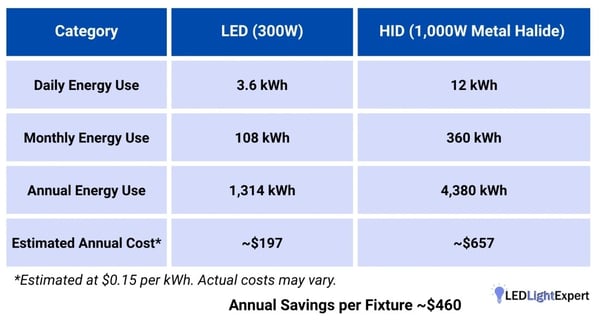
Energy use is a long term cost that can outweigh initial fixture prices. LED technology offers major savings over HID or fluorescent lighting. The difference is especially clear for outdoor applications where lights operate for long hours. The example below shows how a single fixture can reduce energy consumption and annual cost. A 400W metal halide shoebox, including ballast losses, draws approximately 458W; the LED equivalent at 150W delivers equal or greater lumen output with a 67% wattage reduction.
Energy consumption and electricity cost comparison
Example: parking lot light running 12 hours per night, $0.12 per kWh electricity rate.
This comparison highlights the impact on electricity bills. A dealership using fifty outdoor fixtures could save more than twenty thousand dollars per year with LED upgrades. Savings grow further with controls or shorter runtimes — a photocell-plus-motion-sensor setup that dims lot lights to 30% after midnight routinely adds another 15-25% to annual savings without compromising security coverage.
Estimated monthly and annual electricity costs
Most dealerships operate outdoor lighting for ten to fourteen hours per night and indoor lighting for eight to twelve hours per day. LED fixtures reduce wasted energy through lower wattage and improved light distribution. Estimating monthly and annual costs helps owners visualize the budget impact. LEDs may cost more upfront, but savings in energy and reduced bulb replacements offset that initial investment — most dealership LED projects reach payback in 2-4 years even before factoring in utility rebates.
Utility rebates and incentives
Many utility companies offer rebates for LED projects. These incentives help reduce installation costs. Rebates may be available for specific fixture types, wattage reductions, or lighting controls. Prescriptive rebates commonly pay $25-$75 per fixture for DLC-qualified LEDs and $50-$150 per fixture for DLC Premium tier (tighter efficacy and controllability requirements). Custom programs pay $0.06-$0.15 per kWh of first-year savings. Programs vary by region, so early research can help dealerships secure funding before installation begins — most utilities require pre-approval applications before fixtures are purchased or installed.
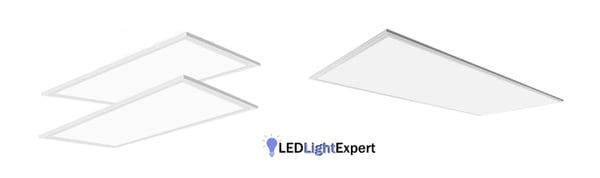
1x4 foot LED panel light - 20/25/30/35/40 watts - tunable - 3000K/4000K/5000K - 5000 lumens.
Cost-Saving Strategies for Dealership Lighting
Switching to LED retrofits
Retrofits allow dealerships to refresh their lighting without replacing poles and wiring. They are an effective upgrade for facilities with outdated metal halides. This approach saves money and modernizes light output with less disruption. Slip-fit LED shoebox retrofits install in 20-30 minutes per pole once the lift is set, keeping the lot operational during the work window.
Phased lighting upgrades
A large lot can require dozens or hundreds of fixtures. Instead of doing everything at once, upgrading in phases spreads costs over time. Prioritize high-traffic areas like the showroom, entrances, security zones, and front-facing display rows first. A typical phased plan: (1) showroom and front display row in month 1 to capture the customer-facing impact immediately; (2) service bays and side display in month 3-4; (3) back lot, employee parking, and perimeter in month 6-9. Each phase should target its own rebate application to avoid one large filing that ties up cash flow.
Using lighting controls to reduce runtime
Timers,
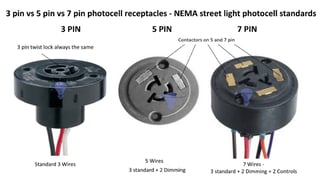
parking lot lights with photocells, and motion sensors lower energy consumption. Parking areas do not need full brightness late at night. Controls can dim lights to 20-30% output during low-traffic periods and ramp back to full output on motion detection — this "bi-level" operation cuts overnight energy another 15-25% while maintaining continuous security coverage. Interior systems can also be zoned to match occupancy: daylight-harvesting sensors near showroom windows reduce perimeter fixture output when sunlight is contributing.
Selecting the right lumen output instead of over-lighting
Bigger is not always better. Oversized fixtures waste energy and increase glare. Light levels should match recommended standards for display areas, service bays, and walkways. This approach avoids wasted wattage and lowers electricity costs. Running the photometric plan against IES RP-20 targets — not against "how bright can we make it" — typically reveals that 150-240W LED shoeboxes cover most dealership display rows, and 300W+ fixtures are only needed for very tall poles (35-40 feet) or wide driveway aisles.
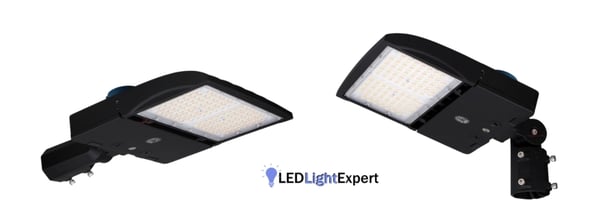
150 watt - NextGen IV Series LED parking lot lights with photocell - 22,500 lumen - color selectable 3000K/4000K/5000K - slip fit mount.
Common Budgeting Mistakes to Avoid
Budgeting for car dealership lighting can be complex, and it is easy to make choices that increase long term expenses. Understanding common mistakes helps dealerships avoid overspending and ensures the lighting system delivers strong performance year after year.
Focusing only on upfront cost
Selecting the cheapest fixtures may seem attractive, but low quality systems often require more replacements and use more electricity. The initial savings disappear once higher bills and maintenance begin to add up. A complete budget should compare total cost of ownership — not just fixture price — including wattage, maintenance, lifespan (look for LM-80 data and L70 ratings of 50,000+ hours), warranty terms, and rebate eligibility.
Ignoring energy and maintenance expenses
HID and fluorescent systems consume more electricity and require frequent lamp and ballast replacements. Metal halide lamps lose 30-40% of their output in the first year and typically need replacement every 2-3 years; ballasts fail at 5-7 years. LED lighting for car dealerships reduces maintenance with long operating life and efficient output. Dealerships that ignore energy and maintenance costs risk paying more over time than they save at installation — often 3-5x the original purchase difference over a 10-year operating window.
Over-lighting or under-lighting key areas
Excessive lighting wastes energy and creates glare that can distort vehicle color and cause discomfort for shoppers. Insufficient lighting makes vehicles look dull and reduces the visibility of inventory. Both mistakes can affect customer confidence. A balanced lighting plan uses the correct lumen output for each area — matching IES RP-20 footcandle targets rather than simply maximizing brightness.
Skipping professional lighting layouts
Lighting layouts and photometric studies help dealerships avoid shadows, fixture overlap, and dark corners. Skipping this step can lead to rework and additional costs. A planned layout ensures the investment produces consistent results. Professional guidance creates a system that matches the lot size, pole placement, and display priorities. A point-by-point photometric study — typically included free with larger fixture orders — documents the uniformity ratio (max-to-min footcandles), confirms BUG compliance, and builds the rebate application package.
Understanding common mistakes helps dealerships avoid overspending and ensures the lighting system delivers strong performance year after year.
Conclusion
Dealerships that want to improve their lighting budget and overall presentation can take steps now to enhance their planning process. Working with a lighting professional removes guesswork and creates a clear path toward savings and better visual results.
Request a lighting audit or
photometric plan to identify weaknesses and uncover opportunities in your current layout. This service highlights areas that need improvement and helps avoid wasted spending.
Get a customized cost estimate for your dealership. A tailored quote reflects local labor rates, fixture counts, wiring needs, and control options. This helps you build a realistic budget and understand where savings are possible.
Explore LED lighting solutions designed for automotive dealerships.
LEDLightExpert.com specializes in high quality fixtures for indoor and outdoor use. The focus is on energy efficiency, long life, and accurate light output. These systems help improve curb appeal, vehicle presentation, and overall efficiency.
Car dealership lighting is more than an expense. It is a long term investment in customer experience, safety, and brand identity. Thoughtful planning, accurate budgeting, and expert support create a lighting system that elevates presentation and reduces operating costs. LED technology offers dealership owners the opportunity to save money and improve customer satisfaction through modern, efficient fixtures.
This complete approach gives dealerships confidence in their budget, clarity in their lighting plan, and a path forward that supports both performance and financial responsibility.





 Free Shipping
 Free Extended Warranty