

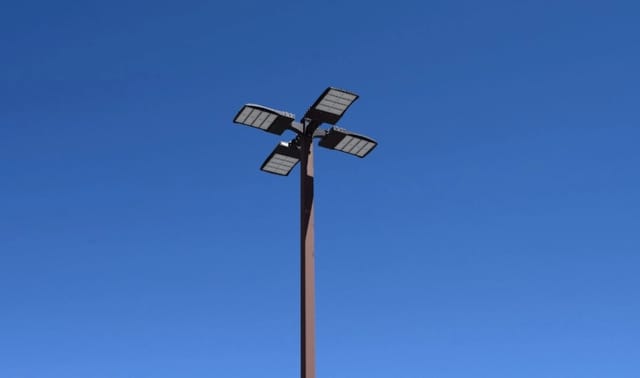
Commercial projects need appropriate output, optics, ratings, controls, serviceability, and layout support.
Commercial Parking Lot Lights Guide
Commercial parking lot lighting has to support drivers, pedestrians, storefronts, cameras, entrances, property edges, and maintenance crews. Fixture wattage alone does not answer the design question. Pole layout, mounting height, distribution, lumens, glare, spill, controls, and uniformity all decide whether the lot works.
What to Check First
- Map lot dimensions, pole locations, entrances, pedestrian routes, neighboring properties, and mounting heights.
- Use photometrics to compare light levels, uniformity, glare, spill, and pole spacing.
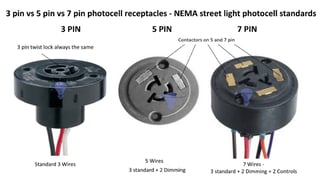
- Review controls, photocells, dimming, surge protection, voltage, fixture EPA, and maintenance access.
Application Decision Table
| Use Case | Practical Guidance |
|---|---|
| Retail lot | Focus on pedestrian routes, entrances, uniformity, glare, and operating schedule. |
| Industrial lot | Review truck routes, perimeter edges, cameras, and fixture durability. |
| Parking garage or canopy | Needs lower mounting review, glare control, and different fixture form factors. |
Specification Checklist
- Delivered lumens
- Distribution type
- Pole height and spacing
- Uniformity
- Glare and spill
- Controls and surge protection
Common Mistakes to Avoid
- Assuming a fixed LED wattage replaces every HID fixture.
- Ignoring dark areas between poles.
- Treating lighting as a complete security plan by itself.
Commercial Parking Lot Lights Are Layout Equipment
Commercial LED parking lot lights are often judged by wattage, but the site cares about delivered light. Pole height, pole spacing, mounting arm, optics, fixture tilt, pavement reflectance, nearby property lines, voltage, controls, wind load, and maintenance access decide whether the lot feels bright, even, and controlled.
| Spec | Why it matters |
|---|---|
| Optic type | Type III, IV, and V distributions spread light differently across lots and drive lanes. |
| Pole height | Higher mounting can improve spread but may increase spill or glare if optics are wrong. |
| Controls | Photocells, timers, dimming, and motion strategies affect energy use and safety. |
| Photometric plan | Confirms average, minimum, maximum, and uniformity before fixtures are ordered. |
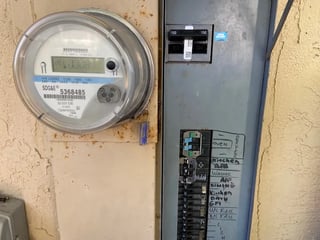
For replacement projects, record the existing pole height, fixture count, voltage, arm style, breaker information, and problem areas before choosing a fixture. That saves time and avoids guessing from wattage alone.
More Details to Consider
Commercial parking lot lights should be selected as layout equipment. Pole height, pole spacing, distribution type, fixture lumens, mounting arm, glare, spill light, controls, voltage, surge protection, EPA wind load, and maintenance access all affect the final result.
Good parking lot lighting supports visibility for pedestrians, drivers, storefronts, cameras, entrances, and property edges. It can support safety and operations, but it is not a complete security plan by itself.
For replacements, document existing pole heights, fixture count, voltage, mounting style, problem areas, and any neighbor or dark-sky limits before buying. A photometric plan is the cleanest way to compare fixture options before labor is spent.
Frequently Asked Questions
- What makes parking lot lighting commercial grade?
- Commercial projects need appropriate output, optics, ratings, controls, serviceability, and layout support.
- How many fixtures are needed?
- Use a photometric layout based on lot geometry, pole height, output, and targets.
- Do brighter lights improve security?
- Good lighting can support visibility, but it is not a complete security plan.
- What CCT should be used?
- Choose CCT with visibility, glare, local rules, and neighbor impact in mind.

Ready to Upgrade Your LED Lighting?
Our lighting specialists can help compare fixtures, confirm light levels, and quote products that fit the site.
Call 800-674-9420 or email [email protected]
Monday-Friday, 8am-5pm PST

About the Author
Dara Greaney is founder and CEO of LED Light Expert with deep expertise in commercial LED lighting, retrofits, and photometric planning.
Editing by David Peguero

Trusted by Thousands
Our customers love us — and we love them back.


-
 Free Shipping
On orders over $49.00
-
 Free Extended Warranty
Up to 7 Years Free Warranty On LED Lights
-
100% Satisfaction Guarantee
