Solar Post Top Lights have become a popular solution for anyone looking to brighten outdoor areas without relying on traditional electricity. The concept is simple: a self-contained lighting fixture that draws energy from the sun during the day and shines after dark. Thanks to modern improvements in solar panel efficiency and LED technology, these lights have seen a surge in demand—both for residential and commercial properties.
What makes them so appealing? First, they’re versatile. You can place post top solar lights along walkways, fences, garden borders, or even on top of existing posts around your patio.
Second, they’re good for the environment because they eliminate the need for grid-based energy and cut down on carbon emissions. People are increasingly looking for greener alternatives for their homes and businesses, and solar light post tops check that box in a big way.
Key Benefits of Solar Post Top Lights
Energy Savings
One of the biggest perks of
solar light for post top fixtures is the energy savings. Because they rely on sunlight, there are no monthly electricity bills to worry about. This can be a huge plus if you’re trying to cut costs around your property or if you have a large outdoor area to light. Over time, the money saved on energy bills often offsets the initial purchase price.
Eco-Friendly
Switching to Solar Post Top Lights is an easy step to help reduce carbon emissions. Traditional lighting depends on electricity generated from fossil fuels, which contribute to pollution. Solar-powered lighting, on the other hand, draws from a renewable resource: the sun. By using post top solar lights, you’re taking a small but meaningful step toward environmental responsibility.
Easy Installation
Since there’s no wiring involved, installing solar lighting is much simpler compared to electrical fixtures. You won’t need to hire an electrician or run cables underground. If you manage a public space like a park or campus, the ability to place lights in remote areas without trenching for power lines is a game-changer. Just make sure the solar panel faces direct sunlight for maximum energy collection.
Low Maintenance
Most solar light post tops feature LEDs that have a long lifespan—sometimes up to 100,000 hours or more. LEDs are more durable than traditional bulbs, making them less likely to burn out prematurely. The batteries do need periodic replacement, but this is relatively simple and doesn’t require specialized tools. Occasional cleaning of the solar panel to remove dirt and debris is generally all that’s required.
Safety & Security
Well-lit spaces are safer for both pedestrians and vehicles. Good outdoor lighting improves visibility around paths, seating areas, parking edges, and building approaches. Whether it’s a community park, a college campus, or your own backyard, a well-planned arrangement of Solar Post Top Lights helps create a welcoming environment.
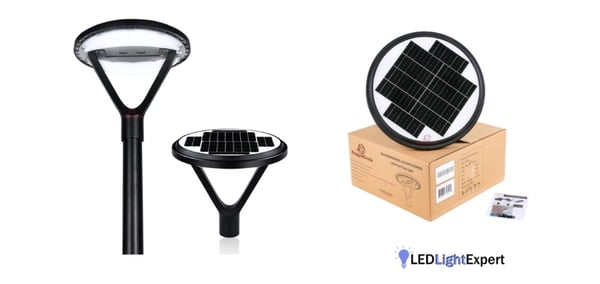
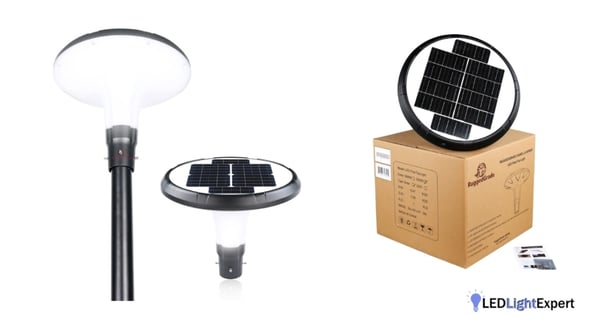
Solar LED Post Top Light - Lucanti Series - LED Light Expert
Choosing the Right Solar Post Top Light for Your Needs
Picking the perfect Solar Post Top Lights may seem overwhelming at first, but it’s really a matter of narrowing down your priorities. Whether you need soft illumination for a quaint garden path or a bright beam for a bustling parking lot, there’s a model designed to match your requirements. Let’s look at the main factors you’ll want to consider.
1. Location & Application
Best Uses
Post top solar lights work beautifully in a variety of settings—residential neighborhoods, parking lots, parks, commercial properties, you name it. In residential spaces, they can line a driveway, highlight a fence perimeter, or showcase a garden walkway. In larger public areas like parks or college campuses, they can boost visibility for pedestrians while also adding a decorative flourish.
Some models are designed with more intense illumination for busy pathways and parking lots, whereas others focus on a softer glow for decorative effect. Before buying, think about how bright you need the area to be and the aesthetic you’re aiming for.
2. Light Output & Brightness
Lumens Explained: How Much Brightness Do You Need?
Lumens measure the total quantity of visible light emitted by a source. The higher the lumens, the brighter the light. For comparison, a standard 60-watt incandescent bulb produces around 800 lumens. So, if you see a solar post top light fixture rated at 300 lumens, you can expect it to be less intense than a typical household bulb.
Your needs will depend on the environment. Soft mood lighting for a backyard seating area might only require 100 to 200 lumens per fixture. A commercial or municipal space could need 700 lumens or more to maintain a well-lit, secure environment.
Comparing Different Lumen Outputs
- 100–300 Lumens: Ideal for ambiance along walkways or gentle illumination around a patio or deck.
- 300–700 Lumens: Good balance of brightness for residential driveways, medium-sized parks, and perimeter lighting.
- 700+ Lumens: Designed for higher-traffic areas like parking lots or larger public spaces where safety and visibility are top priorities.
Keep in mind that more lumens also mean a bigger solar panel and a larger battery capacity, so the fixture might be bigger or more expensive. There’s no need to go overboard on brightness if a lower-lumen light meets your needs.
3. Battery Capacity & Solar Panel Efficiency
Types of Batteries and Their Lifespan
The two most common battery types you’ll see in solar post top lights are lithium-ion (Li-ion) and lead-acid.
- Lithium-Ion: Generally lighter, more compact, and quicker to charge. They also have a longer lifespan, making them a popular choice despite a slightly higher cost.
- Lead-Acid: These batteries are cheaper but tend to be larger and heavier. They also may require a bit more maintenance and have a shorter lifespan compared to Li-ion options.
You’ll want to look for fixtures that clearly state their estimated battery life or the number of charge cycles. More robust battery capacity means your solar light post tops can shine longer, even on cloudy days.
Solar Panel Efficiency and Its Impact on Nighttime Illumination
Solar panel efficiency determines how effectively a panel converts sunlight into usable energy. Panels with higher efficiency can capture more energy in a shorter time, which is especially important in areas with less direct sunlight or shorter winter days.
Quality panels (often made of monocrystalline or polycrystalline silicon) will produce more wattage per square inch, ensuring you have ample stored energy to power your lights through the night.
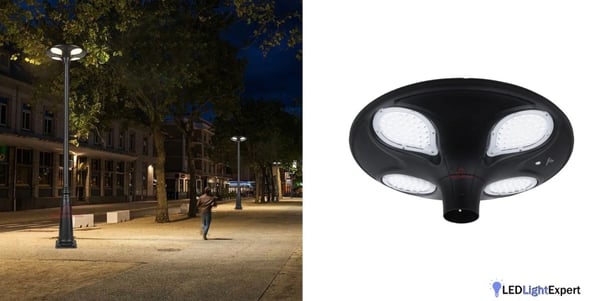
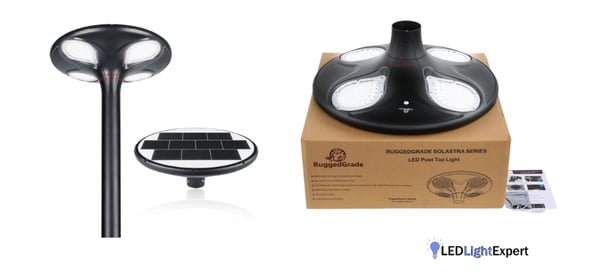
Solastra Series - LED Solar Post Top Lights - LED Light Expert
4. Color Temperature & Light Quality
The color temperature of a light source is measured in Kelvin (K).
Different color temperatures can dramatically affect the atmosphere of an outdoor space.
- Warm White (2700K–3000K): Offers a cozy, inviting glow that works well for residential patios, garden paths, or any area where you want a softer ambiance. It’s great if you’re looking to create a relaxed vibe.
- Neutral White (4000K–5000K): Often called “cool white,” this range is bright enough to enhance security and visibility without feeling too stark. It’s a common choice for commercial sidewalks, parking lots, or areas that need a clear view at night.
- Cool White (6000K–6500K): Approaches daylight-level brightness, which is excellent for streets, large parks, and places that demand strong illumination for safety reasons.
If you’re not sure which color temperature you prefer, you can often find fixtures that let you adjust the color temperature on the fly. That way, you can experiment to see what feels right for your space.
5. Weather Resistance & Durability
Importance of IP Ratings
For example:
- IP65: Offers protection against low-pressure water jets (like rain) and dust. Good for most outdoor applications.
- IP66: Adds stronger defense against water—protecting against powerful jets—and is also dust-tight. This is ideal for areas with heavy rainfall or equipment that needs regular cleaning with pressurized water.
- IP67: Provides even stronger protection against water immersion and dust—ideal for harsher climates or areas prone to flooding.
Choosing a fixture with a higher IP rating gives you peace of mind that it won’t fail the moment a storm rolls in.
Materials: Aluminum vs. Plastic vs. Stainless Steel
The body of a solar light for post top can come in various materials:
- Aluminum: Lightweight, rust-resistant, and dissipates heat effectively—often a favorite in commercial or industrial settings.
- Plastic: Typically budget-friendly, though not always as durable in extreme weather. High-grade plastics can be surprisingly rugged, but low-end models might fade or crack over time.
- Stainless Steel: Sturdy, corrosion-resistant, and often offers a sleek finish. Stainless steel can be heavier and might cost more, but it’s a great long-term investment.
Performance in Extreme Weather Conditions
Not all solar lights are created equal. If you live in an area with harsh winters or scorching summers, pay special attention to the recommended operating temperatures. Batteries, in particular, can be sensitive to temperature swings.
Quality fixtures often include built-in temperature compensation or specialized battery chemistry that can handle broader temperature ranges.
6. Style & Aesthetic Considerations
Traditional Lantern-Style
If you want a bit of old-world charm, lantern-style fixtures are a classic. Often featuring decorative elements like curved frames and glass enclosures, these lights are perfect for historic neighborhoods, garden paths, or anyone who loves a timeless vibe.
Modern & Minimalist Designs
Sleek lines and understated finishes define the minimalist aesthetic. These lights often come in stainless steel or brushed aluminum, fitting right in with contemporary architecture and commercial buildings. They’re also a good pick if you want a fixture that blends into the background.
Architectural & Ornamental Options
For a bolder statement, you’ll find plenty of ornate or architectural solar post top lights. Some feature intricate metalwork or layered geometric shapes that stand out in parks, plazas, or grand entryways. While style is subjective, the right design can elevate an entire landscape, making it both safer and more visually appealing.
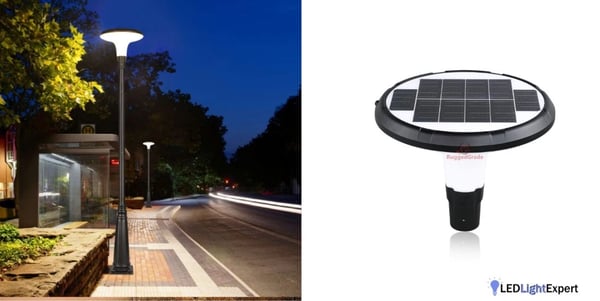
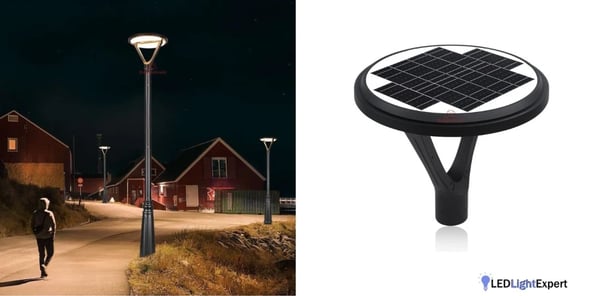
Zabiella Series - LED Solar Post Top Lights - LED Light Expert
Installation & Maintenance Tips
Once you’ve chosen the right post top solar lights for your space, the next step is setting them up and keeping them in good shape. Luckily, most models are designed to be as user-friendly as possible, so even if you’re not a professional installer, you can get them up and running with minimal hassle.
Proper Placement for Maximum Solar Exposure
The success of any solar-powered light hinges on adequate sunlight. If the fixture doesn’t get enough rays during the day, it won’t have the juice to shine through the night. Here are some ways to position your solar light post tops effectively:
- Avoid Shaded Areas: Make sure tall trees, fences, or nearby buildings don’t cast shadows on the solar panel during peak sunlight hours (usually late morning to mid-afternoon).
- Angle of the Panel: Most post top lights have a fixed angle, but if yours is adjustable, tilt the panel so it faces the sky directly. A south-facing orientation (in the Northern Hemisphere) generally yields the best results.
- Spacing: Keep enough distance from other tall or bulky objects that might block the sun. Even partial shading can drastically reduce the amount of energy stored.
Height & Spacing Guidelines
Mounting height plays a big part in how effectively the light covers an area. Generally, a
post height of 8 to 12 feet is sufficient for walkways, pathways, and garden areas. This height offers a decent spread of illumination while keeping the fixture accessible for maintenance.
- Avoid Overcrowding: If lights are placed too close together, the illumination zones will overlap, which can lead to uneven brightness or glaring hot spots.
- Prevent Dark Spots: On the flip side, spacing them too far apart can leave dim sections along walkways. A common rule of thumb is to measure the “beam angle” or coverage area specified by the manufacturer. If a single light covers about 10 feet in diameter, you might space them out so the edges of their lit areas slightly overlap, ensuring a continuous glow.
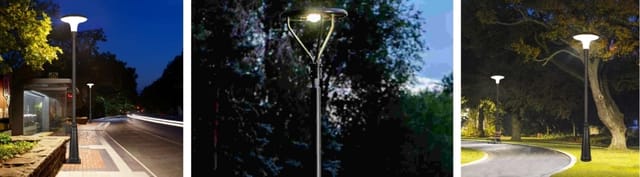
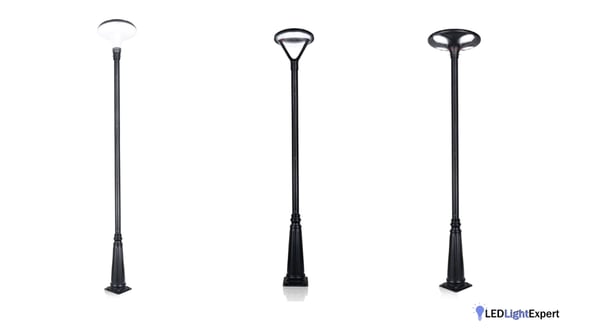
LED Post Top Lights Different Series - LED Light Expert
Battery Replacement & Cleaning
Solar-powered post luminaires are low-maintenance, but they still need occasional upkeep to stay efficient:
- Battery Replacement: Most batteries can last anywhere from one to five years, depending on quality, usage, and environmental conditions. If you notice your lights dimming earlier in the night, it might be time for a battery swap. Make sure to use the type specified by the manufacturer (often lithium-ion) for best results.
- Cleaning the Solar Panel: Dirt, dust, or leaves can block sunlight and cut down on energy absorption. Gently wipe the panel with a damp cloth or rinse it with water. Avoid abrasive cleaners that might scratch the surface.
- General Inspection: Periodically check for any cracks in the housing or loose screws. Addressing minor issues promptly extends the life of the fixture.
These simple measures will keep your lights shining bright year-round, saving you money and reducing the need for frequent replacements.
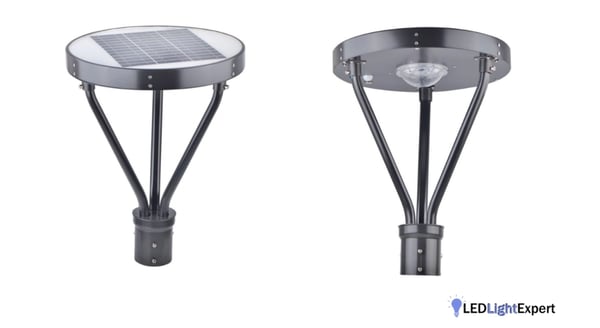
25 Watt Solar LED Post Top Fixture - Kuma Series Solar LED Area Light
Common Questions & FAQs
How Long Do Solar post top lights Last?
There are two main components to consider when judging lifespan: the
LED itself and the battery. LEDs can last a very long time—some are rated up to 50,000 hours, which translates to several years of nightly use. Batteries, on the other hand, typically have a shorter life cycle.
- LED Lifespan: Thanks to the efficiency of LEDs, it’s not unusual for them to outlast other parts of the fixture.
- Battery Replacement Frequency: Depending on the type (lithium-ion vs. lead-acid) and environmental conditions, you might replace the battery every 1–3 years. Keep an eye on performance; if you notice the light is fading earlier, that’s a big clue the battery is on its way out.
Do Solar Post Lights Work in Winter?
Yes, but their effectiveness can be influenced by cold temperatures and reduced daylight hours. Modern lithium-ion batteries handle low temperatures better than older battery types, but energy collection might still drop if your area gets frequent cloudy or overcast conditions.
If your solar light for post top is installed in a location with extremely limited winter sun, consider fixtures with larger panels or a higher battery capacity to store enough energy on days with weaker sunlight.
What Happens on Cloudy Days?
Post top solar lights can still operate, but they might not run at full capacity. Cloud cover reduces the amount of sunlight that reaches the solar panel, which in turn leads to less energy stored. However, most models are designed with a battery sized to handle a day or two of reduced charging.
If you experience extended periods of cloudiness, the lights may dim or shut off earlier in the evening. In these cases, choosing a model with an efficient panel and a higher-capacity battery can help.
Are Solar post top lights Bright Enough for Security?
This depends on the lumens output of the fixture. Some solar lights are designed more for ambiance, while others aim to replace traditional street lamps or floodlights. If security is your primary concern, look for fixtures with at least 700 lumens or higher.
Keep in mind that higher lumen output will likely require a larger solar panel and battery capacity to maintain brightness through the night.
25W Premium Solar LED Post Top Light - Zabiella Series - 5,000 Lumens
Conclusion
Solar-powered post luminaires offer a blend of convenience, sustainability, and cost savings that traditional lighting systems can’t match. By harnessing the power of sunlight, these fixtures eliminate ongoing energy costs while reducing your carbon footprint.
They’re versatile enough for everything from suburban backyards to municipal parks, ensuring you have a reliable lighting solution that aligns with both functional and aesthetic needs.
Switching to
Solar Lights can be a straightforward way to invest in your property, boost outdoor safety, and show some love to the planet. By weighing your options and thinking about all the factors covered in this guide, you’re well on your way to finding the perfect set of post top solar lights for your space.





 Free Shipping
 Free Extended Warranty