


Quick Answer
Photocell sensors turn parking lot lights on when daylight falls and off when daylight returns. For most parking lots, LED fixtures with a photocell or NEMA photocell receptacle are the simplest way to avoid daytime energy waste, reduce manual switching, and keep exterior lighting consistent every night. Choose the photocell type, fail mode, voltage range, and mounting location before installation.
Why Parking Lot Lights Need Photocell Sensors
A photocell sensor is a small daylight control with a big operational job: it turns parking lot lights on when it gets dark and turns them off when daylight returns. That prevents the two most common exterior-lighting problems: lights left on during the day and lights that do not come on reliably at night.
For parking lots, LED fixtures with photocell sensors improve consistency, reduce manual switching, and help property managers control energy use. They are especially useful for businesses, schools, churches, warehouses, apartment communities, and municipal lots where lighting should follow daylight every day of the year.
How Photocell Sensors Work
Photocells measure ambient light. When the light level drops below the sensor threshold, the circuit closes and the fixture turns on. When daylight rises above the threshold, the circuit opens and the fixture turns off. Many parking lot fixtures use twist-lock NEMA photocells, which makes replacement easier than rewiring an internal control.
Placement matters. A photocell should see open daylight, not light from the fixture, another pole, a sign, headlights, or a reflective wall. Bad placement can cause short cycling, late turn-on, or daytime operation.
Photocell vs. Motion Sensor
A photocell answers the daylight question: should the parking lot lighting be enabled at all? A motion or occupancy sensor answers the activity question: should the fixture brighten because someone is nearby? Many modern parking lots combine both. The photocell keeps the fixture off during the day; occupancy control dims or brightens the fixture at night.
What to Check Before Buying
- Voltage: confirm 120V, 208V, 240V, 277V, or 480V compatibility.
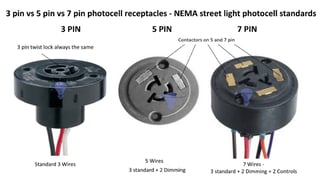
- Mounting: choose built-in photocell, button photocell, or 3-pin/5-pin/7-pin NEMA receptacle.
- Fail mode: know whether a failed sensor leaves the light on or off.
- Controls: use 0-10V dimming or networked controls when schedules or adaptive dimming are needed.
- Location: avoid shadows, uplight from nearby fixtures, and direct exposure to the fixture output.
When Photocells Save the Most
The savings are strongest when lights are currently switched manually, run on poor timer schedules, or are often left on after sunrise. A photocell is not a substitute for a lighting layout, but it is one of the simplest controls to justify because it removes avoidable daytime runtime.
For larger properties, consider LED parking lot lights with photocells plus dimming controls. That allows safe dusk-to-dawn coverage while reducing output during low-traffic hours when full brightness is not needed.
Photocells Need Clear Sky Exposure
Parking lot lights with photocell sensors should turn on at dusk and off at dawn. Place the sensor where it reads ambient light, not fixture glare, tree shade, signage, or reflected building light. Poor placement causes cycling, day-burning, or late turn-on.
| Problem | Likely cause |
|---|---|
| Cycling | The sensor sees its own light or a reflection. |
| Day-burning | The sensor is shaded, failed, or wired incorrectly. |
| Late turn-on | Orientation or threshold may not match the site. |
More Details to Consider
Why Your Parking Lot Needs LED Lights with Photocell Sensors. Parking lots are notorious for being dimly lit, dreary spaces that feel unsafe after dark. But it doesn't have to be this way. By upgrading to smart LED lighting systems with photocell sensors, you can transform your parking lot into a bright, energy-efficient environment that deters crime and meets safety standards. Keep reading to learn all the reasons why LED lights with photocell sensors are a must for your parking lot. What are the Main Problems With Conventional Parking Lot Lighting.
Many parking lots are still relying on outdated high pressure sodium (HPS) or metal halide fixtures for illumination. These older lighting technologies have a number of drawbacks: Harsh Glare: HPS and metal halide lights have significant glare issues. This can reduce visibility, cause eye strain, and create uneven pools of light and dark zones throughout the parking lot. Frequent Burnouts: Traditional parking lot light sources tend to burn out frequently, creating maintenance issues. The average lifespan for metal halide bulbs is only around 15,000 hours.
Manual Operation: Most conventional parking lot lighting relies on manual switching or timers. This means light levels are not responsive to natural light conditions. Lights may operate at full capacity even when ample ambient light is available. Lack of Lighting Control: No dimming or zoning control is possible with standard HPS or metal halide parking lot lights. It's an "all or nothing" operation. Energy Inefficiency: Older lighting technologies like HPS are extremely energy intensive. Keeping lights illuminated at full capacity overnight results in astronomical electricity bills.
These factors contribute to parking lots that feel dark, dated, and unsafe for visitors after hours. Let's look at how upgrading to LED parking lot lights with photocell sensors can help. Why LED Smart Lighting is Essential for Parking Lots. LED (light emitting diode) technology paired with smart lighting controls provides huge advantages for parking lot illumination, including: LEDs emit a broad spectrum of light that enhances visibility and visual acuity. This allows parking lot occupants to see clearly without glare or eye strain.
The white light provides excellent color rendering for increased safety and security. With photocell sensors, LED parking lot lights can automatically adjust output based on ambient light conditions. This results in the ideal illumination levels at all times, without waste or compromise. Adaptive lighting extends the lifespan of LED fixtures as well. LED parking lot lighting systems allow for zoning control. Different preset light levels can be programmed for parking spaces, pedestrian zones, perimeter areas, and other unique needs.
Smart LED lighting systems allow parking lot owners to schedule dimming levels based on time of night and occupancy patterns. Lights can operate at reduced output when full brightness is not needed. LEDs do not require frequent bulb replacements like HPS or metal halide lights. Well-designed LED fixtures often last 100,000 hours or more, even with frequent on/off cycling. This saves greatly on maintenance costs. LEDs consume 50-70% less electricity compared to conventional light sources.
Combined with photocell sensors and dimming, LED smart lighting cuts energy usage - and therefore utility bills - by up to 90%. What Exactly Are Photocell Sensors? Photocell sensors are small, inexpensive devices that measure ambient light conditions and communicate with LED fixtures to adjust brightness accordingly. Also called photocontrollers, photocell sensors work by converting detected light into an electrical signal. This enables automatic on/off switching, dimming control, and adaptive illumination. Photocell sensors are a key component of LED smart lighting systems for parking lots and other exterior spaces.
By continually monitoring ambient light, they ensure lighting levels are tailored to actual conditions. As soon as dusk approaches and natural light decreases, the photocell triggers the LEDs to smoothly turn on and set to the desired lumen output. These sensors also detect dawn, turning off fixtures when sufficient daylight is available. Throughout the night, the photocell sensor tracks subtle changes in natural light from weather events, the moon, or other sources. The LED brightness dims or increases automatically to maintain consistent illumination - without any manual intervention needed.
This not only optimizes light levels for visibility and safety, but also reduces wasted energy consumption when the sun starts rising again. Overall, photocell sensors are a crucial tool for transforming LED parking lot lights into an intelligent system. They enable light levels to be continuously optimized based on data instead of assumptions. The Benefits of Combining LEDs with Photocell Sensors. There are several key advantages to utilizing LED technology with photocell sensors in parking lot lighting.
Precise Lighting Control - Photocell sensors allow LED parking lot lighting to be adjusted within very narrow parameters - down to 1% dimming increments. This grants extremely precise control compared to conventional lighting. Parking lot owners can dial in perfect illumination settings and rest assured the photocell will maintain these conditions. Automatic Light Regulation - With a photocell sensor system, no more manually switching parking lot lights on/off! No more reliance on timers that waste energy. The photocell automatically activates illumination at dusk and shuts off at dawn 365 days a year.
Adaptive dimming aligns brightness with ambient light all night long. Optimized Visibility - Consistent, uniform light levels are achievable with LED and photocell sensors. Eliminating dark zones, shadows, and glare optimizes visibility - and therefore safety - throughout the parking environment. Energy Savings - LED parking lot lighting paired with a photocell offers energy savings of 50% to 90%. Brightness is aligned with occupancy and natural light conditions, rather than operating at 100% constantly. This significantly reduces electricity consumption and costs.
Meets Safety Standards - Smart LED parking lot lighting meets or exceeds illumination standards set by municipalities, insurers, and property management associations. Minimum light levels for safety are maintained at all times. Simple Retrofits - For older existing parking lots, LEDs with photocell sensors are relatively simple to incorporate and you can use retrofit lighting options. The lights can be mounted onto existing poles and wiring upgraded. A complete lighting overhaul is not required. Control Integration - Newer LED parking lot lighting systems allow integration with smart building controls, wireless networks, and IoT applications.
Remote monitoring, zonal control adjustments, and other features are possible. As you can see, the benefits of upgrading to LED lighting under photocell sensor control are enormous for parking lot managers and owners. Photocell sensor technology may sound complex, but its operation is actually quite straightforward. Here is an overview of how they work: Photocells contain a photoresistor or light sensor, that registers ambient light levels. This sensor communicates with a circuit containing a threshold adjustment dial.
The threshold adjustment dial allows the desired light level parameters to be set, typically from around 3-200 footcandles. This dial is set during installation and commissioning. As natural light decreases towards dusk, the sensor reaches the preset threshold and communicates this to the LED driver. The LEDs remain on at the desired output level as natural light continues decreasing after sunset. The photocell maintains the prescribed illumination. As sunlight begins returning, the process operates in reverse. The photocell detects increasing natural light and gradually dims the LEDs proportionally.
Once ambient light exceeds the threshold, the photocell communicates to the LED driver to switch off the fixtures entirely until the next sunset. This continuous monitoring and adjustment ensures lighting levels optimized for visibility, safety, and energy savings 365 days a year. The photocell manages the entire process automatically, eliminating the need for any human intervention. Photocell sensors are relatively inexpensive devices, but there are a few factors to consider when choosing the right product:
Detection Range - Photocells with a detection range centered on the illuminance levels you wish to maintain (often 5-15 FC) perform best. Extremely wide or narrow ranges should be avoided. Response Time - Look for photocell sensors with a response time that isn't overly sensitive to brief light fluctuations. But the response time shouldn't be sluggish either. Switch Type - Photocells are available as incandescent/halogen type or standard on/off style. On/off is best for most LED applications.
Conformance - Choose a UL listed, FCC compliant photocell from a reputable lighting manufacturer to ensure safety and reliability. Your LED lighting vendor can recommend the optimal photocell sensor to pair with your chosen LED fixtures based on your parking lot's lighting needs and conditions. LED parking lot lights combined with photocell sensors represents a higher upfront investment than traditional HPS or metal halide fixtures. However, the long-term savings are substantial and provide a fast payback.
Upgrading a 10,000 sq. ft parking lot from metal halide to LEDs with photocell sensors carries about a $25,000 upfront cost. But it typically results in 60% or more in energy savings, reducing bills by over $2,000 per year. This provides a payback period of 10-12 years. And because LED lifespan is so extensive, you save on maintenance costs as well. Considering the impressive improvements in light quality, visibility, control, and safety, a 10-12 year payback on energy savings alone makes a compelling case for investing in LEDs and photocells.
Additional financial benefits like insurance discounts, tax credits, rebates, and avoided maintenance costs shorten the payback period even further. Do Photocells Meet Codes and Regulations? Parking lot owners must ensure their lighting meets all relevant local, municipal, and federal regulations. Upgrading to LED fixtures with photocells is an excellent way to satisfy - and even exceed - prescribed lighting mandates. Some of the common parking lot lighting regulations that photocells help address include: Illuminance Minimums: Photocells maintain consistent light levels that meet or surpass mandated minimums for parking lot safety.
Light Trespass: Smart LED directionality and photocell control prevents spillage and glare onto adjoining properties. Light Pollution: Adaptive dimming and switching off at dawn reduces skyglow. Fixtures can also be International Dark Sky compliant. Energy Codes: Photocell controlled LEDs curb excess energy usage, helping comply with ASHRAE 90.1 and IECC energy standards. Dark Skies: LEDs and photocell sensors allow parking lots to comply with dark sky ordinances by optimizing lighting duration and levels. Be sure to consult local authorities on specific parking lot lighting regulations in your region.
Also check insurance and property management association rules. But rest assured that LEDs with photocells offer compliance across the board. Start Planning Your Smart Parking Lot Lighting Upgrade. By now the benefits of transitioning from dated parking lot lighting to advanced LEDs with photocell control should be clear. If you're ready to turn your parking lot into a premium, sustainable space that deters crime, optimizes visibility and reduces energy waste, it's time to explore your options. Consulting with qualified lighting professionals is the best next step.
They can assess your current lighting infrastructure, evaluate conditions and needs, and recommend LED and photocell products that will meet your specific requirements. Take advantage of available rebates, tax credits, and financing options to make the upgrade even more affordable. With smart LED lighting under photocell management, your parking lot can become a showcase. Contact us today to get started designing your ideal automated, energy-efficient lighting solution!.
Frequently Asked Questions
- What is a photocell sensor on parking lot lights?
- A photocell sensor is a daylight-sensing control that turns exterior lights on at dusk and off after sunrise. On parking lot lights, it is usually built into the fixture or installed in a NEMA receptacle on top of the fixture.
- Do LED parking lot lights need photocell sensors?
- They do not always need them, but photocells are one of the simplest ways to prevent lights from running during the day. They are especially useful for parking lots, drive lanes, loading areas, and perimeter lighting that should follow daylight automatically.
- Where should a parking lot photocell be installed?
- Install the photocell where it can read open daylight and avoid light from the fixture itself, nearby wall packs, signs, headlights, or reflective surfaces. Bad placement can cause cycling, late turn-on, or daytime operation.
- What is the difference between a photocell and a motion sensor?
- A photocell responds to ambient daylight. A motion sensor responds to activity in the detection zone. Many parking lots use both: the photocell enables nighttime operation, while occupancy controls dim or brighten fixtures based on use.

Ready to Upgrade Your LED Lighting?
Our lighting specialists can help compare options, confirm light levels, and quote the right products for your project.
Call 800-674-9420 or email [email protected]
Monday-Friday, 8am-5pm PST

About the Author
Dara Greaney is founder and CEO of LED Light Expert with deep expertise in commercial LED lighting, retrofits, and photometric planning.
Editing by David Peguero
1 Comments
Carl Mukri
Last year my Homeowners' association purchased 6 of your shoe-box lanterns: 150 Watt - NextGen IV Series LED Parking Lot Light - 22,500 Lumen - Color Selectable 30K/40K/50K - Slip Fit Mount - Black They are currently on one circuit with a timer. We want to switch from the timer control to photocell control, preferably with one photocell controlling all 6 lanterns. Do you have a photocell switch that can control all 6 fixtures together? If not, can you tell me what the photocell specifications must be? Thank you in advance for your attention.
Sales
Thank you for reaching out. Please feel free to contact us directly at 800-674-9420 or [email protected] for pricing/quotes, or product information at any time


