


Quick Answer
A qualified electrician should handle electrical work. Use diagrams for planning and follow the product instructions and local code.
240V and 3-Wire LED Wiring: Planning Notes
LED wiring diagrams are useful for planning, but they are not a substitute for a qualified electrician, the product instructions, and local electrical code. Wire colors, photocell leads, ballast bypass methods, and 240V systems vary by product and jurisdiction.
What to Check First
- Turn power off, verify de-energized conductors, and follow the fixture or lamp instructions.
- Confirm line, load, neutral, ground, voltage, phase, photocell type, and control method before wiring.
- For ballast bypass, label the fixture and follow the lamp listing and wiring diagram exactly.
Application Decision Table
| Use Case | Practical Guidance |
|---|---|
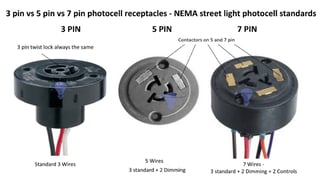
| 3-wire photocell | Usually separates line, load, and neutral, but color codes must be verified against the device diagram. |
| 240V split phase | Confirm the conductors, grounding, and product voltage rating before connecting equipment. |
| Ballast bypass LED tube or corn bulb | Remove or bypass components only when the product instructions require it. |
Common Mistakes to Avoid
- Trusting wire color without reading the actual device diagram.
- Mixing line and load on a photocell or sensor.
- Bypassing a ballast on a product that is not designed for that wiring method.
Before Using Any Wiring Diagram
A wiring diagram is only useful after the site voltage, conductor function, fixture instructions, and local code requirements are confirmed. Wire color can help, but it is not proof. Always shut off power, verify with a meter, and follow the fixture label and instructions. If there is any uncertainty about 120V, 208V, 240V, 277V, neutral, line, load, or ground, use a licensed electrician.
| Wiring situation | Critical check |
|---|---|
| 3-wire LED fixture | Confirm which conductor is line, neutral, ground, dimming, or switched load; do not assume by color alone. |
| 240V circuit | Confirm whether the fixture is rated for line-to-line operation and whether a neutral is required. |
| Photocell wiring | Match line, load, neutral, and voltage rating to the photocell instructions. |
| Ballast bypass | Remove or bypass only as the LED lamp or retrofit kit instructions require. |
More Details to Consider
If you want to switch to LED Lights with 240 volt, you might encounter a wiring challenge. You might have two hot wires and a neutral/ground coming out of the building. In the USA, 120 volt and 277 volt use three classic wires: a hot, a neutral, and a ground. This is the electricity we have all been taught about. 240 volt AC (V=volt, AC=alternating current) throws a spin at you.
It uses two hot wires at 120 volt each that alternate positive to generate the full 240 volt and a ground for safety - no neutral is needed, because the two hots complete the circuit between themselves (as if this isn't confusing enough). By combining the two 120 volt wires, you get 240 volt AC. We'll spare you the technical details of 240 volt and its advantages and disadvantages, but Wikipedia does a good job explaining it. We are going to focus on getting the job done and getting the LED light bulbs, parking lot lights or other installed.
Black, black and green (or other random color)? Yes, in a split phase setup you commonly have black=hot, red=hot and green=ground. Sometimes you see two hot wires both as black. So that is black=hot, black=hot and green (or whatever they want)=ground, but that is less common. There is a ballast, how do I wire my 240 volt to the socket or LED driver? Yes, most of the time when retrofitting to LED Light Bulbs you will have to bypass the ballast and wire direct to the light socket.
That is because higher lumen output bulbs like metal halide, HID or CFL all require a ballast to work correctly. LEDs use a driver and not a ballast. If you are replacing an incandescent then you will not need to. The good news is that rewiring is easy to do. You are literally cutting the ballast out of the system and throwing it away. Then taking those wires and direct connecting to the socket or driver. This cuts out a future point of failure in the ballast as well.
How do I wire the 240 volt 3 wire light socket? Whether it is a classic E26 or larger mogul E39 light bulb we recommend the same thing. Treat the red wire as the hot and land the black on the socket's neutral position. The socket then sees the full 240 volts across its contacts, which is fine for LED bulbs and drivers rated 100-277 volt - the driver does not care that neither leg is a true neutral. Confirm that voltage range on the bulb or driver label before wiring. Doesn't it work better on 240 volt or 277 volt?
Unlike metal halides that worked better with more juice, and even required a pulse start setup for optimal performance, LEDs just do not need it. In fact, the LED driver inside an LED Corn Bulb converts the power from AC to DC for each of the LEDs. What if there is a separate driver? Or just brown, blue and yellow stripe wires? If you are not retrofitting a light bulb socket, but a whole LED high bay light or LED retrofit kit with driver, you do the same thing.
Connect red to brown and black to blue. If they are using American wiring instead of international, then it's red to black and black to white. Here is an illustration of how to wire 240 volt AC split phase for ballast bypass:
Frequently Asked Questions
- Can I wire 240V LED lights myself?
- A qualified electrician should handle electrical work. Use diagrams for planning and follow the product instructions and local code.
- What are the three wires on a photocell?
- Many photocells use line, load, and neutral, but the actual device diagram must be checked.
- Can wire colors be trusted?
- No. Wire colors vary by device and installation, so conductors must be verified.
- What is ballast bypass?
- Ballast bypass rewires the fixture so a compatible LED lamp receives power without the old ballast. Only do this when the product requires it.

Ready to Upgrade Your LED Lighting?
Our lighting specialists can help compare options, confirm light levels, and quote products that fit the site.
Call 800-674-9420 or email [email protected]
Monday-Friday, 8am-5pm PST

About the Author
Dara Greaney is founder and CEO of LED Light Expert with deep expertise in commercial LED lighting, retrofits, and photometric planning.
Editing by David Peguero
Tagged Products

4 Comments
Chuck Joy
I like your website it is great! I have a question on my wiring ,i still have 240v with out the ground .if i hook up 120v to hot and 120v to neutral wont that cause the led bulb to short out?
Customer Service - LEDLightExpert
Please email or call us with your order number and we can help you out with the wiring. Thanks Customer service
Derrick
I Have Ordered LED High Bay Lights For My Church And The Old Metal Halides Were 240 The New Leds Are 110 How Do I Wire These In Place Of The 240 Old Ones Can I Not Just Move One Hot To The Neutral Bus In The Box And Use The 240 Wire As A 110
jay
So what happens to the other hot wire that I am not using?
Austin
Please give our customer service department a call at 800-674-9420 Ext. 2 with your order number so we can pull up your order and provide you with technical advice.
James
Great info, this will help me decide with my voltage and the amount of lights for my project
Sales
Thanks for reaching out. We have sent you a response via email. Please feel free to reach out to us directly at 800-674-9420 or [email protected] for pricing/quotes or product info at any time."


