

Quick Answer
Lighting technology is the method a light source uses to produce and control light, including LED, HID, fluorescent, halogen, incandescent, and induction systems.
Lighting Technologies Explained
Lighting technology should be compared by output, efficacy, color, controls, heat, maintenance, dimming, and application. LED is common now, but users still need to understand how it differs from fluorescent, HID, halogen, incandescent, and induction systems.
What to Check First
- Compare lumens, watts, efficacy, color temperature, CRI, beam control, and dimming.
- Check heat, starting behavior, controls compatibility, and maintenance needs.
- Do not assume old wattage equals new LED output.
Application Decision Table
| Use Case | Practical Guidance |
|---|---|
| LED | Efficient, controllable, and available in many optics. |
| HID | High output but slower start and more maintenance. |
| Fluorescent/CFL | Common legacy technology with ballast and lamp compatibility issues. |
Common Mistakes to Avoid
- Buying by wattage, product name, or old fixture type without checking delivered light and layout.
- Skipping safety listing, environmental rating, controls compatibility, or final commissioning.
- Ignoring glare, maintenance access, documentation, and replacement availability.
Lighting Technology Comparison
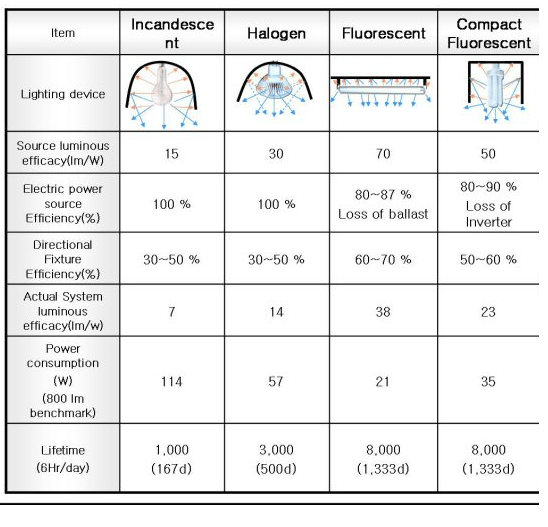
The useful comparison is not whether one technology is newer. It is how each source creates light, how much useful light reaches the task, how much heat it adds, how well it controls glare, how often it needs service, and whether it works with modern controls. LEDs usually win new commercial projects because they combine high efficacy, directional optics, instant start, dimming, sensor compatibility, and long service intervals. Older technologies can still appear in legacy fixtures, specialty lamps, or low-hour areas where replacement cost dominates.
| Technology | Strength | Common limitation |
|---|---|---|
| LED | Efficient, directional, controllable, long service intervals | Requires good thermal design and compatible controls. |
| Fluorescent | Diffuse light and historically low upfront cost | Ballasts, mercury handling, cold-start behavior, and declining availability. |
| Metal halide / HID | High output for older high bay, site, and sports fixtures | Warm-up time, lumen depreciation, relamping, and less precise optics. |
| Halogen / incandescent | Simple warm light and strong color rendering | High heat and high energy use for the delivered light. |
How to Choose Between Technologies
For a retrofit, check operating hours, maintenance access, target footcandles, fixture condition, controls, color needs, and code or rebate requirements. For a new installation, choose the technology that gives the needed light level and distribution with the lowest maintenance burden and the best user experience. In most commercial projects that answer is LED, but the product still needs the right optic, CCT, CRI, voltage, surge protection, and environmental rating.
How Each Lighting Technology Makes Light
The original guide explained the technologies from the light source outward. Incandescent lamps heat a filament until it glows, which gives warm light and strong color rendering but wastes much of the input energy as heat. Halogen is a refined incandescent technology with a small quartz capsule and halogen gas; it can look bright and crisp, and it dims well, but it still runs hot and has a shorter service life than most modern LED systems.
Fluorescent and CFL lamps use an electric discharge to excite phosphors inside the lamp. They were important efficiency upgrades over incandescent lamps, especially for offices and low-cost general lighting, but they bring ballast compatibility, cold-start, color, dimming, and mercury-handling issues. Metal halide and high-pressure sodium are HID technologies. Metal halide can deliver high output for older warehouses, stadiums, parking lots, and industrial fixtures, but it commonly has warm-up time, color shift, lumen depreciation, and relamping needs. High-pressure sodium is efficient and long lived in many legacy outdoor systems, but its yellow-orange light usually has poor color rendering.
LEDs use semiconductors to produce light. Their advantages come from directional output, efficient conversion of power to useful light, instant start, available color temperatures, controls compatibility, and durable packages. The tradeoff is that the LED system depends heavily on thermal design, driver quality, surge protection, optics, and controls compatibility.
| Technology | Best-known advantage | Main caution |
|---|---|---|
| Incandescent | Warm appearance and excellent color rendering | High heat, low efficacy, and short life. |
| CFL / fluorescent | Diffuse light and better efficiency than incandescent | Ballasts, mercury handling, dimming limits, and lamp availability. |
| Halogen | Bright, crisp, dimmable light | Runs hot and still uses more energy than LED for similar output. |
| Metal halide | High output for older commercial and industrial fixtures | Warm-up, color shift, lumen depreciation, and maintenance. |
| High-pressure sodium | Efficient legacy outdoor light with long service history | Yellow-orange appearance and poor color rendering. |
| LED | Directional, efficient, controllable, and long service intervals | Needs good driver, heat management, optics, and surge protection. |
More Details to Consider
Different Lighting Technologies Explained. LED Light Expert gets lots of questions about the different lighting technologies. Understanding the old lighting technology will help you understand where LED lights improve the result and which type to choose. Lighting is an essential part of our daily lives, whether it is for home, work, or leisure. However, not all lighting technologies are the same. They differ in terms of energy efficiency, lifespan, color quality, and environmental impact. In this article, we will explain some of the most common lighting technologies and their pros and cons.
Incandescent bulbs are the oldest and simplest type of electric lighting. They work by passing an electric current through a thin metal filament, which heats up and glows. Incandescent bulbs have a low initial cost and a high color rendering index (CRI), which means they produce natural and accurate colors. However, they also have many disadvantages, such as: • High energy consumption: Incandescent bulbs use a lot of electricity to produce light, and most of the energy is wasted as heat.
They are the least efficient lighting technology available today. • Short lifespan: Incandescent bulbs have a short lifespan of about 1,000 hours, which means they need to be replaced frequently. • High operating temperature: Incandescent bulbs generate a lot of heat, which can pose a fire hazard or damage the fixture or the surrounding materials. • Environmental impact: Incandescent bulbs contribute to greenhouse gas emissions and climate change due to their high energy consumption.
Unlike fluorescent and HID lamps, they contain no mercury, so disposal is simpler. • Cheap to make (happens after 100 years of making them. Although LED Light bulbs are now almost as cheap per lumen). Compact fluorescent lamps (CFLs) are a type of fluorescent lighting that uses a glass tube filled with gas and a small amount of mercury. When an electric current passes through the tube, it excites the gas and mercury atoms, which emit ultraviolet (UV) light.
The UV light then strikes a phosphor coating on the inside of the tube, which converts it into visible light. CFLs have several advantages over incandescent bulbs, such as: • Energy efficiency: CFLs use about 75% less energy than incandescent bulbs to produce the same amount of light. This can result in significant savings in electricity bills and carbon emissions. • Longevity: CFLs have a longer lifespan than incandescent bulbs, lasting about 10,000 hours.
This means they need to be replaced less often. • Low operating temperature: CFLs generate less heat than incandescent bulbs, which reduces the risk of fire or injury. However, CFLs also have some drawbacks, such as: • Color quality: CFLs have a lower CRI than incandescent bulbs, which means they may not render colors as accurately or naturally.
They also come in different color temperatures, ranging from warm white to cool white, which can affect the mood and ambiance of the space. • Dimming and switching: Most CFLs are not compatible with dimmer switches or remote controls, which can limit their functionality and flexibility. Some CFLs may also take time to reach full brightness when turned on or flicker when turned off. • Mercury content: CFLs contain a small amount of mercury, which is a toxic metal that can harm human health and the environment if released.
Therefore, CFLs should be handled carefully and disposed of properly at recycling centers. Halogen lamps are a type of incandescent lighting that uses a halogen gas such as iodine or bromine to increase the brightness and efficiency of the filament. Halogen bulbs provide a brighter, whiter light than standard incandescent bulbs, with typically higher efficiency. Homeowners mostly use the halogen bulbs for their higher brightness levels. They are often used on movie sets and also in auto headlights.
Halogen lamps have some benefits over regular incandescent bulbs, such as: • Brightness: Halogen lamps produce a bright, white light that is suitable for task lighting or accent lighting. They can also be dimmed to create different effects. • Efficiency: Halogen lamps use about 25% less energy than regular incandescent bulbs to produce the same amount of light. • Color quality: Halogen lamps have a high CRI similar to regular incandescent bulbs, which means they produce natural and accurate colors.
However, halogen lamps also have some disadvantages, such as: • Lifespan: Halogen lamps have a shorter lifespan than CFLs or LEDs, lasting about 2,000 hours on average. They also degrade over time and lose their brightness and color quality. • Operating temperature: Halogen lamps generate more heat than regular incandescent bulbs or CFLs, which can pose a fire hazard or damage the fixture or the surrounding materials.
They also require special fixtures that can withstand high temperatures. • Environmental impact: Halogen lamps consume more energy than CFLs or LEDs, which contributes to greenhouse gas emissions and climate change. Unlike fluorescent and HID lamps, they contain no mercury, so disposal is simpler. Metal halide lamps are a type of high-intensity discharge (HID) lighting that uses an electric arc between two electrodes in a gas-filled tube to produce light.
The gas contains mercury and metal halides such as sodium or scandium, which add color and intensity to the light. Metal halide lamps are often used for outdoor or industrial lighting, such as street lights, parking lots, stadiums, or warehouses. They have some advantages over other lighting technologies, such as: • Brightness: Metal halide lamps produce a very bright, white light that can illuminate large areas.
They can also be adjusted to different color temperatures, ranging from warm white to daylight. • Efficiency: Metal halide lamps use less energy than incandescent or halogen lamps to produce the same amount of light. They are more efficient than older mercury-vapor lamps, though high-pressure sodium still beats them on raw efficacy. • Lifespan: Metal halide lamps have a longer lifespan than incandescent or halogen lamps, lasting about 15,000 hours.
However, metal halide lamps also have some drawbacks, such as: • Color quality: Metal halide lamps have a lower CRI than incandescent or halogen lamps, which means they may not render colors as accurately or naturally. They also suffer from color shift over time, which means they may change their color temperature or hue as they age. • Dimming and switching: Metal halide lamps are not compatible with dimmer switches or remote controls, which can limit their functionality and flexibility.
They also take several minutes to reach full brightness when turned on, and even longer to restrike after a power interruption, which can affect their performance and safety. • Mercury content: Metal halide lamps contain a significant amount of mercury, which is a toxic metal that can harm human health and the environment if released. Therefore, metal halide lamps should be handled carefully and disposed of properly at recycling centers. High-pressure sodium lamps are another type of HID lighting that uses an electric arc between two electrodes in a gas-filled tube to produce light.
The gas contains sodium and mercury, which emit a yellow-orange light. High-pressure sodium lamps are mainly used for outdoor or industrial lighting, such as street lights, parking lots, stadiums, or warehouses. They have some advantages over other lighting technologies, such as: • Brightness: High-pressure sodium lamps produce a very bright light that can illuminate large areas. They are more efficient than other HID lamps such as mercury-vapor or metal halide lamps. • Lifespan: High-pressure sodium lamps have a longer lifespan than incandescent or halogen lamps, lasting about 24,000 hours.
However, high-pressure sodium lamps also have some disadvantages, such as: • Color quality: High-pressure sodium lamps have a very low CRI, usually 20, which means they produce a poor and distorted color rendition. They also have a very low color temperature, which means they produce a warm and yellowish light that can affect the mood and ambiance of the space. • Dimming and switching: High-pressure sodium lamps are not compatible with dimmer switches or remote controls, which can limit their functionality and flexibility.
They also take several minutes to reach full brightness when turned on, and even longer to restrike after a power interruption, which can affect their performance and safety. • Mercury content: High-pressure sodium lamps contain a significant amount of mercury, which is a toxic metal that can harm human health and the environment if released. Therefore, high-pressure sodium lamps should be handled carefully and disposed of properly at recycling centers. Light-emitting diodes (LEDs) are a type of solid-state lighting that uses semiconductor materials to convert electricity into light. When voltage is applied across a semiconductor material, electrons move through the material and release energy as light.
Each semiconductor material produces light in a specific wavelength range - LEDs cannot make white light on their own, so white LEDs pair a blue LED with a phosphor coating. LEDs are the most advanced and energy-efficient lighting technology available today. They have many benefits over other lighting technologies, such as: • Energy efficiency: LEDs use about 80% less energy than incandescent bulbs and about 50% less energy than CFLs to produce the same amount of light.
This can result in significant savings in electricity bills and carbon emissions. • Longevity: Many LED fixtures are rated for long service life, often 50,000 hours or more, but actual life depends on heat, driver quality, power conditions, and installation. Ideal for large fixtures like LED Parking Lot Lights. • Low operating temperature: LEDs generate very little heat, which reduces the risk of fire or injury.
It also improves the performance and durability of the LEDs and the fixtures. • Color quality: LEDs have a high CRI similar to incandescent bulbs, which means they produce natural and accurate colors. They also come in different color temperatures, ranging from warm white to cool white, which can affect the mood and ambiance of the space. • Very Durable. Cooler running, solid state and long life lead to high durability in the field. • Cost and efficiency: Long term cost and efficiency means they often pay for themselves in a few years.
The following methods are involved in calculating the cost and efficiency: lamp life, lamp cost, Wattage per fixture, Usage, Energy costs. The math today makes it very easy to see why LEDs are taking over. The lumens to watt and overall quality is untouchable. By going LED you can transform your rooms, buildings or even streets and stadiums. LED lights now come in every size and shape needed. Choose from warehouse lights, parking lot lights, wall pack lights, and LED corn bulbs to illuminate every space in your building.
Frequently Asked Questions
- What is lighting technology?
- Lighting technology is the method a light source uses to produce and control light, including LED, HID, fluorescent, halogen, incandescent, and induction systems.
- Why did LED replace many older technologies?
- LEDs can offer strong efficacy, optical control, long service life, instant start, and better controls compatibility when specified correctly.
- Are watts a good way to compare technologies?
- No. Watts describe power input. Compare lumens, distribution, efficacy, color, controls, and application.
- What should I check before replacing old lights?
- Check voltage, fixture condition, controls, dimming, heat, mounting, target light level, and safety listing.

Ready to Upgrade Your LED Lighting?
Our lighting specialists can help compare options, confirm light levels, and quote the right products for your project.
Call 800-674-9420 or email [email protected]
Monday-Friday, 8am-5pm PST

About the Author
Dara Greaney is founder and CEO of LED Light Expert with deep expertise in commercial LED lighting, retrofits, and photometric planning.
Editing by David Peguero

Trusted by Thousands
Our customers love us — and we love them back.


-
 Free Shipping
On orders over $49.00
-
 Free Extended Warranty
Up to 7 Years Free Warranty On LED Lights
-
100% Satisfaction Guarantee
