

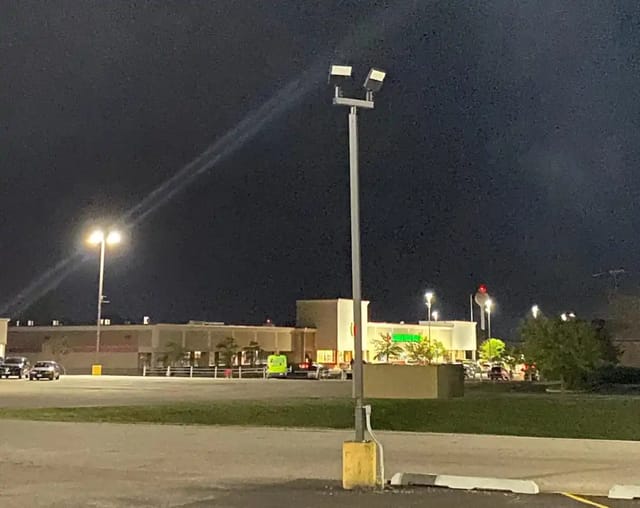
You need a layout based on lot size, pole height, fixture output, and target light levels.
How Many Parking Lot Lights Do I Need?
The number of parking lot lights depends on more than square footage. Pole height, fixture output, distribution type, mounting locations, vehicle circulation, pedestrian paths, neighboring properties, light-level targets, and uniformity all matter. A photometric layout is the reliable way to answer the question before buying fixtures and poles.
What to Check First
- Measure lot dimensions, pole locations, mounting heights, entrances, walkways, and neighboring edges.
- Review fixture lumens, distribution, BUG rating, CCT, controls, and aiming.
- Use a photometric plan when safety, code, or uniformity matters.
Application Decision Table
| Use Case | Practical Guidance |
|---|---|
| Small lot | Existing poles may be enough if fixture distribution and output fit the layout. |
| Retail or public lot | Uniformity, glare control, entrances, and pedestrian zones need closer review. |
| Large commercial lot | Use a full layout with pole spacing, circuits, controls, and spill-light review. |
Inputs for a Layout
- Lot dimensions.
- Pole height and location.
- Fixture lumens and distribution.
- Target light level and uniformity.
- Controls and operating schedule.
Common Mistakes to Avoid
- Counting fixtures without checking pole height and distribution.
- Creating bright hot spots with dark areas between poles.
- Ignoring glare into roads, windows, or cameras.
Why There Is No Universal Parking Lot Light Count
The number of parking lot lights you need depends on the lot shape, pole height, pole spacing, fixture lumens, optic type, target light levels, uniformity, glare, spill light, and whether the lot has drive lanes, pedestrian paths, cameras, or dark edges. A photometric layout is the reliable way to check the answer before buying fixtures.
| Planning input | Why it changes the count |
|---|---|
| Lot size and shape | Long narrow lots, corners, and islands need different pole layouts. |
| Pole height | Taller poles spread light farther but require correct optics and aiming. |
| Fixture distribution | Type III, IV, and V optics put light in different directions. |
| Uniformity goal | A few very bright fixtures can still leave dark spots. |
Focus on Footcandles on the Ground and Uniformity
Footcandles are the unit lighting experts use to measure how much light actually reaches the ground. One footcandle is one lumen falling on one square foot of surface. How much you need depends on how busy the area is: a low-activity back lot can be fine around 0.5 fc, while a busy lot wants about 5 fc. As a working rule, aim for a minimum of 1 fc across the whole lot, with 2 to 4 fc being more desirable for appeal and safe visibility.
Uniformity - how evenly that light is spread - is expressed as the ratio of average to minimum light level, and 3:1 is the common target for parking lots. LED optics deliver excellent uniformity by nature; when a lot looks patchy, it is almost always fixture spacing, or trees and landscaping in the way, rather than the fixture itself.
Pole Height
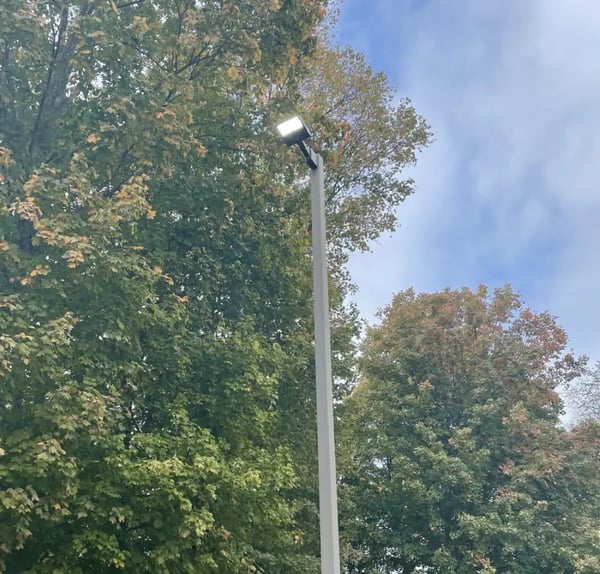
LED parking lot lights are usually pole-top or pole-mounted shoebox fixtures set between 15 and 40 feet high. Mounting height, pole placement, number of heads, and beam angle together decide your illumination quality. Before you design, confirm the maximum pole height your jurisdiction allows, and consider neighboring properties so you do not throw glare past your own lot. Common mounting runs 12 to 20 feet, and in some cases up to about 35 feet - the larger the lot, the taller the pole.
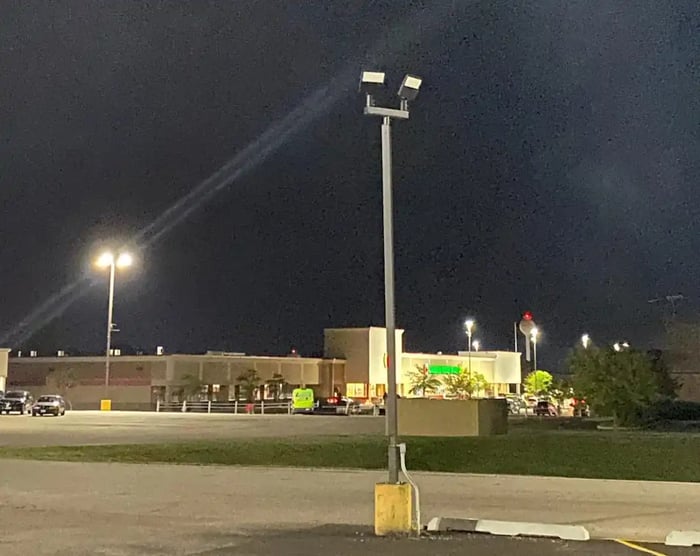
15-Foot Poles: 2 to 4 Heads Per Pole
A 15-foot pole typically runs a Type III pattern with 2 to 4 light heads. At that height a three-light pattern covers roughly 15 feet to each side and 15 feet forward - not exact, but a good way to estimate coverage. Once the mounting height is set, spacing follows, and the rule of thumb is simple: the higher the pole, the fewer poles you need, assuming your beam angles are right.
150 watts, standard, at 60-foot spacing
When replacing old 400-watt HID parking lot lights, conversions track your existing wattage. A 150-watt LED parking lot light generates about 20,000 lumens, and 60-foot spacing gives the average brightness common in lightly used back lots.
150 watts, bright, at 40-foot spacing
Tighten the same 150-watt head to about 40-foot spacing and the coverage overlaps for more brightness and fewer shadowy spots. That extra overlap improves appeal and visibility - a good fit for small home or retail lots.
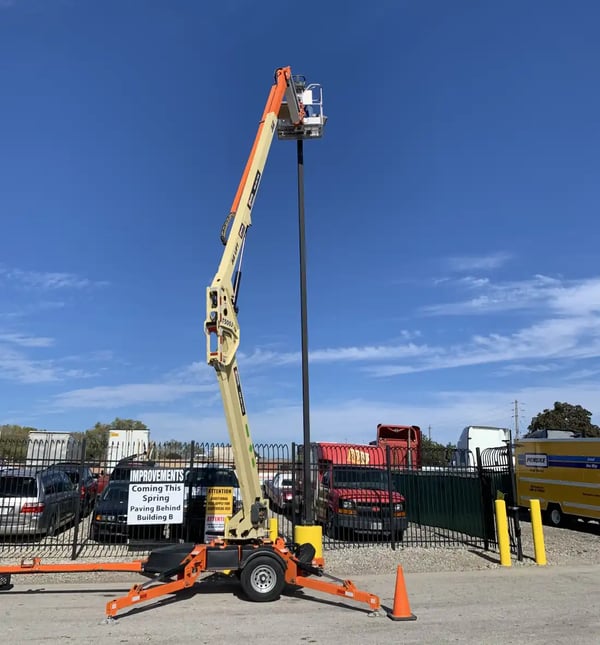
20-Foot Poles: 2 to 4 Fixtures Per Pole
A 20-foot pole suits medium-to-large lots, throwing light farther than a 15-foot pole. Common setups at this height:
- 300 watts, standard, at 60 feet: a 300-watt fixture makes about 40,000 lumens - brighter than a 150-watt head at the same spacing, but still wide enough for commercial visibility such as a car dealership yard.
- 300 watts, bright, at 40 feet: the same height and output at tighter spacing puts more light on the ground and covers more area - ideal for big retail lots that need appeal and brightness.
- 25 feet, 4 per pole: the most cost-effective design. Four heads cross-light from multiple directions, eliminating hot spots and shadows, and tall poles cover a large area with fewer poles - lower install and utility cost.
25-Foot Poles, 4 Heads: Widest Coverage, Lowest Cost
300 watts, standard, at 60 feet with four per pole is a widely spaced setup using few, tall poles - common for large commercial parking lots and sparsely populated areas, and cost-effective because it uses so few poles. Reduce the spacing to 40 feet with four per pole and the lot gets noticeably brighter with enhanced visibility, which suits large commercial lots, big-box retail, and sports courts.
Make Sure Your Coverage Is Even
The Type III pattern has long been the parking-lot standard. Determining coverage is complex, but the light must be even to deliver real uniformity, and getting the pattern right calls for an expert. Contact us for a photometric layout of your lot before you order.
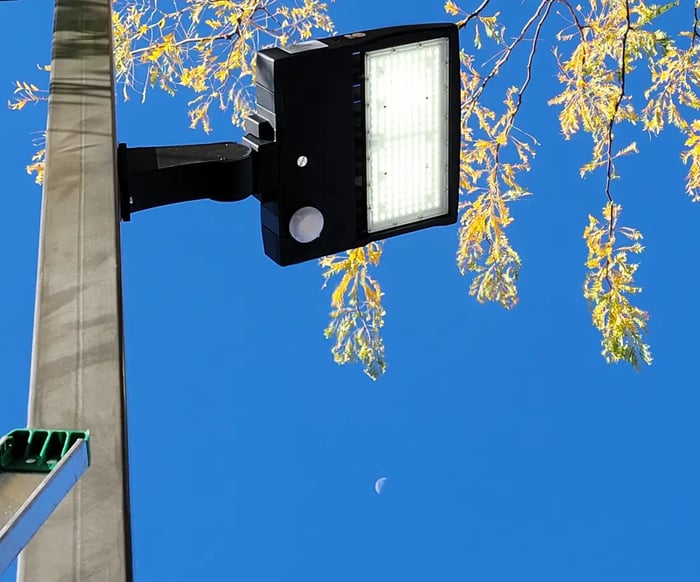
Consider Motion Sensors
A good way to cut energy use and improve security is to add motion sensors. Microwave-based sensors now reach far enough to work on poles up to about 30 feet, and are best used under 22 feet when you need the longest detection distance.
More Details to Consider
The number of parking lot lights depends on lot shape, pole height, pole spacing, fixture lumens, distribution type, target light levels, glare, spill light, and uniformity. A square-foot estimate can help early planning, but it is not enough for a final order.
Footcandles and uniformity matter because a lot can have high average brightness while still leaving dark areas between poles. Type III, Type IV, and Type V optics all place light differently, so the same wattage can produce very different results.
Use a photometric layout when the project affects safety, code, cameras, neighboring properties, or customer experience. After installation, check the lot at night and adjust aiming or controls before the project is closed.
Frequently Asked Questions
- How many parking lot lights do I need?
- You need a layout based on lot size, pole height, fixture output, and target light levels.
- Can I estimate by square foot?
- Only roughly. Photometrics are better for real projects.
- What matters besides brightness?
- Uniformity, glare, spill, pole spacing, controls, and maintenance matter.
- Do motion sensors change the count?
- Usually they change run behavior, not the needed coverage layout.

Ready to Upgrade Your LED Lighting?
Our lighting specialists can help compare fixtures, confirm light levels, and quote products that fit the site.
Call 800-674-9420 or email [email protected]
Monday-Friday, 8am-5pm PST

About the Author
Dara Greaney is founder and CEO of LED Light Expert with deep expertise in commercial LED lighting, retrofits, and photometric planning.
Editing by David Peguero

Trusted by Thousands
Our customers love us — and we love them back.


-
 Free Shipping
On orders over $49.00
-
 Free Extended Warranty
Up to 7 Years Free Warranty On LED Lights
-
100% Satisfaction Guarantee
