

Quick Answer
The phrase can refer to beam spread, distribution type, safety class, product category, or environmental rating.
LED Light Classification and Distribution Types
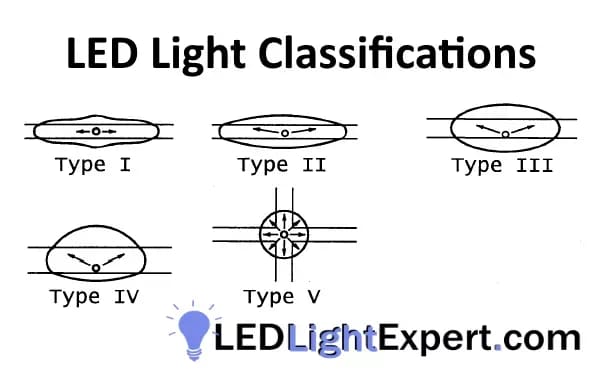
Lighting classification can mean several things: beam spread, roadway or area-light distribution, safety class, environmental rating, and product category. For most commercial buyers, the practical question is how the fixture sends light into the space.
What to Check First
- Separate beam angle, NEMA beam spread, and IES Type I through Type V distribution.
- Use distribution type with mounting height, pole location, target area, and glare limits.
- Check wet-location, IP, impact, emergency, and safety listings separately from optical distribution.
Application Decision Table
| Use Case | Practical Guidance |
|---|---|
| Type II | Common for narrow roads, paths, and long side-to-side coverage. |
| Type III | Often used for parking lots and general area lighting from internal rows. |
| Type IV | Useful along perimeters where forward throw is needed from the edge. |
| Type V | Used where light should spread around a central pole or open area. |
Common Mistakes to Avoid
- Calling one distribution the right answer before reviewing pole location and target area.
- Confusing beam angle with IES distribution type.
- Ignoring glare and spill because the average light level looks acceptable.
IES Distribution Types I-V, in Plain English
The original guide correctly tried to explain that "light class" can mean beam angle or area-light distribution. The clean way to separate them is this: NEMA beam spread is commonly used for flood, spot, and sports lights; IES Type I through Type V is commonly used for roadway, parking lot, and area-light distribution. Both describe where light goes, but they are not the same system.
| Type | Pattern | Typical use |
|---|---|---|
| Type I | Very narrow, long pattern | Walkways, narrow paths, signs, and focused applications. |
| Type II | Long, narrow side-to-side distribution | Roads, smaller streets, jogging paths, and perimeter runs. |
| Type III | Wider forward throw | Parking lots, courts, and general area lighting from rows or edges. |
| Type IV | Forward-throw, asymmetric pattern | Building perimeters, wall-side parking, and edge-mounted fixtures. |
| Type V | Round or square symmetric pattern | Open areas where the pole is near the center of the target zone. |
Why Classification Changes the Fixture Count
Distribution affects pole spacing, uniformity, glare, spill light, and how much of the lumen package reaches the useful target. A Type V fixture in the wrong perimeter location can waste light behind the pole. A Type III or IV fixture in the right location can improve forward throw and reduce spill. For high-output sports and flood lights, beam angle and aiming are usually more important than the area-light Type I-V label.
NEMA Beam Spread Is a Different Classification
NEMA beam spread describes the width of a beam, usually for flood lights, spotlights, and sports lights. A lower NEMA number is narrower and throws farther. A higher number is wider and covers more area close to the fixture. That is different from IES Type I-V distribution, which describes area-light patterns around roads, parking lots, and poles.
| NEMA-style beam choice | Typical use | Field caution |
|---|---|---|
| Narrow spot | Long throw, signs, flags, stage focus, sports aiming, distant targets. | Small aiming errors are more visible; glare can be severe if aimed poorly. |
| Medium flood | General area fill, courts, facades, work zones, and pole-mounted flood lighting. | Check overlap so the center is bright without dark edges. |
| Wide flood | Shorter mounting heights, broad nearby coverage, wall washing, and large close areas. | Can waste light outside the target if there is no shielding or aiming plan. |
For real projects, distribution class should be chosen with a lighting layout. The layout shows average footcandles, minimum levels, uniformity, spill, and glare risk in a way a product name cannot.
More Details to Consider
LED Light Classification- Learn about the Classes of Light. What are LED Light Classifications? A: LED lights have various classifications related to certifications usage and beam angles. For beam angles they are classified by NEMA types from Type 1 very narrow to Type 5 being very wide. Note that in case lighting wasn't confusing enough, there are 2 versions of these light types. There is NEMA Type 1-5 for road and area lighting(pic above), then NEMA type 1-5 for spot and distance lighting(image below).
Yes, you read that correctly - they could not find different numbers or types. We just wanted to make sure you used a light designer. You might not know that LED lights come in as many as 5 classes or types. Each class or type has its own purpose and light distribution pattern. The light distribution pattern refers to how the light is spread or projected from the source. It affects the coverage, intensity, and uniformity of the light in a given area.
The short description is that as you increase the class, the light angles become wider. In this blog, we will discuss in detail the classes of light distribution to give you a clear idea about the type you can choose to illuminate your space in a better way. Since LEDs are already especially efficient and bright, most LED Parking lot lights fall in the class III wide angle range. This ensures a wide light and with LEDs you will still get plenty of light at the ground.
Type I is a narrow spot with a width of 15 degrees in the cone of maximum candlepower. This type of light distribution is ideal for stadiums, landscape spots, signs and other small targets. Any time we want to put the focus on something or someone, such as a stage a narrow Type 1 can also work. For narrow pathways from close distance, typically above, the lighting is ideal to be placed near the center of the pathway.
Type I lighting is suitable for narrow spaces where the width of the area does not exceed 1.5 times the mounting height of the fixture. Type II is built for wide side-to-side coverage without much forward throw, mainly for LED Street Lights. It is also used for long and narrow lighting. This type of lighting is meant for lighting side to side and mostly it is located near the roadside. You'll find this type of lighting also on smaller side streets or jogging paths.
These lights have a width of 100-150 degrees side to side with less than half that forward, which makes the light spread on larger spaces easily without dispersing it. Type II lighting is designed for wider roadways where the width of the area does not exceed 1.75 times the mounting height of the fixture. Type III lighting is used for parking areas and other areas where a medium flood pattern is required. These areas also include basketball courts and other sports, parks and grounds.
This light needs to be placed in the side or corners of the area so that the light can fill the whole arena. Type III light distributions have a 140 x 100 degree pattern which makes it easier to fill the light in all parts of the space. Type III lighting is intended for medium-width roadways and general parking areas where the width of the area does not exceed 2.75 times the mounting height of the fixture. Type III is the most common light because it works so well at 15-25' high.
Type IV produces a semicircular light below it. These are best for illuminating all the boundaries of parking areas and business spaces. The intensity of the Type IV lighting has the same intensity at angles from 90 degrees to 270 degrees. Type IV lighting is also known as forward throw or asymmetric lighting. It provides a wider distribution of 60 degrees lateral width. It is best for perimeters and mounting on the sides of buildings and walls. It provides forward lighting with minimal back lighting.
Type IV lighting is suitable for large spaces where the width of the area runs up to about 3.7 times the mounting height of the fixture. Type V lighting produces a circular distribution that distributes light equally at all angles. This distribution has a circular symmetry of candlepower that is essentially the same at all lateral angles. For parking areas as well as LED Basketball Court Lights these work great. Anywhere in the Class III-V range is good here.
Type V lighting provides a uniform and even illumination for spaces where the mounting height is approximately equal to the width of the area. These are the 5 classes of lights that are available in the market. You can choose the one depending on the requirements. If you have to illuminate larger spaces from higher poles, you can choose class I; from lower installs use class III lighting. It all depends on the space you have to illuminate.
If you want brighter light in small spaces, you can use narrow angles and increase the lumens. Read more on light classifications with this article.
Frequently Asked Questions
- What are LED light classes?
- The phrase can refer to beam spread, distribution type, safety class, product category, or environmental rating.
- What are IES distribution types?
- Types I through V describe how area and roadway fixtures distribute light relative to the mounting location.
- What is NEMA beam spread?
- NEMA beam spread describes beam width, often used with flood and sports lighting.
- Why does distribution matter?
- Distribution affects coverage, uniformity, glare, spill, pole spacing, and fixture count.

Ready to Upgrade Your LED Lighting?
Our lighting specialists can help compare options, confirm light levels, and quote products that fit the site.
Call 800-674-9420 or email [email protected]
Monday-Friday, 8am-5pm PST

About the Author
Dara Greaney is founder and CEO of LED Light Expert with deep expertise in commercial LED lighting, retrofits, and photometric planning.
Editing by David Peguero

Trusted by Thousands
Our customers love us — and we love them back.


-
 Free Shipping
On orders over $49.00
-
 Free Extended Warranty
Up to 7 Years Free Warranty On LED Lights
-
100% Satisfaction Guarantee
