

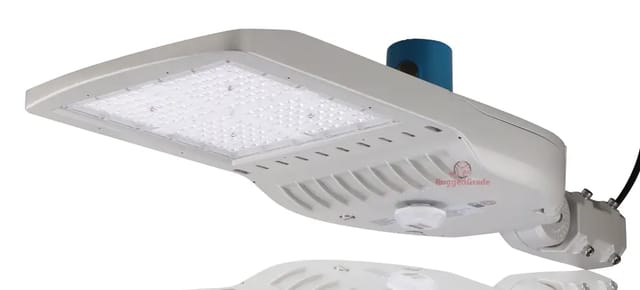
Slip fitter, direct arm, trunnion or yoke, and bracket or flood mounts are common.
LED Street Light Mounts and Wiring
Street light mounting and wiring decisions affect fixture aim, pole compatibility, service access, controls, and long-term reliability. The main mount styles are slip fitter, direct arm, trunnion or yoke, and flood or bracket mounts. The right choice depends on the pole, tenon, arm, roadway geometry, wiring access, and fixture weight.
What to Check First
- Match the mount to the pole, tenon, arm size, and fixture drilling pattern before ordering.
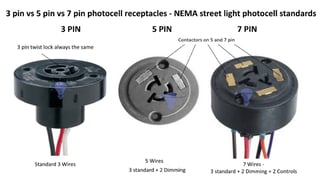
- Confirm voltage, branch circuit, grounding, surge protection, photocell or receptacle, and local code requirements.
- Use qualified electrical labor for wiring, grounding, and field modifications.
Application Decision Table
| Use Case | Practical Guidance |
|---|---|
| Slip fitter | Common on round tenons and useful when the fixture needs aiming adjustment. |
| Direct arm | Common on square or round poles when the fixture and pole pattern match. |
| Trunnion or yoke | Useful for walls, brackets, signs, or special aiming needs. |
Specification Checklist
- Pole or tenon diameter
- Mounting bolt pattern
- Fixture weight and EPA
- Voltage and controls
- Grounding and surge protection
- Photocell or NEMA receptacle
Common Mistakes to Avoid
- Ordering a fixture before measuring the pole or tenon.
- Treating wiring as a plug-and-play step.
- Forgetting surge protection, grounding, and photocell orientation.
Street Light Mounts Change the Wiring Plan
LED street light fixtures can use slip fitter mounts, tenon mounts, direct arm mounts, yoke mounts, wall mounts, or decorative post-top mounts. The mount affects aiming, pole compatibility, wire routing, photocell placement, service access, and whether the fixture can be leveled or adjusted in the field.
| Mount type | Best use | Check first |
|---|---|---|
| Slip fitter | Adjustable mounting on tenons or arms. | Tenon diameter, aiming angle, and set screws. |
| Direct arm | Clean pole-mounted roadway or area lighting. | Pole drill pattern, arm size, and wire entry. |
| Post top | Decorative streetscapes and pathways. | Post size, optics, and wind exposure. |
More Details to Consider
Street light mount type affects aiming, pole fit, wiring, and service access. Common choices include slip fitter, direct arm mount, tenon, yoke, flood mount, and bracket adapters for square or round poles.
Before ordering, confirm pole or arm diameter, voltage, fixture weight, wind exposure, optic type, photocell receptacle, grounding, surge protection, and whether the existing wiring is suitable. A fixture that physically fits may still be wrong for the road or lot distribution.
Wiring should follow the product instructions and local electrical requirements. Connections, photocells, control nodes, and surge devices should be installed in weather-protected locations as designed, then tested after dark for aiming and control behavior.
Frequently Asked Questions
- What are the main street light mount types?
- Slip fitter, direct arm, trunnion or yoke, and bracket or flood mounts are common.
- Can I wire an LED street light myself?
- Commercial wiring should be handled by qualified electrical professionals and local code requirements.
- What should I measure first?
- Measure pole shape, tenon or arm size, bolt pattern, and mounting height.
- Do street lights need surge protection?
- Surge protection is strongly recommended because outdoor poles are exposed to electrical transients.

Ready to Upgrade Your LED Lighting?
Our lighting specialists can help compare fixtures, confirm light levels, and quote products that fit the site.
Call 800-674-9420 or email [email protected]
Monday-Friday, 8am-5pm PST

About the Author
Dara Greaney is founder and CEO of LED Light Expert with deep expertise in commercial LED lighting, retrofits, and photometric planning.
Editing by David Peguero

Trusted by Thousands
Our customers love us — and we love them back.


-
 Free Shipping
On orders over $49.00
-
 Free Extended Warranty
Up to 7 Years Free Warranty On LED Lights
-
100% Satisfaction Guarantee
