

Start with target light levels, mounting height, fixture lumens, distribution, and layout.
Warehouse Light Wattage and CCT Guide
Warehouse lighting should be selected by useful light on the work plane, not by wattage alone. Wattage tells you energy use. Lumens, optics, mounting height, aisle geometry, reflectance, CCT, glare, controls, and uniformity tell you whether the space will work.
What to Check First
- Measure mounting height, rack height, aisle width, open areas, dock zones, and task locations.
- Compare fixture lumens, distribution, lens, glare control, CCT, CRI, controls, and voltage.
- Use a layout for high-rack, forklift, inspection, packing, or high-traffic areas.
Application Decision Table
| Use Case | Practical Guidance |
|---|---|
| Open warehouse | Broad distribution and uniformity usually matter more than raw wattage. |
| Rack aisles | Aisle optics and vertical light help workers see labels and slots. |
| Dock or packing area | Task light, glare control, and controls are important. |
Specification Checklist
- Delivered lumens
- Lumens per watt
- Mounting height
- Beam or distribution
- CCT and CRI
- Dimming and sensors
Common Mistakes to Avoid
- Choosing wattage before deciding target light levels.
- Assuming higher Kelvin is brighter.
- Using one fixture for open areas, aisles, and task zones without a layout.
Start With Lumens and Layout, Not Watts Alone
Warehouse lighting wattage only tells you power draw. To choose the right fixture, compare delivered lumens, mounting height, beam angle, aisle layout, rack height, task area, glare, controls, and target light levels. CCT affects color appearance, while lumens and photometrics determine how well the space is lit.
| Warehouse area | What to prioritize |
|---|---|
| Aisles | Narrower optics, uniform rows, and glare control. |
| Open work zones | Even coverage, task visibility, and comfortable CCT. |
| Loading docks | Impact resistance, shadows, safety, and controls. |
| Cold or damp areas | Temperature rating, lens choice, and sealed housing. |
Wattage-Selectable and Tunable Lights
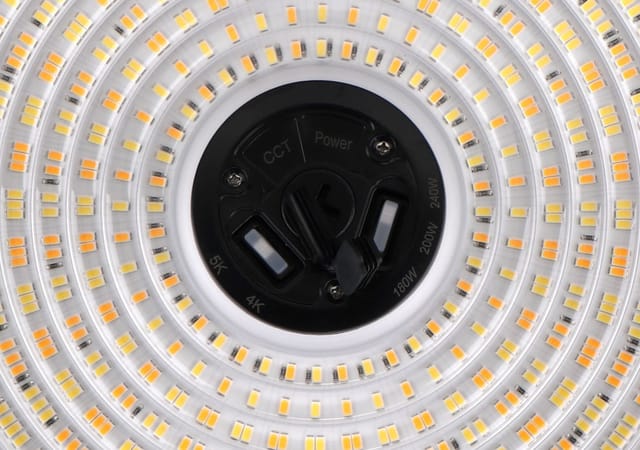
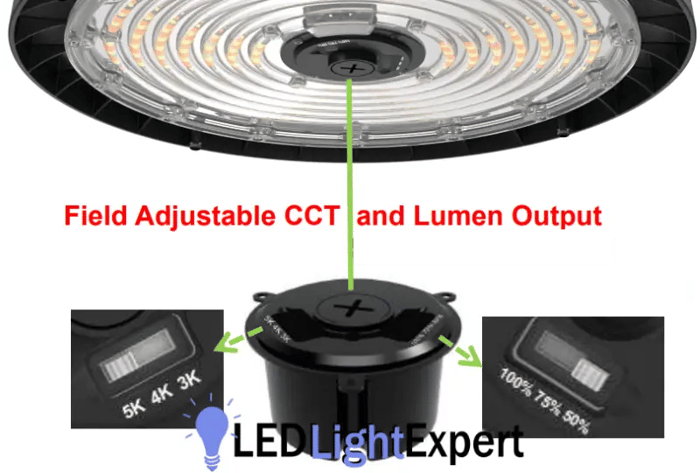
Warehouses are tall, deep, and aisle-heavy, so the fixture has to be matched to the space rather than bought by the box. Modern high bays help here: tunable fixtures carry an onboard wattage dial for brightness and a Kelvin switch for color, and wattage-selectable fixtures let you set the output on site instead of stocking multiple lamps. One SKU covers several applications, which is why these dominate warehouse retrofits. For most spaces, LED high bay lighting suits ceilings of 14 feet and up.
How Wattage Selection Saves Energy
Dialing a fixture down does two things: it delivers the right light level and it cuts power almost one-for-one — run a light at 30% and you save roughly 30% of its energy, while the lower drive current also extends fixture life. Pair that with timers and occupancy control and unused aisles stop burning money. It is a genuinely cheaper, more flexible way to light a warehouse than fixed-output lamps.
Choosing the Right Color Temperature (CCT)
CCT describes the warmth or coolness of white light in Kelvin: 2700K–3000K reads warm and yellow, 3100K–5500K reads cool. For a working warehouse the sweet spot is 4000K to 5000K — a clean, cool white that is not the slightly blue 5700K. Studies show 5000K and below reduces eyestrain and supports a more productive, alert workforce, so this range is the safe default for picking, packing, and inspection work.
Controlling Glare (UGR)
Glare is the visual strain from a bright source in the line of sight, and it comes in two forms: discomfort glare (you instinctively look away) and disability glare (visibility drops with no reflex to look away). On a forklift or a pick line, either one means eyestrain, headaches, fatigue, and accidents. Glare is rated by Unified Glare Rating (UGR); choose the best warehouse fixtures with a UGR under 28, use good beam shaping, and add window shading where sun is a factor. See our explainer on UGR glare ratings.
Matching Beam Angle to Mounting Height
Light distribution is set by mounting height and beam angle — the taller the ceiling, the narrower the beam needed to drive light to the floor. A working guide (180° is full side-to-side):
| Beam angle | Ideal mounting height |
|---|---|
| 120° | 10–18 ft (higher with more fixtures) |
| 90° | 16–25 ft (up to 30 ft with more fixtures) |
| 60° | 28–35 ft |
| 30° | 40–60 ft |
The right distribution maximizes light on the aisle while cutting the number of fixtures — the right optic in the right place, without glare.
Occupancy Control
PIR (passive infrared) sensors turn fixtures on when they detect motion and off when an area empties. Mount motion-sensor high bays roughly 6 to 10 feet above the floor so movement crosses the detection zone rather than heading straight at the sensor, and cover every approach for security. With aisles dark when idle, the energy savings on top of wattage selection are substantial.
More Details to Consider
Warehouse fixture selection starts with the work being done below the lights. Storage aisles, forklift paths, packing tables, loading docks, inspection benches, and open bulk storage may need different light levels and beam patterns.
Wattage selectable and CCT selectable high bays can help when a facility is uncertain about final settings, but they still need a layout. Mounting height, spacing, rack height, fixture lumens, glare, and controls decide whether the warehouse feels even and usable.
Document final wattage and Kelvin settings after installation. If sensors, dimming, or daylight controls are used, commission the hold time, standby level, and detection zones so workers are not left in dark aisles or hit with sudden glare.
Frequently Asked Questions
- How do I choose warehouse light wattage?
- Start with target light levels, mounting height, fixture lumens, distribution, and layout.
- What CCT is best for warehouses?
- Neutral or cool white is common, but task, glare, preference, and consistency matter.
- Are wattage-selectable high bays useful?
- They can be useful when final output needs field tuning.
- Do sensors matter in warehouses?
- Yes, especially in low-occupancy aisles, but settings should match actual movement and safety needs.

Ready to Upgrade Your LED Lighting?
Our lighting specialists can help compare fixtures, confirm light levels, and quote products that fit the site.
Call 800-674-9420 or email [email protected]
Monday-Friday, 8am-5pm PST

About the Author
Dara Greaney is founder and CEO of LED Light Expert with deep expertise in commercial LED lighting, retrofits, and photometric planning.
Editing by David Peguero

Trusted by Thousands
Our customers love us — and we love them back.


-
 Free Shipping
On orders over $49.00
-
 Free Extended Warranty
Up to 7 Years Free Warranty On LED Lights
-
100% Satisfaction Guarantee
