


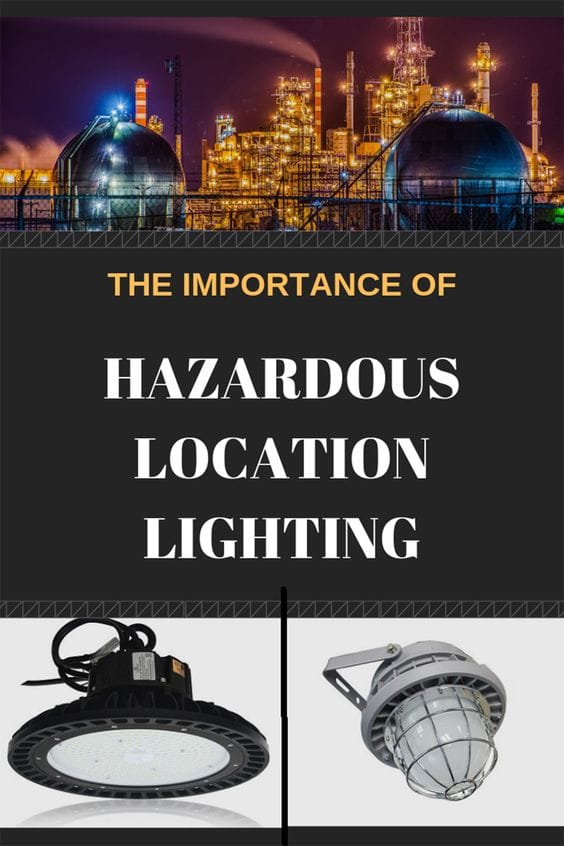
It is lighting approved for areas classified because flammable gases, vapors, combustible dusts, or ignitable fibers may be present.
Hazardous Location Lighting Guide
Hazardous location lighting is for areas where flammable gases, vapors, combustible dusts, or ignitable fibers may be present. The fixture is not chosen by brightness alone. It must be approved for the specific classified location, marked correctly, installed with the proper wiring method, and reviewed by qualified people who understand the site conditions.
What to Check First
- Confirm the area classification: class, division or zone, group, and temperature requirements.
- Verify the fixture listing, marking, ambient rating, corrosion exposure, mounting, and wiring method.
- Coordinate with the authority having jurisdiction, facility safety team, and qualified electrical contractor.
Application Decision Table
| Use Case | Practical Guidance |
|---|---|
| Class I | Locations involving flammable gases or vapors. Fixture approval must match the group and temperature limits. |
| Class II | Locations involving combustible dust. Dust accumulation, sealing, and surface temperature matter. |
| Class III | Locations involving ignitable fibers or flyings. Fixture marking and housekeeping conditions still matter. |
What the Label Must Help You Confirm
- Class and division or zone suitability.
- Group compatibility for the specific gas, vapor, dust, or fiber.
- Temperature code and ambient rating.
- Wet, washdown, corrosion, or marine suitability where needed.
- Listing, installation instructions, and maintenance access.
Common Mistakes to Avoid
- Using a standard industrial fixture in a classified area.
- Assuming explosion-proof means approved for every hazardous location.
- Ignoring temperature code, gas or dust group, conduit seals, and documentation.
Hazardous Location Lighting Is a Classification Problem First
A hazardous location fixture is not chosen by brightness alone. The area must be classified by the gases, vapors, dusts, or fibers that may be present and by how likely they are to be present during normal conditions. Equipment then has to match the class, division or zone, group, temperature code, and listing required for that location.
| Selection step | Why it matters |
|---|---|
| Confirm classification | Class I, II, or III and Division/Zone determine what equipment can be used. |
| Match material group | Gas, vapor, dust, or fiber properties affect approved equipment choices. |
| Check temperature code | Fixture surface temperature must be suitable for the environment. |
| Use proper wiring methods | Conduit, seals, fittings, and installation details are part of the safety system. |
For hazardous locations, confirm the classification documents and work with qualified professionals, the authority having jurisdiction, and current code requirements before selecting or installing lighting.
More Details to Consider
The Importance of Hazardous Location Lighting. Electric equipment, including basic lighting, has the potential to cause fatal explosions and fires in many hazardous locations. The atmosphere in such locations is made up of flammable vapors, gases, mists or dust that are combustible. The basic lighting used in a home is highly dangerous to use in an atmosphere like this. To solve these life-threatening problems, lighting manufacturers have come up with a solution known in the industry as hazardous location lighting. What Are Hazardous Location Lights?
Hazardous location lights are designed and listed to reduce ignition risk when they match the classified location and are installed correctly. These lights are designed with insulation to protect any electrical components from coming in contact with any flammable materials. The casings are completely sealed to prevent flammable dusts and gases or vapors from entering the lamp to prevent combustion and explosions. The NEC (National Electrical Code) and CEC (Canadian Electrical Code) have worked to categorize these dangerous locations into three classifications, Class I/II/III, as a guide for the installation of electrical components, including lighting.
These classifications specify different levels of combustibility, with Class I being the most dangerous due to gases or vapors being present that are easily combustible. Since gases and vapors can very easily get inside standard lighting products, special precautions are taken with the design of the lights used in these areas to prevent external gases and vapors from entering them. Class II is based on combustible dusts and Class III on ignitable fibers.
The requirements in the design of lighting for these different areas change, but most manufacturers usually keep it simple by making most hazardous location lights meet the standards of most or all of these classes. Using a standard LED high bay in a classified location can create serious fire, explosion, property, and personnel risk. Another benefit of hazardous location lights is that they usually have a much higher threshold for temperatures.
Since combustible materials can ignite simply with a rise in temperature, these lights are designed to keep the outside temperature down, along with any surface a combustible material can come in contact with. Additionally, these lights are resistant to high vibrations. What Are the Uses of Hazardous Location Lights? There are many locations that are prone to explosions and combustible materials. Even a little spark or spike in temperature has the capacity to cause damage and risk the lives of personnel.
Hazardous location lights are lighting fixtures that are specially designed to prevent explosions and fires in locations that are exposed to combustible materials or flammable gases. Oil refineries, gas stations, and other places that manufacture, process, or transport petroleum products. Distilleries, wineries, and other alcohol production plants. Ocean vessels and other marine applications. Explosive ordnance, firearm, and ammunition plants and storage locations. Hazardous location lights are essential for the safety of people and property in these locations.
They use special wiring, connections, and other electrical components to avoid sparks or surges that could ignite the hazardous materials. They also use insulation and multiple layers of casing to keep the temperatures low and prevent contact between the electronics and the hazardous materials. Who Has Defined What Are Hazardous Locations? The classifications of hazardous locations are defined by the National Fire Protection Association (NFPA) and the National Electrical Code (NEC) in the US. They are based on the type and degree of risk posed by the hazardous materials.
The Occupational Safety and Health Administration (OSHA) has adopted the NEC classifications to regulate the locations. The classifications are divided into three classes (I, II, and III) and two divisions (1 and 2), as explained in articles 500 to 506 of the NEC (NFPA 70). When buying hazardous location lights, it is important to check the requirements of your location and buy lights that meet the appropriate class and division standards. How Many Types of Lights Are Available for Hazardous Locations?
There are a number of hazardous location light types, such as LED High Bay Lights, both UFO High Bay Lights and Linear High Bay Lights. These hazardous location lights are also available in the form of LED Shoebox Lights, LED Flood Lights, LED Vapor Proof Lights, emergency lighting like Exit signs and more. Just as there are many different types of light fixtures for different applications, there are different hazardous location lights designed for the different needs of the location.
Hazardous location lights come in different types, sizes, shapes, and colors to suit different applications and preferences. Some of the common types of hazardous location lights are: Floodlights: These are lights that have a wide beam angle and a high lumen output that can flood a large area with bright light. They are often used for outdoor lighting, such as parking lots, stadiums, or security areas. Linear lights: These are lights that have a long and narrow shape that can provide uniform and continuous lighting for indoor or outdoor spaces.
They are often used for lighting tunnels, walkways, or corridors. High bay lights: These are lights that have a high mounting height and a high lumen output that can provide powerful and efficient lighting for large indoor spaces. They are often used for lighting warehouses, factories, or hangars. Making the smart investment in proper hazardous location lights can protect you from the risks and give you a safe working environment. Not only does this protect employees, but in locations like gas stations, you are protecting your customers and bystanders.
With upgraded and additional components to help achieve the safety measures required of these lights, it's obvious they will cost more than standard lighting. The additional cost is far less than the additional cost caused by not using the proper lighting and having an accident that could turn fatal. Hazardous location lights, while more expensive than standard lights, are well worth the additional expense. Figure out what class of hazardous location lights you need and buy the right lights.
Frequently Asked Questions
- What is hazardous location lighting?
- It is lighting approved for areas classified because flammable gases, vapors, combustible dusts, or ignitable fibers may be present.
- Can any sealed LED fixture be used?
- No. The fixture must be approved and marked for the classified location and site conditions.
- Who decides the classification?
- Classification should come from qualified site review, applicable codes, documentation, and the authority having jurisdiction.
- Is LED useful in hazardous locations?
- LED can be useful, but only when the fixture listing, temperature rating, optics, and installation method fit the classified area.

Ready to Upgrade Your LED Lighting?
Our lighting specialists can help compare fixtures, confirm light levels, and quote products that fit the site.
Call 800-674-9420 or email [email protected]
Monday-Friday, 8am-5pm PST

About the Author
Dara Greaney is founder and CEO of LED Light Expert with deep expertise in commercial LED lighting, retrofits, and photometric planning.
Editing by David Peguero
4 Comments
JP
whats the difference between classi div 1 and class 1 div 2
4 Reasons for using explosion-proof lights in hazardous areas?
Thanks for sharing such great information about Explosion proof lightening. In ultra-sensitive places, the safety and security of the workers and investments as a whole should be devoid of any vulnerabilities. High-quality safety equipment should be an integral part of the security infrastructure to avoid unwanted accidents. One such safety equipment is the Explosion proof lights, which are considered a crucial investment in high-risk working areas. To know more about explosion-proof lights in hazardous areas visit https://www.sharpeagle.tv/blog/4-reasons-for-using-explosion-proof-lights-in-hazardous-areas/
4 Reasons for using explosion-proof lights in hazardous areas?
Thanks for sharing such great information about Explosion proof lightening. In ultra-sensitive places, the safety and security of the workers and investments as a whole should be devoid of any vulnerabilities. High-quality safety equipment should be an integral part of the security infrastructure to avoid unwanted accidents. One such safety equipment is the Explosion proof lights, which are considered a crucial investment in high-risk working areas. To know more about explosion-proof lights in hazardous areas visit https://www.sharpeagle.tv/blog/4-reasons-for-using-explosion-proof-lights-in-hazardous-areas/
Dany
An insightful article emphasizing the significance of hazardous location lighting for workplace safety. Don't compromise on safety! #HazardousLighting


