


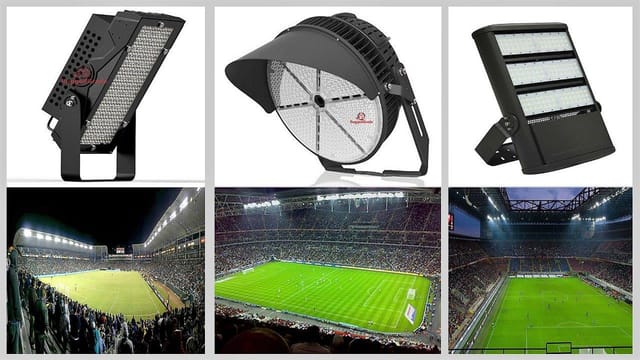
Start with a photometric plan based on the sport, field dimensions, play level, pole layout, and glare limits.
Sports Lighting Guide
Sports lighting is a design problem, not just a fixture purchase. A good plan begins with the sport and level of play, then works through light levels, uniformity, pole locations, aiming, glare, spill, color quality, flicker, controls, and service access. That is true for fields, courts, tracks, arenas, and multi-use facilities.
What to Check First
- Document sport, field dimensions, pole positions, mounting heights, play level, and camera needs.
- Ask for a photometric plan that shows average light, minimum light, uniformity, aiming, and spill.
Application Decision Table
| Use Case | Practical Guidance |
|---|---|
| Tennis or pickleball | Low glare and uniformity across the court matter more than raw output. |
| Baseball or softball | Infield, outfield, batter, and ball-tracking zones need separate review. |
| Soccer or football | Pole height, beam control, vertical light, and spill management are central. |
The Core Sports Lighting Questions
- What sport and play level is the facility built for?
- Will there be video, streaming, or broadcast?
- Are there neighbors, roads, airports, or environmental limits nearby?
- Can the poles support the fixture load and aiming plan?
- How will scenes, schedules, and curfews be controlled?
Common Mistakes to Avoid
- Buying by wattage without a layout.
- Underestimating glare from player and spectator sight lines.
- Forgetting controls, surge protection, aiming verification, and service access.
Sports Lighting Starts With the Game Being Played
A good sports lighting plan matches the speed of play, ball size, field dimensions, viewing direction, and competition level. A recreational pickleball court, a school soccer field, and a broadcast stadium should not be designed from the same wattage guess.
| Planning factor | Question to answer |
|---|---|
| Sport and level | Is the space recreational, scholastic, collegiate, professional, or broadcast? |
| Uniformity | Can players track the ball without bright and dark patches? |
| Glare and spill | Will players, spectators, neighbors, or drivers see uncomfortable light? |
| Controls | Are there scenes for practice, games, maintenance, and curfew? |
| Maintenance | Can drivers, optics, aiming hardware, and surge protection be serviced safely? |
Why LEDs Are the Key to Perfect Sports & Stadium Lighting
Sports lighting affects the visibility, safety, and comfort of players, spectators, and officials - and the energy cost, maintenance, and environmental impact of the venue. Choosing the right system is a strategic decision, not a short-term fix. Modern high-efficiency LED stadium lights have significant advantages over metal halide or halogen in power consumption, light projection, maintenance, and durability.
Why Choose LED Over Metal Halide or Halogen?
Power consumption to light output. Metal halide and halogen waste up to 80% of their energy as heat, so they need far more electricity to make the same light. A good LED wastes under 10%, delivering roughly 70% overall savings. A 500-watt Stadium Pro 4 produces about 78,000 lumens - more usable light than a 1,500-watt metal halide plus its 50-watt ballast.
Light projection and beam angle. Brightness alone is not enough; what matters is how far the light projects with intensity and uniformity. LED sports lights offer beam angles from 10 to 120 degrees, customizable to your field, with high CRI for accurate color and selectable CCT for the right ambiance. You want a balance of beam angles and an even distribution with no dark spots or glare.
Maintenance. LEDs outlast metal halide and halogen, hold their brightness and color, and need no ballast or transformer. Problems do arise - usually the driver goes first, and stadium fixtures typically use one to four drivers, so you want to be able to replace just the failed one. Look for a reputable driver such as Sosen VP or UPowerTek so replacements are still available 10 to 20 years out.
Durability and safety. LEDs resist weather, vibration, and impact better and run cooler, reducing overheating and fire risk. They also deliver low glare with CRI above 70 so everyone perceives color, shape, and shadow accurately, and a controller can add flash effects or RGB color for touchdowns and halftime shows.
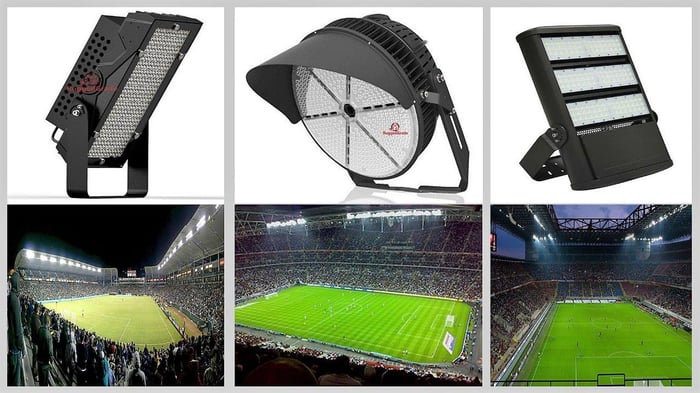
Is a High-Power LED Automatically More Efficient?
No. There is a baseline lumens-per-watt figure worth checking, but in sports lighting distance is what matters. If a light is bright in the first 5 to 10 meters but its intensity fades beyond that, very little reaches the field - and stadium fixtures sit high on poles or towers. So look past raw luminosity to beam angle and lux (the light measured at a specific spot, say 70 feet below the fixture on the grass), not brightness alone.
How Light Travel Is Achieved: Optics
Delivering high intensity and uniformity on the field takes geometric optics and quality lenses. We run photometric studies - mathematical models and simulations of how rays leave the LED and how lenses redirect them - to concentrate the light (less scatter and waste) and to set the beam angle to the field's size and shape. Combining the right wattage with the right optics is what gives an LED fixture real reach, and it is why good optical design can make a fixture roughly twice as effective as a comparable competitor.
How to Choose the Best LED Stadium Lights
The right choice depends on field size and shape, the sport and level of play, location and orientation, local lighting regulations and standards, and your budget. For competitive play, a photometric layout should confirm average light, minimums, uniformity, and aiming before purchase - our team offers a free lighting design and simulation so you can see how a layout will perform on your field.
Halogen vs. LED Stadium Lights
| Halogen / Metal Halide | LED Stadium Lights |
|---|---|
| Lower throw and efficiency onto the playing surface. | Higher throw - optics put more light on the court or field. |
| High power use; only 20-60% of energy becomes light. | Low power use; about 95% of energy becomes light. |
| Low power factor (60-80%), causing electrical interference. | Switched drivers exceed 95% efficiency with better voltage stability. |
| Fragile glass tubes with high maintenance. | Shockproof, 3G wind rated, IP65 weatherproof. |
| Slow start - up to 20 minutes to full brightness. | Instant full brightness in milliseconds. |
| More UV output; bulbs may contain mercury or other toxics. | Visible-spectrum focus, minimal UV, cleaner light source. |
| Runs hot - lost light as heat plus a safety hazard. | Runs cooler, generating far less heat. |
See the full ranges: LED stadium lights, sports lights, and court lights. For a deeper dive, read our LED stadium lights buyers guide.
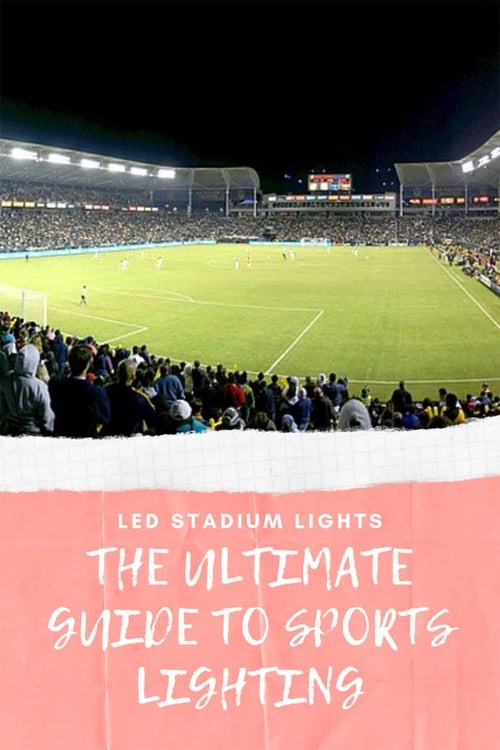
More Details to Consider
Sports lighting is a design problem before it is a fixture purchase. The right system depends on the sport, field dimensions, pole layout, mounting height, play level, spectator areas, nearby properties, and whether the venue needs camera or broadcast-quality light.
LED sports lights can reduce energy use compared with many metal halide or halogen systems, but the main performance gain is control. Beam angles, optics, aiming, glare control, spill control, color quality, flicker performance, and dimming all affect whether players can track the ball and spectators can see comfortably.
Maintenance planning is also important. LEDs remove HID lamp and ballast replacement cycles, but drivers, surge protection, controls, lenses, aiming hardware, and mounting brackets still need inspection. Choose products with replacement parts and support that will be available later.
Photometric studies reduce guesswork. A plan should show average light, minimum light, uniformity, aiming, spill, and glare risk before fixtures are ordered. That is especially important for baseball, football, soccer, tennis, pickleball, rodeo, racing, and multi-use venues.
Avoid broad claims such as one fixture being best for every field or one optical design being stronger than every competitor. A good outcome comes from matching the fixture package to the field and verifying it after installation.
Frequently Asked Questions
- How do I choose sports lights?
- Start with a photometric plan based on the sport, field dimensions, play level, pole layout, and glare limits.
- What is uniformity?
- Uniformity compares brighter and darker areas so players can track the ball and move safely.
- Do LEDs reduce light spill?
- They can when optics and aiming are designed correctly, but fixture selection alone is not enough.
- Is a sports-lighting plan worth it?
- Yes. It reduces guesswork before money is spent on fixtures, poles, wiring, and installation.

Ready to Upgrade Your LED Lighting?
Our lighting specialists can help compare fixtures, confirm light levels, and quote products that fit the site.
Call 800-674-9420 or email [email protected]
Monday-Friday, 8am-5pm PST

About the Author
Dara Greaney is founder and CEO of LED Light Expert with deep expertise in commercial LED lighting, retrofits, and photometric planning.
Editing by David Peguero
Tagged Products

1 Comments
Francisco Távora
Some typical solutions in sports fields (indoor and outdoor) lighting solutions, with led's floodlights , as foottball (soccer), voleyball, handball, tenis, badminton, swimming pool, role skates hochey, box, etc.


