


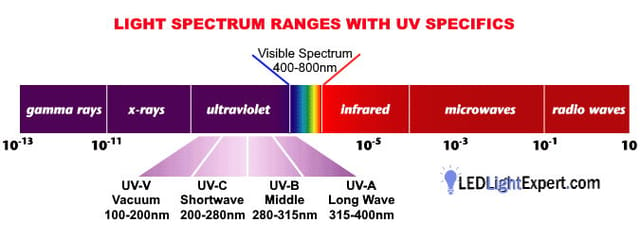
No. UV-C should not be used as general lighting in occupied spaces.
UV-C Light Bulbs: Safety Limits
UV-C is not ordinary lighting. Germicidal ultraviolet systems can be useful in carefully designed air-treatment or equipment applications, but direct or reflected exposure can harm eyes and skin. UV-C bulbs should not be placed in occupied rooms like normal corn bulbs or general lighting. Claims about disinfection, air treatment, or pathogen reduction need careful support, correct labeling, qualified design, and safe operation.
What to Check First
- Confirm whether the product is for air, surface, duct, upper-room, or equipment use.
- Require shielding, interlocks, warning labels, restricted switches, training, and maintenance procedures.
- Review EPA device rules and CDC/NIOSH guidance before accepting disinfection claims.
Application Decision Table
| Use Case | Practical Guidance |
|---|---|
| Upper-room GUV | Designed to treat air above occupants and requires professional layout, measurement, and training. |
| In-duct UVGI | Installed inside HVAC equipment so occupants are not exposed to the UV source. |
| Open UV-C bulb | Not appropriate as normal occupied-space lighting because exposure risk is high. |
Safety Questions Before Using UV-C
- Can any person see or reach the UV source?
- How is exposure measured after installation?
- Who is trained to maintain the system?
- What happens during cleaning, lamp replacement, or ceiling work?
- What claims are made on the label or in advertising?
Common Mistakes to Avoid
- Selling UV-C as a simple plug-in substitute for a visible LED bulb.
- Making broad germ-kill claims without design, dose, exposure, and maintenance context.
- Allowing untrained people to switch on, service, or work near active UV-C equipment.
UV-C Is Not Ordinary Lighting
UV-C can be useful in properly engineered disinfection systems, but direct exposure can injure skin and eyes. It should not be installed like a normal visible-light bulb in an occupied room. Safe UV-C use depends on shielding, interlocks, timers, warning labels, trained operators, and manufacturer instructions.
| Risk | Safer planning step |
|---|---|
| Skin or eye exposure | Prevent direct exposure with shielding, controls, and restricted access. |
| Consumer shortcuts | Avoid products that promise unsafe seconds-fast disinfection without safety details. |
| Wrong fixture | Do not place UV-C lamps in fixtures meant for ordinary corn bulbs. |
| Compliance | Use qualified designers and follow current safety guidance and product labeling. |
More Details to Consider
UV-C lighting should be handled carefully because real germicidal UV-C can injure eyes and skin. It is not the same thing as visible purple light, blacklight, or a standard LED bulb. Any UV-C product used for air or surface treatment should include verified wavelength/output data, safety controls, installation instructions, and appropriate listing.
Be skeptical of screw-in bulbs that promise germicidal performance without test data. True UV-C performance depends on dose, distance, exposure time, shadowing, airflow, lamp age, and maintenance. Color alone does not prove that a product produces useful UV-C output.
For occupied buildings, use purpose-built UV-C systems only when the application is designed, shielded, tested, and maintained by qualified people. UV-C can be part of a broader hygiene or air-treatment plan, but it does not replace ventilation, filtration, cleaning, or safe operating procedures.
Frequently Asked Questions
- Is a UV-C bulb safe to use like a normal light bulb?
- No. UV-C should not be used as general lighting in occupied spaces.
- Can UV-C damage eyes or skin?
- Yes. Direct or reflected UV-C exposure can cause temporary eye or skin injury and must be controlled.
- Does UV-C replace ventilation or cleaning?
- No. CDC describes GUV as a supplemental layer, not a replacement for required ventilation or filtration.
- Who should design UV-C systems?
- Use qualified UV/GUV professionals with training, measurement tools, and clear maintenance procedures.

Ready to Upgrade Your LED Lighting?
Our lighting specialists can help compare fixtures, confirm light levels, and quote products that fit the site.
Call 800-674-9420 or email [email protected]
Monday-Friday, 8am-5pm PST

About the Author
Dara Greaney is founder and CEO of LED Light Expert with deep expertise in commercial LED lighting, retrofits, and photometric planning.
Editing by David Peguero
Tagged Products

12 Comments
Liz
When I was in high school, participating in Plant Tissue Culture experiment, we used UV light to sterilize the medium, our teacher told us not to expose ourselves directly to the UV light as it may lead to skin cancer, so everytime we entered the room, we turn off the UV light and won't stay there for too long. More than 10 years has passed, but I still remember it clearly, have no idea why people are getting so crazy for UV light...To beat the virus, we need to turn to the scientists and doctors, not medias...
DG
well said Liz! Teachers seem smarter the older we are. (or now that we have to home school, they seem amazing)
Gill
Hiya, DG. I was intrigued by the first thing you listed as being a potential issue: " You can make the virus stronger. The saying, what doesn't kill you makes you stronger holds true here. Most don't know that Covid-19 already has an A and B strain (probably C and D by now). Just like influenza, they tend to mutate every 4 moths, if widespread enough, and Covid is big enough, different variations can be happening at the same time If you only partially damage the DNA, the virus may alter and mutate, creating a new version that existing vaccines and drugs may not work on. As the saying goes; If you are going to kill the king, don't miss." I would love to read more about the potential for the virus to mutate whilst under insufficiently powerful UV-C lighting conditions. Please could you direct me to any scientific/scholarly articles on the matter. Thanks.
DG
Gill, That's the problem. There is no research. We are introducing dna altering light and radiation and have no idea the effects. Might not be that bad, might be dangerous, but we should not use it until we test it. The IES published some recommendations on GUV lights this week. Lots of data, but not much to your specific question. https://media.ies.org/docs/standards/IES-CR-2-20-V1-6d.pdf " GUV radiant energy damages nucleic acids (DNA and RNA) by causing mutations that prevent replication," but we have no research to show what happens with partial damage.
Gene Inger
Very interesting article; even if results so far inconclusive. So what I gather is that UV-C 'long bulbs; possibly mercury' (like PhoneSoap tubes) are more effective than UV-C LED? I have two 'corn' UV-C fixtures with timers; but claiming to be non-ozone producing. Although I wonder. Any reflection on this welcomed. Main question would be I think you're saying this is one time to go for the older 'tube-style' UV-C for disinfection rather than LED. Thanks for the wonderful site; I appreciate the comments.
Sales
Thanks for reaching out. Please feel free to reach out to us directly at 800-674-9420 or [email protected] for pricing/quotes or product info at any time.
Brian Nicolich
Early in the COVID crisis I was looking for a small container with a built in steryilizing UV lamp to disinfect my wallet, keys, phone, etc. but I could only find ones barely big enough for a smart phone. I finally setteled on a 60W UVC lamp from Banggood and just received it. I always had respect for power types of radiation but my gosh this thing puts the fear in you. I think I will build a nice little box which can fit the lamp and any goods I want to disenfect. That should minimize O3 production.
DG
I wouldn't waste too much time. Those are not really UV-c LEDs.
This guy actually tested some (and found out of course they are NOT Uv c)
https://hackaday.com/2020/04/15/buyer-beware-this-led-bulb-sold-as-germicidal-doesnt-emit-uv-c/
None of them are real. Stop buying Chinese junk fake UV-C. Better places to waste your money.
Christian
Hi! Been using the Corn-cob lamb to disinfect masks for me and my family, by now i have done some research and know that it is probably or most likely fake. I have a Large Moving box that i have attached aluminium to all walls and stick the lamp in there. I am trying to figure out an easy way to test it if real. After we use this corn-cob supposedly uv-c light bulb, we smell something different once we open the box; it's not necessarily burn smell. Would this tell us something? Also, I saw a Youtube video, where someone put a banana inside and covered a portion with a tape, the after results was that the shell was darken compared to the part where the tape was which was much more clear as it originally was. Could this prove UVC light is real?
DG
The answer is simple; they are all fake. The banana test does not tell you anything. UV-A and UV-B would do the same (probably faster) and are easier to manufacture. (closer to visible spectrum, see image above) Need a true spectrometer to see if it UV-C, specifically 257nm where germs are killed. Return it. Total Scam. None of the big 3 corn bulb makers are building them and no one else has the skills (or ethics)
Vish
Buy Ozone producing UV-C (non LED) So when you turn on after sometime you can smell Ozone to confirm that its not fake at least.
Mark Lutz
Some UVC mercury lamps are made with envelopes that block the wavelengths that will create ozone.
Mark Lutz
I think at a minimum you do a disservice to readers by saying the corn cob lamps aren't real. I read comments on Amazon from people saying their meter didn't measure anything at 254nm. I tested I have today using an Ophir meter with a broadband sensor and a 280NM bandpass filter and it is putting out 90mW of uv overall. It put out nothing at 254nm. Not huge but stilI you don't want to be casual about it. I suggest people who can't measure what they have shouldn't mess with this stuff.
DG
a disservice? Your research that its does ZERO at 254nm proves my point exactly. Any other UV is just going to fade the walls,kill no viruses, and give a false sense of safety, even below 280nm with your filter (Not to mention higher nm Uv-a and uv-b are known carcinogens.) Don't be bitter you bought junk, return it and leave a 1 star review. No point in keeping something that is dangerous and does not kill viruses. Don't shoot the messenger, thank me for warning people. I knew they were all junk before the first one was sold. Pay it forward and warn everyone else.
Dennis
Love the research u've done and i have been doing my own to see if the majority are fakes that WE can get
Sales
Thanks for reaching out, Please feel free to contact us directly at 800-674-9420 or [email protected] for pricing/quotes or product info at any time.
Peter Lue
UVC is generally a great idea if you want to keep your environments germs free
Sales
Thanks for reaching out. Please feel free to contact us directly at 800-674-9420 or [email protected] for pricing/quotes or product info at any time
SR
You are putting out great information.Thank you.
Sales
Thanks for reaching out. Please feel free to contact us directly at 800-674-9420 or [email protected] for pricing/quotes or product info at any time
Philip Snow
There has never been a greater urgency for a safe UV light than now.
Sales
Thanks for reaching out. Please feel free to contact us directly at 800-674-9420 or [email protected] for pricing/quotes or product info at any time
Louise
Are there any genuine UV shoe sanitisers on the market? I've been recommended them as a way of helping prevent toe fungal infections but after reading your article I'm wondering whether any of them actually work!
Jason
Thanks for reaching out. Please feel free to reach out to us directly at 800-674-9420 or [email protected] for pricing/quotes or product info at any time.


