

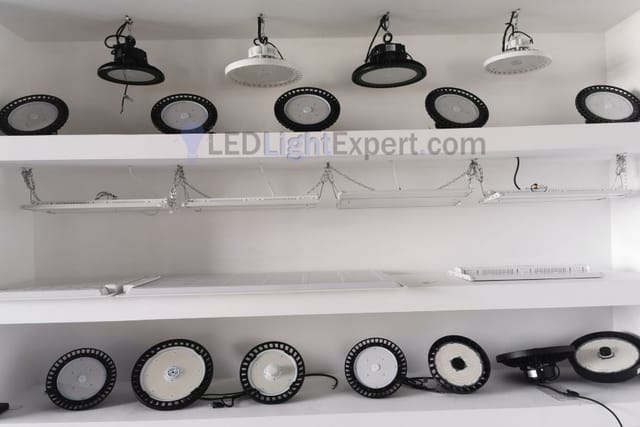
It is lighting designed for high-ceiling spaces such as warehouses, shops, gyms, and industrial buildings.
LED High Bay Lighting Guide
LED high bay lights are used where ceilings are high and the floor, shelves, aisles, work stations, or equipment need useful light. They are common in warehouses, gyms, factories, shops, pole barns, and distribution centers. The right high bay is chosen by mounting height, delivered lumens, beam angle, spacing, glare, controls, voltage, temperature, and service access.
What to Check First
- Measure ceiling height, fixture spacing, aisle layout, and the task performed below.
- Compare delivered lumens, beam angle, lens, voltage, dimming, sensor options, and environmental rating.
- Use a layout when uniformity, glare, code, or worker safety matters.
Application Decision Table
| Use Case | Practical Guidance |
|---|---|
| Open warehouse | Use wide distribution, uniform spacing, and controls for zones with different activity. |
| Aisle storage | Use narrower optics or aisle lenses so light reaches vertical rack faces. |
| Shop or gym | Balance brightness, glare control, impact exposure, and mounting height. |
Why High Bays Are Popular
- They deliver useful light from high ceilings.
- They can pair with occupancy sensors and dimming.
- They start instantly compared with many older HID systems.
- They reduce lamp-change work in hard-to-reach areas.
- They come in optics and mounting styles for different buildings.
Common Mistakes to Avoid
- Buying by wattage instead of delivered light and layout.
- Assuming every high bay works at every height.
- Ignoring glare, sensor placement, voltage, ambient temperature, and service access.
Do High Bay LED Lights Get Hot?
LED high bay lights produce less wasted heat than older high-intensity discharge fixtures, but they still need thermal management. Heat sinks, driver quality, ambient temperature, dust, and ceiling height all affect reliability. Do not trap a high bay in a space or fixture type it was not designed for.
| Selection point | What to check |
|---|---|
| Ceiling height | Match lumens, beam angle, and mounting method to the space. |
| Heat | Confirm ambient-temperature rating and ventilation. |
| Controls | Use sensors or dimming where aisles or zones are not always occupied. |
Frequently Asked Questions
- What is LED high bay lighting?
- It is lighting designed for high-ceiling spaces such as warehouses, shops, gyms, and industrial buildings.
- Do high bay lights get hot?
- LED fixtures still make heat, but good thermal design moves heat away from the LEDs and driver.
- How high should high bays be mounted?
- The correct height depends on the fixture, beam angle, layout, and light level target.
- Do I need sensors?
- Sensors are useful where areas are empty for long periods, but placement and settings matter.
More Details to Consider
LED high bay lights are popular because they solve practical problems in tall spaces: high energy use, lamp changes, uneven light, slow warm-up, and limited control. A good high bay upgrade is planned around mounting height, fixture spacing, distribution, glare, controls, and the task being done below.
The best fixture is not always the highest wattage. Warehouses, gyms, shops, and manufacturing areas need different light levels and beam patterns. Use lumens, photometrics, CRI, CCT, dimming, surge protection, and driver quality to compare products.
High bay lights still need correct installation and maintenance. Heat, dust, vibration, voltage, lift access, and controls can all affect performance. A simple layout review before ordering usually prevents dark aisles, glare, and overlit work areas.

Ready to Upgrade Your LED Lighting?
Our lighting specialists can help compare fixtures, confirm light levels, and quote products that fit the site.
Call 800-674-9420 or email [email protected]
Monday-Friday, 8am-5pm PST

About the Author
Dara Greaney is founder and CEO of LED Light Expert with deep expertise in commercial LED lighting, retrofits, and photometric planning.
Editing by David Peguero
Tagged Products

Trusted by Thousands
Our customers love us — and we love them back.


-
 Free Shipping
On orders over $49.00
-
 Free Extended Warranty
Up to 7 Years Free Warranty On LED Lights
-
100% Satisfaction Guarantee
