

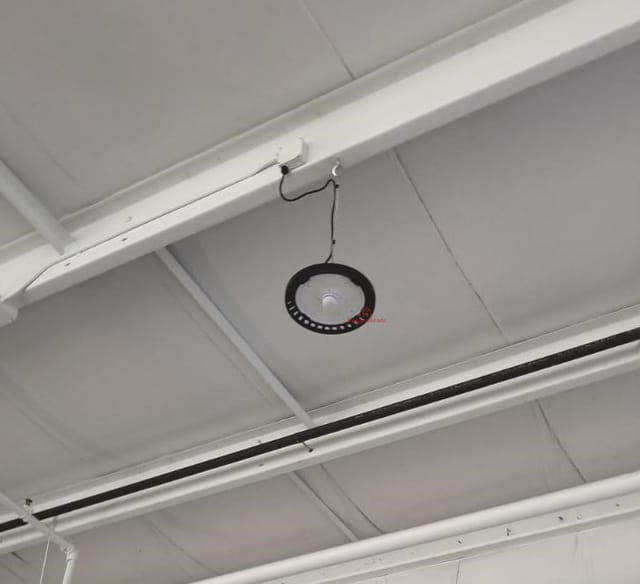
They reduce wasted runtime in spaces that are not continuously occupied.
High Bay Lights with Motion Sensors
High bay lights with motion sensors are popular because many high-ceiling spaces are not occupied evenly all day. Sensors can reduce wasted runtime in aisles, storage zones, back rooms, and warehouses. The value depends on sensor type, mounting height, detection pattern, dimming behavior, delay time, aisle layout, and worker comfort.
What to Check First
- Map traffic patterns, forklift routes, shelf height, mounting height, and zones.
- Choose PIR, microwave, fixture-integrated, or remote sensors by ceiling height and detection needs.
- Set hold time, standby dim level, daylight response, and grouping so lights behave predictably.
Application Decision Table
| Use Case | Practical Guidance |
|---|---|
| Warehouse aisle | Use aisle-aware detection and grouping so workers are not left in dark zones. |
| Open shop floor | Use broader detection and dimming rather than abrupt off behavior. |
| Storage room | Shorter hold times may work when activity is brief. |
Control Settings That Matter
- Detection sensitivity.
- Hold time after motion stops.
- Standby dim level.
- Daylight harvesting behavior.
- Zone grouping and override controls.
Common Mistakes to Avoid
- Using the wrong sensor type for mounting height.
- Setting lights to turn off too quickly.
- Ignoring forklift movement, rack shadows, and daylight contribution.
Where Motion Sensor High Bays Make Sense
High bay motion sensors work best in spaces with uneven occupancy: warehouses, aisles, storage areas, back rooms, shops, and gyms. The sensor has to match mounting height, aisle layout, detection pattern, warm-up needs, and whether the fixture should turn off or dim down.
| Setting | Control approach |
|---|---|
| Warehouse aisle | Aisle-lens or high-mount sensor with dim-to-bright settings. |
| Open shop | Wide detection with timeout tuned to normal work patterns. |
| Storage area | Occupancy control to avoid all-day runtime in low-use zones. |
More Details to Consider
High bay lights with motion sensors are popular because many tall spaces are not fully occupied all day. Warehouses, shops, storage areas, gyms, and back rooms can reduce wasted runtime when sensors dim or brighten fixtures based on activity.
The best setup is usually dim-to-bright, not dark-to-bright. A low standby level helps people move safely and keeps cameras usable while still saving energy during quiet periods. Hold time, standby dim level, detection range, daylight behavior, and fixture grouping should be tuned after installation.
Sensor choice matters. PIR, microwave, and networked controls respond differently to height, aisles, racks, doors, and moving equipment. Test the lights in real use before deciding the default settings are correct.
Frequently Asked Questions
- Why use motion sensors on high bays?
- They reduce wasted runtime in spaces that are not continuously occupied.
- Are PIR and microwave sensors the same?
- No. They detect differently and can behave differently at high mounting heights or around obstructions.
- Should lights turn fully off?
- Sometimes, but a low standby level may feel better and avoid abrupt dark areas.
- Do sensors save energy automatically?
- Only when the settings, layout, and occupancy pattern fit the space.

Ready to Upgrade Your LED Lighting?
Our lighting specialists can help compare fixtures, confirm light levels, and quote products that fit the site.
Call 800-674-9420 or email [email protected]
Monday-Friday, 8am-5pm PST

About the Author
Dara Greaney is founder and CEO of LED Light Expert with deep expertise in commercial LED lighting, retrofits, and photometric planning.
Editing by David Peguero

Trusted by Thousands
Our customers love us — and we love them back.


-
 Free Shipping
On orders over $49.00
-
 Free Extended Warranty
Up to 7 Years Free Warranty On LED Lights
-
100% Satisfaction Guarantee
